Lesson 9. What Consensus Costs
Mission link: This is stage 4's capstone. Lessons 7 and 8 covered what consensus is for and how Raft provides it; this lesson is the actual cost, in latency and availability, and closes the mission's third success criterion: explaining what a consensus protocol buys and what it costs, without needing to prove its correctness from first principles.
Primary source: Paper: "In Search of an Understandable Consensus Algorithm", Ongaro and Ousterhout, 2014
Prerequisites: Lesson 8, Partial failure
Warm-up
- ▢ Why does Raft require only a majority, not unanimity, to elect a leader or commit a log entry?
Check
Requiring unanimity would let a single unreachable or crashed server block the entire cluster from making progress. A majority requirement lets the cluster keep working as long as more than half its servers can communicate, tolerating the rest being slow, partitioned, or down.
- ▢ What specifically stops a stale, partitioned-away leader from causing a conflicting write once it reconnects?
Check
The term number: any message from the stale leader carries its old, lower term, and any follower or server that has already moved on to a higher term rejects it. The stale leader discovers a higher term as soon as it communicates with anyone from the new one and steps down.
Know this
The latency cost: every write waits for a majority round trip
A client write isn't committed, and can't be safely reported as successful, until the leader confirms a majority of the cluster has durably stored it (lesson 8). This means every write pays at least one network round trip to enough other servers to form a majority, even when nothing is failing: consensus trades raw write latency for the safety guarantee that a committed write survives the crash of any minority of servers. A single-node system, with no such requirement, is always faster for a plain write; that speed is exactly what consensus gives up to get its guarantee.
The availability cost: a minority partition can't make progress, on purpose
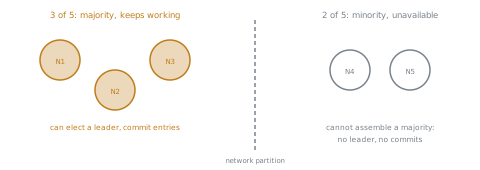
If a network partition splits the cluster such that no side has a majority, the side without one cannot elect a leader, and the side that does have one keeps working normally. This isn't a bug to be fixed; it's the direct, intended consequence of the safety property from lesson 8: allowing the minority side to also elect its own leader and keep accepting writes would let both sides commit conflicting entries, exactly the split-brain the majority requirement exists to prevent. A minority partition loses availability specifically so the majority side's guarantee stays intact.
This is CAP's trade-off, concretely mechanized
Lesson 4 described CAP's conditional choice: during an actual partition, a system prioritizing consistency refuses to answer rather than risk a stale or conflicting response. Consensus is the concrete mechanism that makes this real: the minority side of a partition isn't merely "choosing" unavailability in the abstract, it structurally cannot elect a leader or commit anything, because it cannot assemble a majority. What CAP describes as a trade-off, Raft (and any majority-based consensus protocol) enforces as a hard mechanical consequence of its safety requirement.
Weighing the cost: what justifies paying it
Consensus is worth its latency and availability cost specifically when a system needs the guarantee lesson 8 provides, a single agreed order that survives the crash of a minority of servers, the same guarantee a linearizable system (lesson 5) needs underneath it. A leader-election mechanism for a cluster manager, a configuration store multiple services must agree on, or a lock service where two conflicting grants would be a real correctness failure are all worth this cost. A system that only needs eventual consistency (lesson 6), where a temporarily stale or diverging answer is tolerable, doesn't need consensus's cost at all: paying for a majority round trip on every write to protect an invariant nothing actually depends on is waste, not safety.
Practice
- ▢ Why does every committed write in a consensus-based system pay at least one network round trip, even when nothing is failing?
Check
Because a write can't be safely reported as committed until the leader has confirmed that a majority of the cluster has durably stored it, which requires sending the entry out and waiting for enough acknowledgments to form a majority, regardless of whether every server happens to be healthy at that moment.
- ▢ A five-node Raft cluster is split by a partition into a group of two and a group of three. Which group, if either, can keep electing a leader and committing writes, and why?
Hint
Consider which group, if either, can assemble a majority of the original five-node cluster.
Check
The group of three can keep working: three out of five is a majority, so it can elect a leader and commit entries normally. The group of two cannot: two out of five is not a majority, so it structurally cannot elect a leader or commit anything, and correctly stays unavailable rather than risk a conflicting decision.
- ▢ Why is a minority partition's loss of availability described as intended rather than a bug?
Check
Because allowing the minority side to also elect a leader and accept writes would let two sides of the same cluster commit conflicting entries, exactly the split-brain scenario the majority requirement exists to prevent. Losing availability on the minority side is the direct, necessary price of keeping the safety guarantee intact everywhere.
- ▢ How does consensus turn CAP's abstract consistency-versus-availability trade-off (lesson 4) into something mechanically enforced rather than a policy choice?
Check
A system relying on majority-based consensus doesn't merely choose to refuse requests during a partition as a policy; the minority side structurally cannot assemble the majority required to elect a leader or commit an entry at all. The unavailability isn't a decision made under pressure, it's a direct, mechanical consequence of the safety property requiring majority agreement.
-
▢ Which claim correctly weighs when consensus's cost is worth paying?
- a) Consensus should be used for every piece of data a system stores, since stronger guarantees are always better
- b) Consensus is worth its latency and availability cost specifically when a system needs a single agreed order that survives a minority of crashed servers; data that only needs eventual consistency doesn't need it
- c) Consensus has no latency cost as long as the cluster has no failures
- d) A minority partition's unavailability is a design flaw that better consensus protocols eventually eliminate
Check
b) That's the actual decision this lesson (and the mission) asks for: match the guarantee's cost to the data's actual need. (a) is false: paying consensus's round-trip cost for data that tolerates eventual consistency is waste, not safety. (c) is false: every committed write pays the majority round trip regardless of whether anything is currently failing. (d) is false: minority unavailability is a structural consequence of the safety property, not a solvable inefficiency; any protocol providing the same safety guarantee under partition has the same consequence.
Real-world reps
- [ ] For a consensus-backed system you know of (or the one from lesson 7's or 8's rep), estimate how many extra network round trips its majority-commit requirement adds to a single write, compared to a hypothetical single-node version of the same system.
- [ ] For that same system, identify what would actually break if it were replaced with an eventually-consistent alternative instead, to test whether its use of consensus is actually justified by this lesson's standard.
- [ ] Tomorrow: read the primary source's evaluation section in full, and note what latency numbers (or throughput trade-offs) the authors report for Raft under normal operation versus during a leader election.
Going further
- Paper: "In Search of an Understandable Consensus Algorithm", Ongaro and Ousterhout, 2014
- Article: "CAP Twelve Years Later: How the 'Rules' Have Changed", Eric Brewer, InfoQ
- Resources
Not landing? Reread the primary source at the top, since this lesson compresses it and compression is where understanding leaks. Check the glossary for any term that felt slippery.
If the lesson itself is unclear rather than the material, that is a defect: open an issue.