Lesson 10. Retention and Log Compaction
Mission link: Stage 6 opens the part of a topic layout lesson 7 assumed but never named: how long data actually lives, and under which of two genuinely different deletion models. A defended layout has to state this, not leave it as whatever the cluster default happens to be.
Primary source: Docs: "Design", Apache Kafka
Prerequisites: Lesson 9, Partition
Warm-up
- ▢ Does using Kafka Connect grant a new delivery guarantee beyond what the underlying producer and consumer APIs already provide?
Check
No. A sink connector's delivery and ordering guarantees still come from whatever the topic and its consumer-side configuration actually provide, and a source connector's exactly-once behavior still relies on the same idempotent-producer and transaction machinery lesson 5 derived.
- ▢ Why does more partitions cost something beyond just capping consumer parallelism?
Check
Every partition adds file and replication overhead on every broker holding a replica, and adds to the leadership reassignment work a broker failure or restart has to do; producer batching efficiency can also suffer, since the same produce rate spread across more partitions shrinks the batch each producer accumulates per partition.
Know this
cleanup.policy=delete: whole segments age out, not individual messages
The default cleanup policy, delete, removes data once it's older than retention.ms (or exceeds retention.bytes, a size-based cap), but not at the granularity of one message at a time: a partition's log is physically stored as a sequence of segments, and Kafka deletes an entire segment once every message inside it has aged past retention, not individual messages within a segment still holding some data younger than the cutoff. This means the practical deletion boundary is closer to "whichever segment boundary falls after the retention cutoff" than an exact per-message guarantee, and it's why retention isn't instantaneous the moment a message crosses the configured age: it waits for that message's segment to close out entirely.
cleanup.policy=compact: keep the latest value per key, regardless of age
Log compaction is a genuinely different cleanup model: instead of deleting by age, a background log cleaner thread retains only the most recent value for each distinct key in the topic, removing older values for that same key once it runs. A compacted topic's guarantee is "at least the latest value for every key that's ever been written still exists somewhere in the log," not "every message survives for some fixed window." This is the shape a changelog topic needs, a topic backing a materialized view or a key-value store's replicated state, where a consumer replaying the topic from the beginning should reconstruct the current state of every key, not relay every historical write that key ever had.
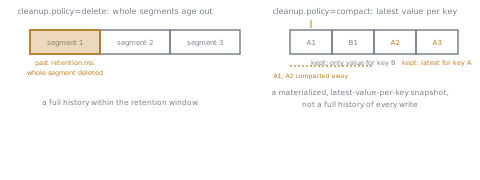
Compaction isn't synchronous, and a tombstone is how a key actually disappears
The log cleaner runs periodically and opportunistically, not on every single write; a consumer reading a compacted topic shortly after several writes to the same key can still see older, not-yet-compacted values for a while, since compaction hasn't caught up to that segment yet. To actually remove a key from a compacted topic entirely (not just keep its latest value), a producer writes a tombstone, a message with that key and a null value; the cleaner removes the key's prior values as usual, and after delete.retention.ms (a grace period giving any consumer that hasn't yet seen the tombstone a chance to), the tombstone itself is also removed, at which point the key is gone from the log completely. cleanup.policy=compact,delete combines both: keep the latest value per key, but also enforce an outer time bound, useful for cleaning up genuinely stale keys after a grace period rather than keeping every key's latest value forever.
Why this belongs in a defended topic layout, not left as a default
Lesson 7's defended layout named a key choice, a partition count, and a delivery guarantee; it never named how long the data itself survives, or under which deletion model. cleanup.policy changes what a consumer replaying the topic from the start actually gets: a full history within a time window under delete, or a materialized, latest-value-per-key snapshot under compact, a materially different contract a downstream consumer's own logic has to be written against. Leaving cleanup.policy and retention.ms as whatever the cluster-wide default happens to be is exactly the kind of unstated, accidental decision the rest of this mission has argued against for every other setting.
Practice
- ▢ A topic is configured with
retention.msset to 7 days. A message is written into a segment that also contains messages up to 2 days older. Does that specific message get deleted the instant it turns 7 days old?
Hint
Consider what Kafka actually deletes: a message, or something larger containing it.
Check
Not necessarily the instant it turns 7 days old. Kafka deletes whole segments once every message in that segment has aged past retention.ms; if the segment also holds messages up to 2 days older than this one, the segment (and this message along with it) isn't deleted until the oldest message in that segment also crosses 7 days, meaning this specific message can survive somewhat past its own 7-day mark.
- ▢ A topic backs a materialized view of "current account balance per user ID." Which cleanup policy fits, and what would
cleanup.policy=deletewith a 7-day retention get wrong for this use case?
Check
cleanup.policy=compact fits: the topic needs to guarantee the latest balance for every user ID that's ever existed, regardless of how long ago it was last updated, not a rolling window of recent writes. delete with a 7-day retention would silently lose the state of any user ID that hasn't been updated in the last 7 days, breaking a consumer trying to reconstruct the full current state from the topic.
- ▢ A consumer reads a compacted topic moments after a key was updated twice in quick succession. Is it guaranteed to see only the final value, skipping the intermediate one? Why or why not?
Check
Not necessarily. The log cleaner runs periodically, not synchronously on every write, so a consumer reading shortly after the writes can still see the intermediate, not-yet-compacted value if the cleaner hasn't processed that segment yet. Compaction guarantees the latest value eventually remains, not that intermediate values are immediately invisible.
- ▢ A team wants a key to actually disappear from a compacted topic entirely, not just have its latest value retained. What do they write, and what determines how long it takes for the key to actually vanish from the log?
Check
A tombstone: a message for that key with a null value. The cleaner removes the key's prior values as usual, and the tombstone itself is retained for delete.retention.ms (a grace period letting any consumer that hasn't yet seen it catch up) before it, too, is removed, at which point the key is fully gone from the log.
-
▢ Which claim correctly distinguishes
cleanup.policy=deletefromcleanup.policy=compact?- a) Both delete data at the same granularity, individual messages, just triggered by different conditions (age versus key)
- b)
deleteremoves whole segments once every message in them is pastretention.ms;compactretains only the latest value per key regardless of age, via a periodic, not synchronous, log cleaner - c) A compacted topic guarantees a consumer never sees an outdated value for any key, even momentarily
- d)
cleanup.policy=compact,deleteis invalid; a topic must choose exactly one policy
Check
b) That's the precise mechanism and guarantee shape for each policy. (a) is false: delete operates at the segment granularity, not per-message. (c) is false: the cleaner runs periodically, so a consumer can momentarily see a stale, not-yet-compacted value. (d) is false: compact,delete is a valid, combined policy, keeping the latest value per key while also enforcing an outer time bound.
Real-world reps
- [ ] For a topic you have access to, check its
cleanup.policyand, ifdelete, itsretention.ms/retention.bytes. Confirm whether that matches what a consumer replaying the topic from the start would actually need. - [ ] Find (or design) a topic that should logically be a changelog (representing current state per key rather than an event history). Check whether it's actually configured with
cleanup.policy=compact, or is quietly relying ondeletewith a long retention instead. - [ ] Tomorrow: read the primary source's section on log compaction in full, and note what it says about the minimum guarantees compaction provides for a consumer that never falls behind versus one that's frequently disconnected.
Going further
Not landing? Reread the primary source at the top, since this lesson compresses it and compression is where understanding leaks. Check the glossary for any term that felt slippery.
If the lesson itself is unclear rather than the material, that is a defect: open an issue.