Lesson 9. Strings, Hashes, and Lists
Mission link: Stage 6 opens what Redis actually stores. Every prior stage assumed a key held some opaque value; this lesson is the first three shapes that value can actually take, and the specific cost each one carries, the foundation "design correct usage from scratch" needs before choosing a structure means anything.
Primary source: Docs: "Data types", Redis
Prerequisites: Lesson 8, maxmemory
Warm-up
- ▢ Why is eviction even a concept Redis needs, when a typical disk-backed database doesn't delete data to make room for new writes?
Check
Redis keeps its entire dataset in RAM, so its capacity is bounded by available memory in a way a disk-backed database isn't; that hard ceiling is what makes eviction necessary.
- ▢ What does Redis Cluster's automatic failover not eliminate, even though it keeps the cluster available through a node failure?
Check
The possibility of losing a write during the failure: Cluster's replication between a slot's primary and its replicas is asynchronous, so a write acknowledged just before a primary fails can still be lost if it never reached the replica that gets promoted.
Know this
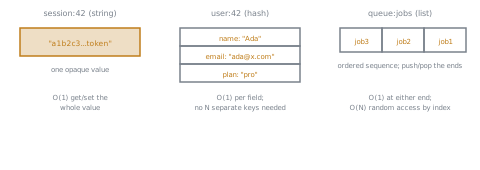
A string: one opaque value, and Redis's actual default
A string is Redis's simplest type, a binary-safe sequence of bytes up to 512MB, addressed by one key: SET session:42 "a1b2c3...", GET session:42. Every value this workspace has discussed so far, a session token, a cached page, a rate-limit counter, has actually been a string; it's the type every other lesson in this mission implicitly assumed. Strings also support atomic numeric operations, INCR/DECR, useful specifically because they avoid the read-modify-write race a client doing GET then SET itself would have. A string's cost is close to what it looks like: GET/SET are O(1) regardless of length, but repeatedly growing one with APPEND can force reallocation as it crosses internal capacity boundaries, a cost worth knowing about for a string that grows unboundedly rather than being set once.
A hash: fields under one key, instead of N separate keys
A hash groups several named fields under one key, HSET user:42 name Ada email ada@x.com plan pro, HGET user:42 name, representing something like an object without needing a separate top-level key per field. This matters for more than convenience: many small keys each carry their own per-key overhead (bookkeeping Redis maintains for every key it tracks), so a hash with a handful of fields is meaningfully more memory-efficient than the same data spread across that many individual string keys. Redis encodes a small hash compactly (a listpack, a flat, cache-friendly layout) up to a configured size (hash-max-listpack-entries, hash-max-listpack-value); crossing that threshold converts it to a full hash table internally, a real shift in both memory use and per-field access cost that a hash growing past its expected size can trigger without anyone noticing until it does.
A list: ordered, cheap at the ends, expensive in the middle
A list holds an ordered sequence of values under one key, LPUSH queue:jobs job1, RPOP queue:jobs, the standard shape for a queue (push one end, pop the other) or a capped recent-items feed (LPUSH plus LTRIM to keep only the newest N). Internally a list is a quicklist (a linked structure of compact nodes), which is exactly why pushing or popping at either end is cheap, O(1), while LINDEX at an arbitrary middle position, or LINSERT into the middle, is O(N): the list has to walk from an end to reach that position, since nothing in its structure supports jumping there directly. Treating a Redis list like an array with fast random access anywhere is the specific mistake this cost model rules out.
Practice
- ▢ A team stores a user's profile as five separate string keys (
user:42:name,user:42:email,user:42:plan, and two more) instead of one hash. What does switching to a single hash actually save, beyond looking tidier?
Hint
Consider what Redis tracks for every individual key it manages, separate from the value each key holds.
Check
It saves the per-key overhead Redis maintains for each of those five separate keys (the bookkeeping every tracked key carries, independent of its value's own size); consolidating them into one hash with five fields keeps that overhead to a single key's worth instead of five, meaningfully reducing memory use for data this small and this related.
- ▢ A script uses
LINDEX queue:jobs 5000inside a loop that checks every position in a very long list one at a time. Why does this get slower as the list grows, in a wayLPUSH/RPOPat the ends wouldn't?
Check
A Redis list is a quicklist, a linked structure with no direct way to jump to an arbitrary middle position; reaching position 5000 means walking from an end, an O(N) operation whose cost grows with the list's length. LPUSH/RPOP only ever touch an end directly, staying O(1) regardless of how long the list gets.
- ▢ A counter is implemented as
value=$(redis-cli GET counter); value=$((value + 1)); redis-cli SET counter "$value"from a client, rather thanredis-cli INCR counter. What real risk does this introduce thatINCRavoids?
Check
A race condition: two clients doing GET then SET at close to the same time can both read the same starting value and both write back the same incremented result, silently losing one of the two increments. INCR performs the read-modify-write as a single atomic operation inside Redis, closing that window entirely.
- ▢ A hash is expected to stay small (a handful of fields per user) but one user's account accumulates hundreds of fields over time. What changes once it crosses
hash-max-listpack-entries, and why might this go unnoticed until it matters?
Check
Redis converts the hash's internal encoding from a compact listpack to a full hash table, a real shift in memory use and per-field access characteristics. This can go unnoticed because nothing about the hash's external behavior (HGET/HSET still work identically) signals the change; only inspecting the hash's actual memory footprint or encoding would reveal it crossed the threshold.
-
▢ Which claim correctly distinguishes a Redis hash from spreading the same fields across separate string keys?
- a) A hash and separate string keys have identical memory and per-key overhead; the difference is purely stylistic
- b) Grouping related fields into one hash avoids the per-key overhead each separate string key would carry individually, at the cost of a size threshold beyond which the hash's internal encoding changes
- c) A hash can only ever use as much memory as a single string key, regardless of how many fields it holds
- d) Fields inside a hash are accessed in O(N) time, while separate string keys are always O(1)
Check
b) That's the exact trade-off: real memory savings from consolidation, with a real encoding-change threshold to be aware of. (a) is false: per-key overhead is exactly what consolidating into a hash avoids. (c) is false: a hash's memory use grows with its fields and can exceed a single small string's, though it's still typically cheaper than N separate keys for the same data. (d) is false: HGET/HSET on a specific field are O(1), the same as a string key's GET/SET.
Real-world reps
- [ ] Find a system you have access to storing related fields as several separate Redis keys (
user:*:name,user:*:email, and similar). Estimate the per-key overhead being paid and what consolidating into one hash would save. - [ ] Find (or design) a queue implemented with a Redis list. Confirm it only ever accesses the list from its two ends (
LPUSH/RPOP, or the reverse), never at an arbitrary middle index. - [ ] Tomorrow: read the primary source's sections on strings, hashes, and lists in full, and note the exact configured thresholds (
hash-max-listpack-entriesand its list equivalent) your own instance is running with.
Going further
Not landing? Reread the primary source at the top, since this lesson compresses it and compression is where understanding leaks. Check the glossary for any term that felt slippery.
If the lesson itself is unclear rather than the material, that is a defect: open an issue.