Lesson 11. Streams and Pub/Sub as a Messaging Surface
Mission link: Stage 7 opens what Redis does beyond storing a value under a key: moving a message from one client to another. This lesson is the two mechanisms that do it, and why reaching for the wrong one for a queue quietly loses messages the moment a subscriber isn't there to catch them.
Primary source: Docs: "Data types", Redis
Prerequisites: Lesson 10, maxmemory
Warm-up
- ▢ Why does a sorted set beat a plain list for keeping a leaderboard ordered as scores keep changing?
Check
A sorted set's skip-list backing keeps members ordered automatically at O(log N) per insertion or score update; keeping a plain list sorted by hand costs O(N) to find and insert at the correct position every time a score changes.
- ▢ Why might a bitmap beat a set for tracking a simple yes/no per user ID across 50 million users?
Check
A bitmap costs one bit per ID regardless of how many are actually marked, a fixed, predictable footprint; a set storing the same information as individual member entries carries far more per-member overhead at that scale.
Know this
Pub/Sub: fire-and-forget, with nothing kept for anyone who wasn't listening
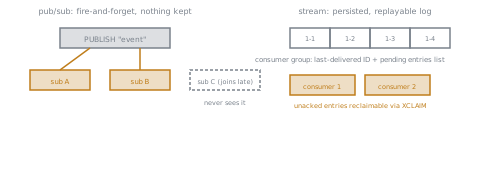
Pub/Sub (PUBLISH channel message, SUBSCRIBE channel) delivers a published message only to clients subscribed to that channel at the exact moment it's published; Redis keeps no record of it afterward. A subscriber that connects a second later, or one that briefly disconnected, simply never sees a message published in that gap, with no error and no way to notice one was missed. This makes Pub/Sub a genuinely good fit for something where a missed message is harmless (a live notification a connected dashboard happens to be showing right now) and a fundamentally wrong fit for anything resembling a queue, a job, or a message a system actually needs delivered.
Streams: an append-only log, with entry IDs and real consumer groups
A stream (XADD mystream '*' field value, XREAD) is a persisted, append-only log of entries, each automatically assigned an ID (a timestamp plus a sequence number) that can be replayed later with XRANGE, unlike Pub/Sub's here-and-gone delivery. A stream's consumer group (XGROUP CREATE, XREADGROUP) tracks, per group, the last entry ID delivered and a pending entries list (PEL), every entry delivered to some consumer but not yet acknowledged with XACK. A consumer that crashes mid-processing leaves its unacknowledged entries in the PEL, where XCLAIM lets another consumer explicitly take them over after a timeout, rather than losing them the way an unfinished Pub/Sub delivery would.
How a stream's consumer group differs from Kafka's
Both track group progress and let multiple consumers split the work, but the mechanism differs in a way worth naming precisely: Kafka tracks one committed offset per partition per group, a single number marking how far a group has confirmed reading. A Redis stream's consumer group instead tracks an explicit pending entries list per consumer, individually acknowledged per entry via XACK, which is closer to a per-message acknowledgment model than Kafka's offset-based one. A stream also has no native cross-node partitioning the way a Kafka topic does (a single stream lives on whatever node holds its key, though Cluster can shard different streams by key across nodes); a Kafka topic's partitions are the unit that spreads one logical stream of data across a cluster from the start.
Choosing between them isn't about which is "better," it's about what a missed message costs
Pub/Sub's fire-and-forget shape is the right choice specifically when nothing needs to survive a gap in delivery; a stream's persisted log and per-entry acknowledgment is the right choice the moment a message represents work that has to happen, a job to process, an event a downstream system can't be allowed to silently miss. Reaching for Pub/Sub because it looks simpler, for something that's actually a job queue, is the same shape of mistake data/kafka's workspace and this one both warn against from opposite directions: treating a fire-and-forget mechanism as if it had delivery guarantees it was never designed to provide.
Practice
- ▢ A service publishes order-confirmation events over Pub/Sub. A consumer service is redeployed and briefly disconnects for a few seconds during the restart. What happens to any order-confirmation events published during that gap?
Hint
Consider what Pub/Sub actually keeps after a message is published.
Check
They're lost entirely. Pub/Sub delivers only to clients subscribed at the exact moment of publishing and keeps no record afterward, so a consumer that was disconnected during that window has no way to retrieve what it missed once it reconnects; nothing was persisted to replay.
- ▢ Why does a stream's
XCLAIMmechanism matter specifically for a consumer that crashes mid-processing, in a way Pub/Sub has no equivalent for?
Check
A crashed consumer's in-flight entries stay in the consumer group's pending entries list (PEL), unacknowledged; XCLAIM lets another consumer explicitly take over those specific entries after a timeout, so the work isn't lost. Pub/Sub has no delivery record at all once a message is sent, so there's nothing analogous to reclaim; a message a crashed subscriber was "processing" simply never existed anywhere Pub/Sub could recover it from.
- ▢ Contrast how a Kafka consumer group tracks progress against how a Redis stream's consumer group does.
Check
Kafka tracks one committed offset per partition per group, a single number marking confirmed progress. A Redis stream's consumer group instead tracks a pending entries list per consumer, acknowledging individual entries one at a time via XACK, a closer-to-per-message model than Kafka's single offset marker.
- ▢ A team builds a background job queue on Redis Pub/Sub because "it's already there and simpler than setting up a stream." A worker restart during a deploy causes several jobs to silently never run. Diagnose what went wrong, using this lesson's vocabulary.
Check
Pub/Sub was the wrong mechanism for a job queue in the first place: it has no persistence and no acknowledgment model, so any job published while a worker was disconnected (during the restart) is gone with no trace, and no worker (the same one or a different one) can recover or retry it. A stream's persisted log and consumer-group PEL, with XACK/XCLAIM, is what a job queue actually needs; choosing Pub/Sub for this traded away exactly the delivery guarantee the use case required.
-
▢ Which claim correctly distinguishes Pub/Sub from a Redis stream?
- a) Both persist every message identically; the only difference is API syntax
- b) Pub/Sub delivers only to clients connected at publish time with nothing kept afterward; a stream persists entries with IDs and supports consumer groups with per-entry acknowledgment and reclaiming via
XCLAIM - c) Streams cannot support multiple consumers reading the same data independently
- d) Pub/Sub is always the correct choice for anything resembling a job queue, since it's simpler to set up
Check
b) That's the precise, load-bearing distinction this lesson draws. (a) is false: Pub/Sub keeps nothing after delivery, the opposite of a stream's persisted log. (c) is false: multiple consumer groups can each read the same stream independently, tracking their own separate progress. (d) is false: Pub/Sub's lack of persistence and acknowledgment makes it a poor fit for anything where a missed message has a real cost.
Real-world reps
- [ ] Find a system you have access to using Redis Pub/Sub. Check whether a missed message (a brief subscriber disconnect) would actually be harmless for that use case, or whether it's quietly relying on a guarantee Pub/Sub doesn't provide.
- [ ] Find (or design) a job queue built on a Redis stream. Confirm it uses a consumer group with
XACK(and, ideally, a periodicXCLAIMsweep for stuck pending entries) rather than reading with plainXREADand no acknowledgment at all. - [ ] Tomorrow: read the primary source's sections on Pub/Sub and streams in full, and compare a stream consumer group's pending-entries model against
data/kafka's offset-based model, in your own words.
Going further
- Docs: "Data types", Redis
- Consumer Groups and Rebalancing:
data/kafka's reference sheet on its offset-based consumer group model, for the direct comparison this lesson draws - Resources
Not landing? Reread the primary source at the top, since this lesson compresses it and compression is where understanding leaks. Check the glossary for any term that felt slippery.
If the lesson itself is unclear rather than the material, that is a defect: open an issue.