Lesson 18. DoRA: Magnitude and Direction
Mission link: The third method named in the mission, and the one whose mechanism is most often described wrongly.
Primary source: Paper: "DoRA: Weight-Decomposed Low-Rank Adaptation", Liu et al., arXiv:2402.09353
Prerequisites: Lesson 8, Lesson 9
Warm-up
- ▢ Write the LoRA update and say which factors are trainable.
Check
h = W₀x + (α/r)BAx. Only A and B are trainable; W₀ is frozen. B starts at zero.
- ▢ What is the maximum rank of a LoRA update at
r = 8?
Check
Eight. BA cannot exceed the rank of its inner dimension, which bounds what updates the adapter can express.
- ▢ Why is quantisation not free on small models?
Check
Quantisation error is a fixed relative perturbation, and small models have less redundancy available to absorb it.
Know this
The observation
Any weight matrix can be decomposed into a magnitude and a direction. Taking it column by column:
W = m · (V / ‖V‖_c)
where ‖·‖_c is the per-column norm, V / ‖V‖_c is a matrix of unit-norm columns, which is pure direction, and m is a vector of one scalar per column, carrying magnitude.
The DoRA authors analysed how full fine-tuning and LoRA move each of these two quantities during training, and found the patterns differ. Full fine-tuning tends to make relatively large directional changes with comparatively modest magnitude changes, and shows a distinctive relationship between the two. LoRA's updates move magnitude and direction together in a more coupled way, because a single low-rank additive term changes both at once and has no way to adjust them independently.
The hypothesis: that coupling is a limitation, and decoupling the two should give LoRA learning behaviour closer to full fine-tuning.
The method
Decompose the frozen W₀ into its magnitude and direction. Then:
- Make the magnitude vector
mtrainable directly. It is one scalar per column, sod_outparameters, negligible. - Apply the low-rank update to the direction, and renormalise afterwards.
W' = m · (W₀ + BA) / ‖W₀ + BA‖_c
Read that carefully, because it is where descriptions go wrong. BA is added to the weight and then the result is renormalised to unit columns, which strips out whatever magnitude change BA introduced. Magnitude is then supplied separately and explicitly by the trainable m.
So BA can no longer change magnitude even accidentally, since it only steers direction, and m handles scale. That is the decoupling, and it is the entire contribution.
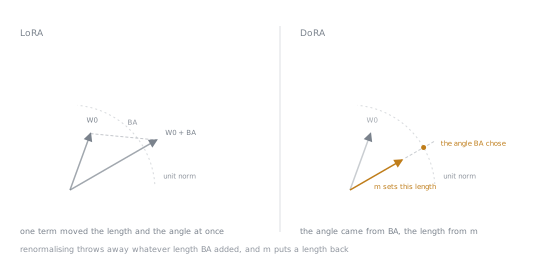
The two panels use the same W0 and the same BA. On the left one term moved both quantities at once; on the right the angle is everything BA contributed, and the length is whatever m says it is.
What it costs
Parameters: one extra vector per adapted layer, of length d_out. For a 4096-wide layer that is 4096 numbers against a rank-16 adapter's 131,072. Essentially free.
Compute: not free. The column norm of W₀ + BA must be computed, and it depends on BA, so it changes every step and cannot be cached across updates. This makes DoRA measurably slower per step than LoRA, commonly on the order of tens of percent, varying by implementation and how much of the work the library manages to fuse or cache.
Complexity: merging is more involved. The merged weight is m · (W₀ + BA)/‖W₀ + BA‖_c, still an ordinary matrix, so a merged DoRA is exact and has zero inference overhead, exactly like LoRA. But the arithmetic to get there is not a simple addition, and the implementation matters.
Using it
In PEFT, DoRA is a flag on the LoRA config rather than a separate method:
config := {
    use_dora: true,
    rank: 8,
    alpha: 32,
    target_modules: "all-linear",
    dropout: 0.05,
    adapt_bias: false,
}
Everything you know about rank, alpha, target modules and learning rate carries over. It is a modification to how the update is applied, not a new set of decisions. Confirm the flag name against the installed version, as always.
DoRA also composes with quantisation: a quantized base plus a DoRA adapter, sometimes called QDoRA. The interaction is worth measuring rather than assuming: the renormalisation now operates on dequantised weights carrying quantisation error, which is not obviously harmless.
The honest summary
DoRA is a well-motivated refinement with a clear mechanism, reported gains concentrated at low rank, and a real speed cost. It is not a replacement for LoRA and it is not a large effect at every setting. Lesson 19 is about predicting when it will pay for itself.
Practice
- ▢ Write the DoRA formula and identify every trainable quantity.
Check
W' = m · (W₀ + BA) / ‖W₀ + BA‖_c.
Trainable: the magnitude vector m, plus A and B. Frozen: W₀.
- ▢ What does the renormalisation accomplish?
Check
It removes any magnitude change that BA introduced, leaving BA able to affect direction only. Magnitude is then set explicitly by the trainable m.
That separation is the decoupling the method is named for.
- ▢ Why is DoRA slower than LoRA despite adding almost no parameters?
Check
The column norm of W₀ + BA must be computed, and because it depends on BA it changes every step and cannot be cached across updates. The extra parameters are negligible; the extra arithmetic is not.
- ▢ How many extra parameters does DoRA add to a 4096 × 4096 layer, and how does that compare to a rank-16 LoRA there?
Check
4096, one magnitude scalar per output column.
Rank-16 LoRA on that layer is 16 × (4096 + 4096) = 131,072. So DoRA's addition is about 3% on top, which is not the reason to hesitate. The step time is.
- ▢ Does a merged DoRA have inference overhead?
Check
No. The merged result m · (W₀ + BA)/‖W₀ + BA‖_c is an ordinary weight matrix, so a merged DoRA is indistinguishable from any other model at inference.
The arithmetic to produce it is more involved than LoRA's simple addition, but the product is the same kind of thing.
-
▢ Which statement describes DoRA correctly?
- a) It adds a second low-rank update to the magnitude term
- b) It trains magnitude directly and low-rank-updates direction
- c) It replaces the low-rank update with a full-rank scaling
- d) It normalises the gradients rather than the weight matrix
Check
b) It trains magnitude directly and low-rank-updates direction.
There is no second low-rank factor. The update is not full-rank. The normalisation is applied to the weight, not to gradients.
Real-world reps
- [ ] Implement the decomposition by hand: take any weight matrix, compute per-column norms, split into
mand unit-normV, and verifym · Vreconstructs it. - [ ] Train the same configuration with
use_dora=TrueandFalse. Record seconds per step for both and compute the overhead. - [ ] Tomorrow: read section 4 of the DoRA paper, where the magnitude-direction analysis of full fine-tuning versus LoRA is presented. That analysis is the argument.
Going further
- Paper: "DoRA: Weight-Decomposed Low-Rank Adaptation", Liu et al., arXiv:2402.09353
- Docs: LoRA variants, Hugging Face PEFT
- Lesson 19. When DoRA Wins, and When It Doesn't
Not landing? Reread the primary source at the top, since this lesson compresses it and compression is where understanding leaks. Check the glossary for any term that felt slippery.
If the lesson itself is unclear rather than the material, that is a defect: open an issue.