LoRA Hyperparameters
Decision sheet. Read the installed library version for exact parameter names, because this surface changes between releases.
The equation
h = W₀x + (α/r) · BAx
A random, B zero, so ΔW = 0 at step 0 and the model starts identical to the base.
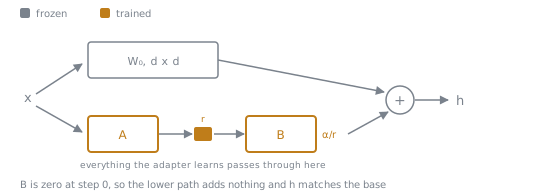
The bar between A and B is r values wide, and it is the only route the adapter has from input to output. That is what the next section means by capacity: raising the rank widens that bar and changes nothing else about the picture, which is why it buys expressiveness for almost no memory.
Rank
Capacity. Bounds how complex an update the adapter can express.
| Rank | Suits |
|---|---|
| 4 to 8 | Style, tone, output format; small datasets |
| 16 to 32 | A real task, a few thousand examples |
| 64 to 128 | Harder tasks, larger data, reasoning-heavy behaviour |
| 256+ | Approaching full fine-tuning capacity on large SFT data |
Rank costs almost no memory. Its real cost is overfitting risk on small data.
Alpha
Only α/r matters. Convention is α = 2r.
r | α | α/r | |
|---|---|---|---|
| 8 | 16 | 2.0 | baseline |
| 16 | 32 | 2.0 | more capacity, same scale |
| 16 | 16 | 1.0 | weaker update |
| 64 | 16 | 0.25 | trap: capacity up, influence down 8× |
Raising r without raising α turns the adapter down. At rank ≥ 64 consider use_rslora=True, which uses α/√r.
Target modules
| Situation | Targets |
|---|---|
| Default for a real task | all linear |
| Small dataset (< ~1k) | attention only, low rank |
| Style or tone only | attention only, low rank |
| Needs new discriminations | must include MLP |
| Reproducing a paper | exactly theirs |
"all-linear" resolves against the loaded model, so it cannot go stale against unfamiliar naming. Attention-only is a 2021 ablation, not a default.
Typical names, but verify with named_modules():
attention: q_proj  k_proj  v_proj  o_proj
mlp:       gate_proj  up_proj  down_proj
Learning rate
| Method | Range |
|---|---|
| Adapter fine-tuning | 1e-4 to 2e-4 |
| Full fine-tuning | 1e-5 to 5e-5 |
Importing a full fine-tuning rate into an adapter run is a leading cause of a disappointing first result. Use warm-up (a few hundred steps) and cosine decay.
Other settings
| Setting | Default | Notes |
|---|---|---|
lora_dropout | 0.0 to 0.05 | Raise only if held-out loss is rising |
bias | "none" | Rarely decisive; complicates merging |
| Epochs | 2 to 3 | On small instruction data; more usually memorises |
| Gradient checkpointing | on | Nearly a default for adapters |
use_cache | off in training | Conflicts with checkpointing; useless for training |
Variants, by axis
| Axis | Method | Helps when |
|---|---|---|
| Scaling | rsLoRA | High rank |
| Learning rates | LoRA+ | Separate rates for A and B |
| Init | PiSSA, OLoRA | Faster convergence; gives up zero-init |
| Init | LoftQ | Training against a quantized base |
| Structure | DoRA | Rank pinned low for another reason |
| Structure | AdaLoRA | Layers need unequal rank |
| Structure | VeRA | Adapter size is the binding constraint |
Baseline to beat: all-linear, adequate rank, tuned learning rate. Most variants do not clear it by more than seed noise.
Quantized base (QLoRA)
BitsAndBytesConfig(
    load_in_4bit=True,
    bnb_4bit_quant_type="nf4",             # not "fp4"
    bnb_4bit_use_double_quant=True,
    bnb_4bit_compute_dtype=torch.bfloat16,  # do not leave at default
)
Then prepare_model_for_kbit_training(model, use_gradient_checkpointing=True). Skipping it gives unstable runs or opaque gradient errors.
Every other hyperparameter is unchanged. QLoRA is LoRA with a cheaper base.
Merge into the full-precision base, never the quantized one.
Diagnosis by curve
| Train | Held-out | Diagnosis | Action |
|---|---|---|---|
| ↓ | ↓ | Learning | Continue |
| ↓ | ↑ after a dip | Overfitting | Ship the minimum; less capacity or more data |
| → high | → high | Underfitting | More rank, more targets, higher LR |
| Flat from step 1 | Flat | Broken | Check the adapter attached and labels are not all -100 |
NaN | also NaN | Overflow | Lower LR; add warm-up; prefer bf16 |