Lesson 3. Growth, Prefill, Decode, and Precision
Mission link: A latency budget depends on when cache memory gets claimed during a request, not only on its final size, and on the other levers a server has over that size besides batch and context length.
Primary source: Docs: vLLM Documentation, vLLM Project
Prerequisites: Lesson 2, KV cache
Warm-up
- ▢ Write the formula for a batch's total KV cache footprint, in terms of bytes per token, context length, and batch size.
Check
total cache bytes = bytes per token × context length × batch size.
- ▢ Why does a model using grouped-query attention have a smaller KV cache than the same model under full multi-head attention?
Check
The cache holds one key/value pair per KV head, not per query head, and GQA uses fewer KV heads than query heads. The cache scales with num_kv_heads, which full MHA sets equal to num_heads.
Know this
The cache doesn't grow at a steady rate
A request has two phases, and they claim cache memory very differently.
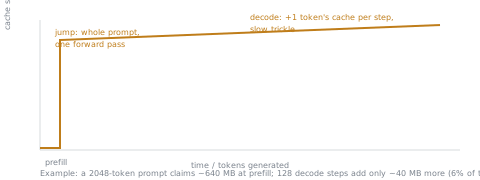
Prefill processes the entire prompt in one forward pass: every prompt token's key and value vectors get computed and cached together, in a single step. The cache jumps from empty to bytes per token × prompt length before the model has generated a single output token. This phase is compute-bound: it is one large, parallel matrix multiplication over the whole prompt.
Decode then generates one output token at a time. Each step computes and caches exactly one more token's worth of keys and values, so the cache grows by bytes per token per step, a slow trickle by comparison. This phase is memory-bandwidth bound: each step has to read the entire cache back to attend over it, for only one new token's worth of new work.
A long prompt therefore claims most of a request's eventual cache footprint immediately, at prefill, while decode adds the rest gradually. A capacity plan that only looks at "final context length" is really asking "how big will this get after prefill plus however many decode steps I expect," and the two phases contribute on very different schedules.
A lever independent of the model's own weights: cache precision
Lesson 2's formula carried bytes_per_value as its own term, separate from num_layers, num_kv_heads, and head_dim. That term does not have to match the precision the model computes in. A serving stack can store the KV cache itself in a lower precision, commonly fp8, while the model still computes in bf16 or fp16. Halving bytes_per_value from 2 bytes to 1 halves the cache's footprint outright, with no change to num_kv_heads, no change to context length, and no retraining: it is a serving-time choice, independent of whatever precision the weights were quantized to.
This stacks with everything from lesson 2. Take the Llama-2-70B numbers again (80 layers, 8 KV heads, head_dim = 128): at fp16, per-token cost was 320 KB. At fp8, it is 2 × 80 × 8 × 128 × 1 byte = 163,840 bytes ≈ 160 KB, exactly half, because only bytes_per_value changed.
Practice
- ▢ A request has a 2048-token prompt. Using Llama-2-70B's fp16 figure of 320 KB per token, how much cache does prefill alone claim, before any output token is generated?
Check
320 KB × 2048 ≈ 640 MB, claimed in the single prefill step.
- ▢ That same request then generates 128 output tokens by decode. How much additional cache does decode add, and what fraction of the request's total final cache does that represent?
Hint
Decode adds bytes per token × number of decode steps. Compare that to the prefill figure from question 1.
Check
320 KB × 128 ≈ 40 MB added by decode. Total cache is 640 MB + 40 MB = 680 MB, so decode is only about 6% of the total; prefill claimed the other 94% in one step.
- ▢ Using Llama-2-70B's fp8 cache figure of 160 KB per token, compute the total cache footprint for a batch of 64 sequences at a 4096-token context.
Hint
total cache bytes = bytes per token × context length × batch size, same formula as the warm-up.
Check
160 KB × 4096 × 64 = 41,943,040 KB ≈ 40 GB.
- ▢ The fp16 version of that same batch (question 3, but at 320 KB per token) would cost how much cache, and what does the comparison show about stacking a precision change on top of a head-sharing change?
Check
320 KB × 4096 × 64 ≈ 80 GB, exactly double. The fp8 cache halves the footprint on top of whatever GQA already bought back from full MHA: the two levers are independent and multiply together rather than substituting for each other.
Real-world reps
- [ ] Find your serving stack's flag for KV cache data type (vLLM:
--kv-cache-dtype) and read what precisions it supports and what it warns about accuracy. - [ ] For a request shape you actually expect (prompt length, expected output length), compute how much of its final cache prefill claims versus decode, using a model's real per-token figure.
- [ ] Tomorrow: read one paragraph of the vLLM docs on chunked prefill and note in one sentence why breaking prefill into pieces changes the memory-claim schedule this lesson described.
Going further
- Docs: vLLM Documentation, vLLM Project
- Article: "Transformer Inference Arithmetic", Kipply
- Resources
Not landing? Reread the primary source at the top, since this lesson compresses it and compression is where understanding leaks. Check the glossary for any term that felt slippery.
If the lesson itself is unclear rather than the material, that is a defect: open an issue.