Lesson 11. Arrays (Indexed and Associative)
Mission link: This is stage 8's capstone. Lesson 10 covered transforming one value; this lesson is holding several at once, without falling back to a space-separated string and the word-splitting fragility lesson 4 already warned against.
Primary source: Docs: "Bash Reference Manual", GNU
Prerequisites: Lesson 10, Word splitting
Warm-up
- ▢ Given
path="/var/log/app.log", what does${path##*/}expand to?
Check
app.log. ## removes the longest match of */ from the front, stripping everything through the last /.
- ▢ Why does
${v/pattern/replacement}need calling out explicitly in a script meant to stay POSIXsh-portable?
Check
It has no POSIX sh equivalent at all; it's a bash-only extension, so declaring #!/bin/sh while using it makes a false claim about the script's actual requirements.
Know this
Indexed arrays: sequential positions, both bash-only
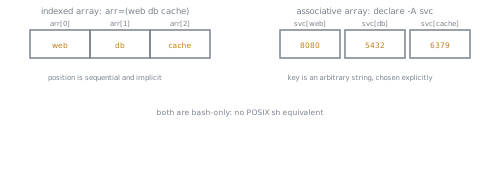
arr=(web db cache) creates an indexed array, positions 0, 1, 2 holding those three values; ${arr[0]} reads the first. Indexed arrays, like [[ ]] and the parameter-expansion forms in lesson 10, have no POSIX sh equivalent at all; a portable script falls back to a space-separated string (with all of lesson 4's word-splitting care) or positional parameters instead. Appending is arr+=(logging), not a re-assignment of the whole array; ${#arr[@]} gives the element count.
${arr[@]} versus ${arr[*]}: the one quoting distinction that actually matters
Quoted, "${arr[@]}" expands to each element as its own separate word, spaces inside an element and all, exactly what a for x in "${arr[@]}"; do loop needs to visit each element intact regardless of what it contains. "${arr[*]}" instead joins every element into a single string, separated by the first character of $IFS (a space, by default), which is right when the goal genuinely is one combined string and wrong the moment it's mistaken for the per-element form. Unquoted, both ${arr[@]} and ${arr[*]} undergo word splitting and globbing the same way any other unquoted expansion does (lesson 1), erasing the distinction entirely; the whole reason to reach for @ over * only exists once both are quoted.
Associative arrays: string keys, declared before use
declare -A svc declares an associative array (string keys instead of sequential positions) before anything can be assigned into it; svc[web]=8080 assigns, ${svc[web]} reads. ${!svc[@]} expands to the array's keys (not its values), the way to iterate over both together: for key in "${!svc[@]}"; do echo "$key -> ${svc[$key]}"; done. Associative arrays are bash-only too, and more recent than indexed arrays even within bash's own history, so a script using one is unambiguously declaring a bash dependency, not something that could plausibly have run under an older or more minimal shell by accident.
Why an array beats encoding structure into one string
Before arrays, a script needing several related values commonly encoded them into one delimited string ("web:db:cache", split on : later) or relied on positional parameters standing in for a list. Both work until a value itself needs to contain the delimiter, or until the encoding and decoding logic itself becomes the least reliable part of the script, exactly the kind of fragile text-manipulation-under-strain lesson 7 named as a signal shell has outgrown its judgment-free zone. An array holds each value as its own element from the start, with no delimiter to collide with and no decoding step that can go wrong.
Practice
- ▢
hosts=(web1 "web 2" web3). What doesfor h in "${hosts[@]}"; do echo "[$h]"; doneprint, one line per iteration?
Hint
Consider what quoting "${hosts[@]}" specifically preserves about each element.
Check
Three lines: [web1], [web 2], [web3]. The quoted @ form expands to each element as its own word, so the space inside "web 2" stays part of that one element rather than splitting it into two.
- ▢ Same array,
hosts=(web1 "web 2" web3). What doesfor h in "${hosts[*]}"; do echo "[$h]"; doneprint instead?
Check
One line: [web1 web 2 web3]. "${hosts[*]}" joins every element into a single string first (on the first character of $IFS, a space by default), so the loop only ever sees one combined word, not three separate elements.
- ▢ Write, in words, how to declare an associative array
portmapping service names to port numbers, populate it with three entries, and print every key alongside its value.
Check
declare -A port first, since an associative array has to be declared before assignment. Then port[web]=8080, port[db]=5432, port[cache]=6379. To print every pair: for key in "${!port[@]}"; do echo "$key -> ${port[$key]}"; done, iterating ${!port[@]} (the keys) and looking each one up in port inside the loop.
- ▢ A script encodes a list of three related values as
"a:b:c"and splits it on:whenever it's needed. What real risk does this carry that an array wouldn't, and what does lesson 7 call this kind of fragility?
Check
If any of the three values could ever legitimately contain a : itself, the encode/decode step breaks silently, splitting one value into two or merging two into one, with the delimiter choice itself becoming a source of bugs. Lesson 7 names encoding structure into a string, and the fragile decoding it requires, as exactly the kind of text-manipulation-under-strain signal that a script has outgrown shell's judgment-free zone.
-
▢ Which claim correctly distinguishes
"${arr[@]}"from"${arr[*]}"?- a) They are identical once both are quoted
- b)
"${arr[@]}"expands to each element as a separate word, preserving any spaces inside an element;"${arr[*]}"joins every element into one string on the first character of$IFS - c)
${arr[*]}is the portable POSIX form;${arr[@]}is bash-only - d) Neither form is affected by quoting; both always split on whitespace regardless
Check
b) That's the exact distinction, and the reason "${arr[@]}" is the default choice for iterating elements. (a) is false: quoting is precisely what makes them differ. (c) is false: arrays themselves are bash-only, so neither form has a POSIX equivalent at all. (d) is false: unquoted, both undergo word splitting identically, erasing the distinction; it only exists once both are quoted.
Real-world reps
- [ ] Find a script you have access to that encodes a list of values into one delimited string, and rewrite the relevant section using an indexed array instead.
- [ ] Find (or write) a loop iterating over an array without quoting the expansion (
for x in ${arr[@]}), and confirm what breaks once an element contains a space. - [ ] Tomorrow: read the primary source's sections on indexed and associative arrays in full, and note one array operation (slicing, negative indices, or removing an element) this lesson didn't cover.
Going further
Not landing? Reread the primary source at the top, since this lesson compresses it and compression is where understanding leaks. Check the glossary for any term that felt slippery.
If the lesson itself is unclear rather than the material, that is a defect: open an issue.