Lesson 16. mktemp, Safe Temp Files, and the eval/Injection Surface
Mission link: Stage 11 opens the mission's safety half directly. Lesson 15 handled a script's own concurrency and shutdown; this lesson is two of the sharpest ways a script that otherwise looks correct still gets exploited: a guessable temp filename, and a string built from untrusted input handed to eval.
Primary source: Site: "Shell Style Guide", Google
Prerequisites: Lesson 15, Word splitting
Warm-up
- ▢ Why does
$?immediately aftercmd &almost never report what a script actually wants to know?
Check
It reports whether starting the background job succeeded (almost always 0), not cmd's eventual exit status, since cmd hasn't necessarily finished by the time $? is checked; that requires wait "$pid" later.
- ▢ Why does a script launching background jobs need to explicitly forward
SIGTERMto them?
Check
A background job is a separate process; the script's own termination doesn't automatically propagate to it. Without a trap forwarding the signal, background children become orphaned, still running after the script that started them is gone.
Know this
A predictable temp filename is an attack surface, not just an aesthetic choice
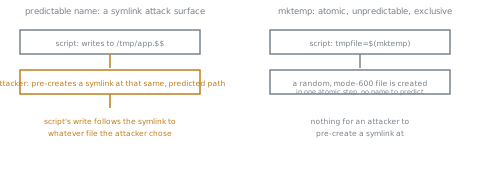
A script that builds a temp filename itself, /tmp/app.$$ ($$ being the script's own PID), makes that name predictable to anything else on the same machine, including a hostile process watching for it. An attacker who predicts the name can create a symlink at that exact path, pointing at a file the script has no business touching, before the script ever runs; when the script then writes to "its" temp file, it's actually following the symlink and writing to (or, worse, truncating) whatever the attacker pointed it at. This is a real, historically-exploited class of bug (a symlink attack / TOCTOU race, "time of check to time of use"), not a hypothetical: checking "does this path exist" and then creating a file at it are two separate steps an attacker can act between.
mktemp: unpredictable, exclusive, and correctly permissioned in one step
mktemp creates a file (or, with -d, a directory) with a name nothing could have predicted in advance, atomically, so there's no window between checking a name is free and claiming it for an attacker to exploit, and with restrictive permissions (mode 600, readable and writable only by the file's owner) from the moment it's created rather than as an afterthought. tmpfile=$(mktemp) is the whole pattern; pairing it with lesson 3's cleanup trap, trap 'rm -f "$tmpfile"' EXIT, guarantees the file is removed whether the script succeeds, fails, or is interrupted, closing both the security risk and the "script leaves junk in /tmp forever" annoyance in the same line.
eval: re-parsing a string as shell code, exactly the shape SQL injection takes in a database
eval STRING takes STRING and runs it as if it had been typed directly into the shell, a second full parse-and-execute pass over whatever that string happens to contain. eval "some_command $user_input" is exactly as dangerous as building a SQL query by concatenating unsanitized user input into it: if user_input is "; rm -rf ~", the shell doesn't see one argument containing a semicolon, it sees two full commands to run in sequence, because eval deliberately re-parses the string from scratch, quoting and all. The rule this lesson is named for: never eval a string built from input the script doesn't fully control, the same discipline as never concatenating untrusted input directly into a SQL query.
Building a command dynamically without eval: an array, not a string
The common reason a script reaches for eval in the first place, building up a command with a variable number of arguments or flags, has a safer answer: an array (lesson 11). cmd=(rsync -av); [ "$dry_run" = 1 ] && cmd+=(--dry-run); cmd+=("$src" "$dst"); "${cmd[@]}" builds the same flexible command without ever re-parsing a string, since each array element is already a distinct, already-quoted argument that never gets tokenized a second time. This closes the injection surface entirely, not by sanitizing the input more carefully, but by never handing untrusted content to a step that re-interprets it as code at all.
Practice
- ▢ A script does
tmpfile="/tmp/report.$$"and later writes report data to it. What specific attack does this expose the script to, and why does the script's own logic look correct while still being exploitable?
Hint
Consider what a second, hostile process running on the same machine could do to that exact path before the script gets there.
Check
A symlink attack: since $$ (the PID) is predictable, an attacker who anticipates or observes it can create a symlink at /tmp/report.<pid> pointing at a file the attacker wants overwritten, before the script writes anything. The script's own write logic is entirely correct; the vulnerability is the filename being guessable at all, which is exactly what mktemp removes.
- ▢ Rewrite
tmpfile="/tmp/report.$$"to usemktemp, and add the cleanup this lesson (and lesson 3) recommend pairing with it.
Check
tmpfile=$(mktemp) followed by trap 'rm -f "$tmpfile"' EXIT, guaranteeing an unpredictable, mode-600 file that's removed automatically on any exit path, success, failure, or an interrupting signal.
- ▢ A script builds
eval "grep $pattern $file", where$patterncomes from a command-line argument. A caller passespatternasfoo; rm -rf ~. What actually happens, and why doesn't quoting$patternat the call site fix it?
Check
eval re-parses the entire string a second time, so the semicolon inside $pattern is interpreted as a command separator rather than literal text, running grep foo followed by a completely separate rm -rf ~. Quoting $pattern where it's first assigned doesn't help, since eval strips a layer of quoting away as part of its second parse; the fix is not using eval on untrusted input at all, building the command as an array instead.
- ▢ Rewrite the grep example above (lesson practice 3) as an array-based command, avoiding
evalentirely.
Check
cmd=(grep "$pattern" "$file"); "${cmd[@]}" (or simply grep "$pattern" "$file" directly, if no additional flags need to be conditionally assembled). Either way, $pattern is passed as a single, already-delimited argument to grep; nothing re-parses it as shell syntax, so an embedded ; is just a literal character in the search pattern, not a command separator.
-
▢ Which claim correctly describes the risk
evalintroduces with untrusted input?- a)
evalis dangerous only when the string it's given contains a typo - b)
evalre-parses its argument as shell code a second time, so any shell metacharacter in untrusted input (;,`,|) is interpreted as syntax rather than literal text, the same class of risk as building a SQL query from unsanitized input - c) Quoting the variable passed to
evalat the point it's assigned fully neutralizes the risk - d) An array-based command is exactly as vulnerable as
eval, since both involve building a command from variable parts
- a)
Check
b) That's the exact mechanism, and the direct analogy to SQL injection this lesson draws. (a) is false: the risk is structural, present in correctly-formed input too, not just malformed input. (c) is false: eval's second parse strips a layer of quoting, which is exactly why quoting at assignment time doesn't protect against it. (d) is false: an array never re-parses its elements as code, which is precisely what makes it safe where eval isn't.
Real-world reps
- [ ] Find a script you have access to that builds a temp filename itself (
$$, a fixed name, a timestamp) rather than usingmktemp. Rewrite it to usemktemppaired with a cleanuptrap. - [ ] Search for
evalin any scripts you maintain. For each occurrence, check whether the string it's given can ever contain untrusted input, and if so, whether it can be rewritten using an array instead. - [ ] Tomorrow: read the primary source's guidance on
evaland temp files in full, and note any additional risk or mitigation it names that this lesson didn't cover.
Going further
Not landing? Reread the primary source at the top, since this lesson compresses it and compression is where understanding leaks. Check the glossary for any term that felt slippery.
If the lesson itself is unclear rather than the material, that is a defect: open an issue.