Lesson 8. Record Types
Mission link: Modelling a domain means choosing the right type rather than a class for everything, and record is the type that carries data. It is also the first C# feature where the Java equivalent is close enough that the differences are the whole lesson.
Primary source: Docs: "Records (C# reference)", Microsoft Learn
Prerequisites: Lesson 7, Lesson 1
Warm-up
- ▢ Name what each of
required,initand a non-nullable type promises, and what each one does not.
Check
required: every construction expression must initialise the member, but the value may be null. init: assignable only during construction, but it need not be assigned at all. A non-nullable type: the value should not be null, but nothing says it must be set or cannot change. Three mechanisms, three diagnostics.
- ▢ Does
public string Name => $"{First} {Last}";allocate a backing field?
Check
No. An expression-bodied property has no backing field and computes its value on each access, so it cannot disagree with the parts it is derived from. The cost is that every read does the work.
- ▢
var b = a;whereais a class instance. What did the assignment copy?
Check
The reference, not the object. Both names now denote the same instance, so a mutation through either is visible through the other. For a struct the same line copies the value instead.
Know this
record is a modifier, not a third kind of type. record class (which you may write as just record) defines a reference type, and record struct defines a value type (Records). What the modifier adds is generated members, and one precision worth having early: the compiler creates properties from primary constructor parameters only on types carrying the record modifier. A plain class with a primary constructor gets constructor parameters, not properties.
What positional syntax generates. From public record Person(string FirstName, string LastName); the compiler produces:
| Generated | Detail |
|---|---|
| One public auto-property per positional parameter | Init-only for record class and readonly record struct; read-write for record struct |
| A primary constructor | Parameters matching the positional parameters |
| A parameterless constructor | Only for record struct types, setting each field to its default |
A Deconstruct method | One out parameter per positional parameter. It covers only the positional properties and ignores any property you declared with ordinary syntax |
ToString, via a synthesized PrintMembers | Prints the type name and then each public property and field as name and value |
That Deconstruct row is the first gotcha: mix positional parameters with hand-written properties and deconstruction silently covers only half your type.
Value equality, and the mechanism underneath it. Without the modifier, class equality means the same object in memory and struct equality means the same type and the same values. All three record forms use the struct definition: same type, same values. The difference is how it is implemented. A plain struct inherits ValueType.Equals, which relies on reflection; a record's equality is compiler synthesized from the declared data members. Same semantics, very different cost.
Equality follows the runtime type, not the declared one. This applies to record class and is the surprise worth predicting. Given an abstract Person record with Teacher and Student deriving from it, two instances with identical property values compare unequal if their runtime types differ, even when both variables are declared as Person. Meanwhile a Person-typed variable and a Student-typed variable holding equal Student values compare equal. The compiler implements this with a synthesized EqualityContract property, so the runtime type is part of the comparison rather than an accident of it.
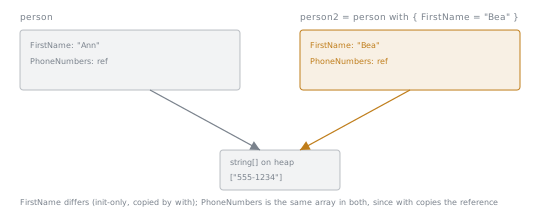
with copies, then changes. A with expression produces a copy of the instance with the named properties replaced, leaving the original untouched, and it works for both record classes and record structs. Two details worth knowing: original == modified is false after a real change, and original with { } produces a copy that compares equal to the original, which is a neat way to see that equality is about values rather than identity.
Shallow immutability is the trap, and lesson 1 predicted it. Init-only properties, whether generated from positional parameters or written by hand, give shallow immutability: after initialisation you cannot change a value-type property's value or a reference-type property's reference. What you can still change is the data the reference points at. The documentation's own example is a positional record holding a string[], where person.PhoneNumbers[0] = "555-6789" succeeds.
So a record freezes its fields, not the objects they name, which is the same distinction lesson 1 drew for struct against class assignment. If a record's contents must not change, the property's type has to be something that cannot be mutated, and with does not help: it copies the reference into the new instance, so both records then share the same mutable array.
Where records are the wrong choice, which matters for this workspace's mission. Some data models require reference equality. Entity Framework Core depends on it to guarantee one instance per conceptual entity, and the documentation is explicit that records and record structs are therefore not appropriate as EF Core entity types. It also notes that EF Core does not support updating with immutable entity types. Stage 6 reaches EF Core, and this is the constraint that decides the shape of a domain model there.
Against Java. Java records also give value equality, a canonical constructor and a generated toString, so equality is the part that transfers. Three things do not: C# has a value-type record form, C# records may participate in inheritance (with the runtime-type equality rule above), and C# has with, which is the feature that makes an immutable model pleasant to work with rather than merely correct. If you have written Java records, the new habit to build is reaching for with instead of a constructor call that repeats every unchanged argument.
Practice
- ▢
public abstract record Person(string FirstName, string LastName);withTeacherandStudentboth deriving from it and both addingint Grade. Predictteacher == studentwhere both arePerson-typed variables holding the same three values.
Check
False. Record equality requires the runtime types to match, and one is a Teacher while the other is a Student, so identical values do not make them equal. The declared type of the variable is irrelevant: a Person-typed variable holding a Student compares equal to a Student-typed variable holding the same values. The compiler implements this through a synthesized EqualityContract, which is worth knowing because it explains why the behaviour cannot be talked out of: the type is one of the compared members.
- ▢
public record Person(string FirstName, string LastName, string[] PhoneNumbers);Doesperson.PhoneNumbers[0] = "555-6789";compile and run? And doesperson with { }protect against it?
Hint
Ask what the init-only property actually holds, and what the assignment is actually changing.
Check
It compiles and it works. The property is init-only, which freezes the reference, and the assignment changes an element of the array that reference points at. The documentation calls this shallow immutability, and lesson 1 is the reason: the property holds a reference, so freezing it freezes which array, not what is in it.
with makes it worse rather than better. It copies the instance, which copies the reference, so the original and the copy then share one array and a mutation through either is visible through both. The only real fix is at the type level: hold something that cannot be mutated, such as a read-only collection type, so that no caller has an array to write into.
- ▢ For each of
record class Point(double X, double Y),record struct Point(double X, double Y)andreadonly record struct Point(double X, double Y), say whether the generated properties are writable after construction.
Check
record class: init-only, so no. readonly record struct: init-only, so no. record struct: read-write, so yes, which is the one that surprises people, because it is the form whose name contains the word most associated with values. A positional record struct gives you mutable properties unless you add readonly, and it also gets a parameterless constructor that sets every field to its default. If you want the value-type record to behave the way its name suggests, write readonly record struct.
- ▢ A colleague proposes making every Entity Framework Core entity a
recordfor the free equality andToString. Give the argument against.
Check
EF Core depends on reference equality to ensure it uses only one instance for what is conceptually one entity, and the documentation states directly that records and record structs are not appropriate as EF Core entity types for that reason. Value equality would make two separately loaded rows with equal column values indistinguishable to code that is supposed to be tracking one identity. There is a second reason in the same section: EF Core does not support updating with immutable entity types, so init-only positional properties fight the change tracker as well.
The useful generalisation: value equality is a claim that two instances with the same contents are the same thing. That is right for a money amount or a coordinate, and wrong for a row that has an identity of its own.
-
▢ Which claim about record equality is correct?
- a) Two records of different derived types with equal values still compare equal
- b) Two records compare equal only when their runtime types and values match
- c) Two records compare equal when the declared variable types and values match
- d) Two records compare equal only if they reference the same underlying object
Check
b) Same runtime type and same values, which is why a Teacher and a Student holding identical data are unequal. (a) is the intuition that value equality means "compare the fields and ignore the type", and the EqualityContract exists to prevent it. (c) uses the wrong type: the declared type of the variable never enters the comparison, which is why a Person-typed and a Student-typed variable can compare equal. (d) is what a plain class does, and getting away from it is the reason to write record in the first place.
Real-world reps
- [ ] Find a C# type used purely to carry data. Decide whether it would be better as a record, and specifically whether anything relies on comparing two instances by identity.
- [ ] Find a record with a collection-typed property. Work out whether a caller can mutate that collection through it, and whether
withwould give two records a shared one. - [ ] Tomorrow: take one immutable type you have written with a constructor and hand-written equality, and rewrite it as a positional record. Count the lines that disappear, then check whether any of them were doing something the generated members do not.
Going further
- Docs: "Records (C# reference)", Microsoft Learn
- Docs: "C# record types", Microsoft Learn
- Docs: "Properties (C# Programming Guide)", Microsoft Learn
- Resources
Not landing? Reread the primary source at the top, since this lesson compresses it and compression is where understanding leaks. Check the glossary for any term that felt slippery.
If the lesson itself is unclear rather than the material, that is a defect: open an issue.