Lesson 7. Packages and Modules
Mission link: Go's unit of encapsulation is the directory, not the type. Getting this wrong produces a repository that fights every import you write, and it is hard to undo later.
Primary source: How to Write Go Code, The Go Authors
Prerequisites: Lesson 6
Warm-up
- ▢ Which methods are in the method set of
T, and which in the method set of*T?
Check
T has only the value-receiver methods. *T has both value- and pointer-receiver methods. The asymmetry is why a value can fail to satisfy an interface its pointer satisfies.
- ▢ What does
go vet'scopylockscheck protect you from?
Check
Copying a value that contains a sync.Mutex or similar, which silently produces two independent locks where the code assumes one.
Know this
A package is a directory. Every .go file in one directory declares the same package name, and files are otherwise interchangeable: Go has no header files, no ordering between files, and no rule about which type lives where. Splitting a package across five files is a readability choice with no semantic weight.
A capital letter is the entire visibility system. An identifier starting with an uppercase letter is exported and visible to importers. Anything else is package-private. There is no protected, no friend, and no per-symbol export list. The unit of privacy is the package, so two types in the same package can always see each other's unexported fields. That is a feature rather than a leak, and it is why Go packages tend to be larger than Java packages.
Modules
A module is a collection of packages released together, rooted at a go.mod:
module github.com/you/svc

go 1.26
The module path prefixes every import inside it, so a package in internal/store/ is imported as github.com/you/svc/internal/store. The go directive states the minimum language version the module requires. It changes what the compiler accepts, and it is why Go 1.22's loop-variable change could ship without breaking older code.
Since Go 1.26, go mod init writes a slightly older version than the toolchain you ran it with, so a new module does not immediately demand the newest release from everyone who builds it.
The commands worth memorising now:
| Command | Does |
|---|---|
go run ./cmd/svc | build and run, no binary left behind |
go build ./... | compile everything, report errors |
go test ./... | run every test in the module |
go vet ./... | static checks the compiler does not make |
go mod tidy | add what is imported, remove what is not |
go fmt ./... | canonical formatting, not negotiable |
go fix ./... | rewrite to modern idioms, rebuilt in Go 1.26 |
gofmt output is the only accepted format for Go source. There is no style debate to have, and that is deliberate.
internal/ is enforced by the compiler
A directory named internal limits imports to code rooted at its parent:
github.com/you/svc/
├── cmd/svc/main.go              # package main
├── internal/store/store.go      # importable only within github.com/you/svc
└── httpapi/server.go            # importable by anyone
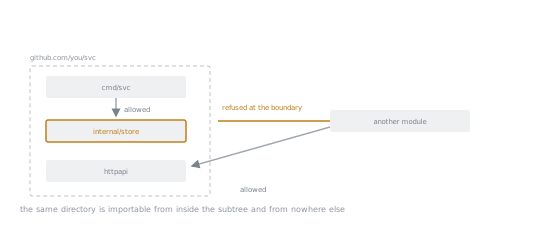
Two imports cross the boundary and one of them is turned back. Which one depends only on where the target sits in the tree.
This is not a convention: the toolchain rejects the import. It is the mechanism for having a large package surface inside your own module while publishing a small one, and it is the first tool to reach for when you are unsure whether something should be public. Start everything in internal/; move it out when an external caller genuinely needs it. That direction is easy, and the reverse is a breaking change.
The package name is part of every call site
Callers write store.New, not New. So the package name and the identifier are read together, and repeating the package in the name stutters:
store.NewStore()   // stutter
store.New()        // idiomatic

http.HTTPServer    // stutter
http.Server        // idiomatic
Package names are short, lowercase, one word, no underscores, no plurals: store, httpapi, token. A package named util, common, helpers or base has no name because it has no subject, and it becomes the place everything lands. That is the single most reliable predictor of a repository that is hard to work in.
Two constraints that shape layout
Import cycles are a compile error. Go has no forward declarations and no lazy resolution. If a imports b, then b can never import a. This is the constraint that most often forces a design change, usually by extracting the shared type into a third package that both import.
init() runs before main. Each package's variables are initialised, then its init functions run, and all of that completes before any importer's code runs. It is genuinely useful for registering a driver, and it is a poor place for anything you might want to fail, configure, or test; see Lesson 23. Prefer explicit construction in main.
Practice
- ▢ You have
internal/storeand want to use it from a second repository. What does the compiler say, and what are your options?
Check
The build fails: use of internal package not allowed. The rule is that internal/x is importable only by code rooted at internal's parent directory.
Options: move the package out of internal and accept that it is now public API you have to keep compatible, or extract the shared part into its own module. The error is the design question arriving on time.
-
▢ Which name is idiomatic for a package that decodes JWTs?
- a)
package jwtutils - b)
package JWTDecoder - c)
package jwt_decode - d)
package jwt
- a)
Check
d) package jwt.
Call sites read jwt.Decode(...), which says everything. jwtutils names a grab bag, JWTDecoder is capitalised and repeats what the function will already say, and jwt_decode uses an underscore that gofmt will not remove but every reviewer will.
- ▢ Package
orderimportspayment, and nowpaymentneeds anorder.ID. Name two ways out.
Check
Extract ID into a small third package both import. That is often the right call, and the reason repositories grow a types-shaped package that should still be given a real name.
Or invert the dependency: define the narrow interface payment needs inside payment, and let order satisfy it. Go's implicit interfaces make this cheap, and it is usually the better design, per Lesson 11.
Merging the two packages is the third option, and it is right more often than people expect.
- ▢ Why does Go not need a
privatekeyword?
Check
Because the case of the first letter carries the information, and the boundary is the package rather than the type. Within a package everything is visible; across the boundary only exported identifiers are.
The consequence to internalise is that a Go package is a bigger unit than a Java class. Splitting a type and its helpers into separate packages to "encapsulate" them buys nothing and costs you an import cycle later.
- ▢ Interleaving Lesson 1: your package needs a registry populated at startup. Why prefer building it in
mainover aninit()?
Check
Because init runs implicitly, cannot return an error, and cannot be skipped by a test. A failure inside it kills the process before main gets a chance to report anything useful, and any test that imports the package pays the cost.
Explicit construction in main gives you an error to handle, a dependency to substitute in tests, and an order you can read. init earns its keep for self-registration, such as a database driver adding itself to database/sql, and little else.
Real-world reps
- [ ] Create a module with
cmd/svc/main.goandinternal/store/store.go. Import the store from main, build it, and then try to import it from a second module to watch the toolchain refuse. - [ ] Run
go vet ./...andgo fix ./...on a scratch package. Read whatgo fixproposes. The Go 1.26 modernizers are a fast way to see which idioms have moved on. - [ ] Tomorrow: open a repository you work in and list every package whose name does not describe a subject. That list is your refactoring backlog.
Going further
- How to Write Go Code
- Package names, The Go Blog
- Organizing a Go module: the layouts the Go team actually recommends
- Lesson 14. Designing a Package: the same material as a design skill rather than a mechanism
- Resources
Not landing? Reread the primary source at the top, since this lesson compresses it and compression is where understanding leaks. Check the glossary for any term that felt slippery.
If the lesson itself is unclear rather than the material, that is a defect: open an issue.