Lesson 10. defer, panic and recover
Mission link: defer is how a Go service releases what it acquired, and its two surprises, argument evaluation and loop accumulation, leak resources quietly under load.
Primary source: Defer, Panic, and Recover, The Go Blog
Prerequisites: Lesson 8
Warm-up
- ▢ What breaks if a middle layer changes
%wto%vwhen wrapping?
Check
The chain is cut, so errors.Is and errors.As above that point stop finding anything below it. The message still looks right, which is what makes it hard to spot.
- ▢ When should you not wrap with
%w?
Check
When the wrapped error is an implementation detail you do not want callers matching on, such as a driver error or a JSON parse failure. %w makes it API; %v keeps the message and drops the commitment.
Know this
defer schedules a call to run when the surrounding function returns, normally or through a panic.
f, err := os.Open(name)
if err != nil {
    return err
}
defer f.Close()
Acquire, check, defer the release, immediately. That order matters: deferring before the error check would call Close on a nil file.
Three rules carry all the surprise.
Deferred calls run last-in, first-out. Three defers unwind in reverse, which is what you want for nested acquisition.
Arguments are evaluated when defer executes, not when the call runs.
i := 0
defer fmt.Println(i)   // prints 0
i = 42
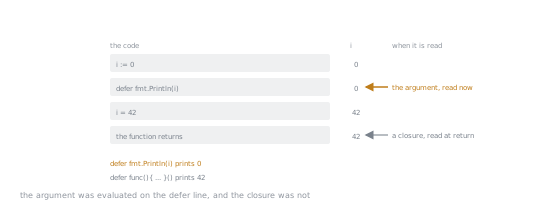
Both forms read the same variable from the same column; they differ only in which row they read it on, and what each prints is the value sitting there.
The value 0 was captured at the defer line. To see the final value, defer a closure, defer func() { fmt.Println(i) }(), which captures the variable rather than its value.
A deferred closure can modify named results. This is the idiomatic way to add context to every error path at once:
func load(path string) (err error) {
    defer func() {
        if err != nil {
            err = fmt.Errorf("load %s: %w", path, err)
        }
    }()
    ...
}
It only works with a named result, because the closure needs a variable to assign to.
The loop trap
defer is scoped to the function, not the block:
for _, name := range names {
    f, err := os.Open(name)
    if err != nil {
        return err
    }
    defer f.Close()   // 10,000 open files before any of them close
}
Every iteration adds a deferred call that waits for the whole function. Over a large input this exhausts file descriptors. Move the body into its own function, either a small named one or a closure called immediately, so each iteration has a function to return from.
Close on a writer is not a free call
defer f.Close() discards the error. For a reader that is fine. For a writer the final flush happens in Close, so discarding it can lose the tail of the file and report success:
defer func() {
    if cerr := f.Close(); cerr != nil && err == nil {
        err = cerr
    }
}()
panic is for bugs
panic unwinds the stack, running deferred functions as it goes, and if nothing stops it the program exits with a stack trace. Use it for conditions that mean the program is wrong: an impossible switch branch, a required template that failed to compile at startup, an invariant a caller violated.
Do not use it for expected failures. A missing file, a rejected input and a timed-out request are all errors, and the whole of Lesson 8 is about why.
recover stops a panic, and only inside a directly deferred function:
func safe() (err error) {
    defer func() {
        if r := recover(); r != nil {
            err = fmt.Errorf("recovered: %v", r)
        }
    }()
    return risky()
}
Two hard limits worth knowing before you rely on it:
- A panic in a goroutine cannot be recovered from another goroutine. Every goroutine you start needs its own recovery if a panic there must not kill the process. The stack does not connect them.
- A fatal error is not a panic.
concurrent map writesandall goroutines are asleep - deadlock!bypassrecoverentirely and end the process, as Lesson 4 showed.
Recovery belongs at boundaries where one unit of work should not take the process down: an HTTP middleware, a worker loop, a plugin call. net/http already recovers panics in handlers, logs the stack, and closes the connection, so your own middleware is about turning that into a 500 and a structured log line rather than about survival.
Practice
-
▢ Predict the output.
func f() {
    for i := range 3 {
        defer fmt.Print(i, " ")
    }
}
Check
2 1 0. Last-in, first-out, and each i was captured by value at its defer line.
Note that this is correct in Go 1.22 and later for a different reason than people expect: even though loop variables are now per-iteration, the argument was already evaluated eagerly, so the behaviour here never depended on that change.
-
▢ What is wrong with this, and what is the smallest fix?
for _, name := range names {
    f, err := os.Open(name)
    if err != nil {
        return err
    }
    defer f.Close()
    process(f)
}
Check
Nothing closes until the whole function returns, so a long list exhausts the file-descriptor limit.
The smallest fix is to give each iteration its own function:
for _, name := range names {
    if err := func() error {
        f, err := os.Open(name)
        if err != nil {
            return err
        }
        defer f.Close()
        return process(f)
    }(); err != nil {
        return err
    }
}
A named helper is usually clearer than the inline closure. Either way, the point is that defer needs a function boundary to fire at.
-
▢ Which use of
panicis defensible?- a) A user submitted a form with an invalid email
- b) A database connection was refused during a request
- c) A template required at startup failed to parse
- d) An upstream service returned a 503 response
Check
c) A template required at startup failed to parse.
It is a programming error, discovered before serving traffic, with no sensible way to continue, which is why template.Must exists and panics by design. The other three are ordinary runtime failures that a caller can act on, and each should be an error.
- ▢ A worker goroutine panics. Your
mainhas a deferredrecover. What happens?
Check
The process exits. recover only works within the goroutine that panicked, and main's deferred function is on a different stack entirely.
Each long-lived goroutine needs its own deferred recovery if a panic there must not be fatal. In practice this means wrapping the goroutine body in a small helper that recovers and logs, rather than calling go doWork() directly.
- ▢ Interleaving Lesson 2: why does the named-result trick require
(err error)rather than a bareerror?
Check
The deferred closure has to assign to something. With an unnamed result there is no variable in scope to assign to, because the value was already handed back, so the closure can only read its own copies.
Naming the result gives the closure a variable that is still live during unwinding, and assigning to it changes what the function actually returns. It is the one place where naming results earns its keep; elsewhere it mostly hurts readability.
Real-world reps
- [ ] Run the LIFO example and the eager-argument example. Then change the second to a closure and watch the printed value change.
- [ ] Write a function that opens 5,000 files in a loop with
defer f.Close()inside it, and run it. Note the exact error you get when the descriptor limit is hit. You will recognise it in a log one day. - [ ] Tomorrow: add a recovering wrapper for one goroutine in code you own. Make it log the stack with
debug.Stack(), not just the panic value.
Going further
- Defer, Panic, and Recover, The Go Blog
- Go Code Review Comments: don't panic
runtime/debug.Stack- Error Handling
- Resources
Not landing? Reread the primary source at the top, since this lesson compresses it and compression is where understanding leaks. Check the glossary for any term that felt slippery.
If the lesson itself is unclear rather than the material, that is a defect: open an issue.