Lesson 11. Interfaces Are Satisfied Implicitly
Mission link: This is the habit Java punishes hardest. Declaring interfaces next to implementations produces Go that compiles, works, and that every reviewer will describe as written in the wrong language.
Primary source: Effective Go: Interfaces
Prerequisites: Lesson 6, Lesson 7
Warm-up
- ▢ When are the arguments to a deferred call evaluated?
Check
At the defer statement, not when the call runs. Defer a closure if you need the value as it is at return time.
- ▢ Where must
recoverbe called for it to work?
Check
Inside a function deferred directly by the function that panicked, and in the same goroutine. It cannot reach across goroutines, and it cannot stop a fatal runtime error.
Know this
There is no implements. A type satisfies an interface by having the methods, and the compiler checks this at the point where the value is used as the interface:
type Stringer interface{ String() string }

type Celsius float64
func (c Celsius) String() string { return "..." }   // never mentions Stringer

var s Stringer = Celsius(20)                        // satisfied, checked here
Celsius does not import the package that declares Stringer and does not know it exists. That decoupling is the whole design.
The interface belongs to the consumer
Because satisfaction is implicit, the interface can be declared where it is used rather than where it is implemented. That is the idiom, and it inverts the habit from Java:
// package report, the consumer
type UserStore interface {
    GetUser(ctx context.Context, id string) (*User, error)
}

func Generate(ctx context.Context, s UserStore) error { ... }
store.Postgres satisfies report.UserStore without importing report. The dependency arrow points from the consumer to the implementation, so:
- The consumer's interface has exactly the methods that consumer needs, often one, instead of everything the implementation offers.
- Tests substitute a fake by writing a type with one method, in the test file, with no mocking framework.
- The implementation package stays free of abstractions it does not use.
- The import cycle from Lesson 7 goes away, because the arrow only points one way.
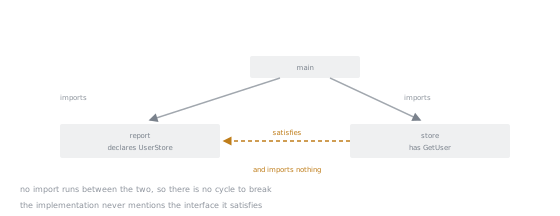
Two of the three lines are imports and one is not. The one that is not is the only line joining the two packages that actually have to agree.
The corollary is the phrase you will hear in review: accept interfaces, return structs. Take the narrowest interface you can use as a parameter; return the concrete type, so callers keep every method and can decide their own abstraction.
Small is not a slogan
io.Reader is one method, and it is the most reused abstraction in the language: files, network connections, HTTP bodies, gzip streams, strings.Reader, and anything that will ever be written all satisfy it. error is one method. fmt.Stringer is one method. sort.Interface is three and is already at the edge.
Rob Pike's proverb states the reason: the bigger the interface, the weaker the abstraction. Each method you add excludes implementations and buys the caller nothing it asked for. A five-method UserService interface with exactly one implementation is not an abstraction; it is a second copy of the type's signature that must now be kept in sync.
Interface embedding composes small ones instead of growing large ones:
type ReadWriter interface {
    Reader
    Writer
}
When to declare one at all
Do not declare an interface because a type exists. Declare one when you have a reason:
- A consumer needs to work with more than one implementation, including a test double that is not a mocking framework artefact.
- You want to narrow a large dependency down to the two methods you use.
- You are publishing a plugin point that outside code must implement.
One implementation and no test need means no interface yet. Adding one later costs a single line, precisely because implementations never name it, which is the argument for waiting.
any is an alias for interface{}, added in Go 1.18. It says "any type", which means it says nothing; each use is a place the compiler stopped helping.
Compile-time assertions
Since implementations do not name their interfaces, nothing normally fails when a method signature drifts. Pin the ones that matter:
var _ http.Handler = (*Server)(nil)
Zero runtime cost, and the build breaks at the type rather than at the distant call site.
Practice
- ▢ Package
mailersends email usingstore.Postgresto look up addresses. Where should the interface be declared, and what should it contain?
Check
In mailer, containing only the methods mailer calls, probably AddressFor(ctx, id) (string, error) alone.
Declaring it in store beside the implementation is the Java reflex. It forces store to anticipate consumers, produces an interface with every method the type has, and makes mailer depend on store for its abstraction as well as its implementation.
- ▢ Why does
func Save(w io.Writer, v Record) errorbeatfunc Save(f *os.File, v Record) error?
Check
io.Writer is one method, so the same function serves a file, a network connection, an HTTP response, a gzip stream, and a bytes.Buffer in a test, with no mock and no interface declared by anyone.
The *os.File version can only be tested by touching a real filesystem, which is why "accept interfaces" is a testability argument before it is a design one.
-
▢ Which is the strongest reason to declare an interface in Go?
- a) The type will probably gain a second implementation eventually
- b) A consumer needs only two of the type's fourteen methods
- c) Every service type in the codebase already has one
- d) The team standard says implementations should have interfaces
Check
b) A consumer needs only two of the type's fourteen methods.
That narrowing is real value available today: a smaller dependency, a trivial test double, and a signature that documents exactly what the function touches. Option a is speculation the language lets you defer at no cost, and c and d are habits rather than reasons.
- ▢ A colleague's PR adds
type UserService interfacewith eight methods, next to the singleuserServicestruct that implements it. Name the concrete problem, not the style objection.
Check
The interface has no consumer that needs eight methods, so it abstracts nothing: it duplicates the struct's surface and now has to be updated in two places for every change. Any test double must implement all eight to call one.
Concretely: it adds maintenance cost and removes compiler help, in exchange for a substitutability nobody has asked for. If a test needs a fake, the fix is a one-method interface in the consumer.
- ▢ Interleaving Lesson 6:
Postgreshasfunc (p *Postgres) GetUser(...). DoesPostgres{}satisfyUserStore?
Check
No. GetUser has a pointer receiver, so it is only in the method set of *Postgres. &Postgres{} satisfies it.
This is the most common way method sets bite in real code: the interface is fine, the implementation is fine, and the assignment fails at a line far from either. var _ UserStore = (*Postgres)(nil) in the implementation package catches it at the definition.
Real-world reps
- [ ] Write a function taking
io.Writer, and call it three ways: withos.Stdout, with abytes.Bufferin a test, and with anhttp.ResponseWriter. No mocking library. - [ ] Take a service type you own with more than five methods. Write the interface its biggest consumer actually needs, and count the methods. It will be smaller than you expect.
- [ ] Tomorrow: find an interface in a codebase with exactly one implementation and no test double. Decide whether deleting it would lose anything.
Going further
- Effective Go: Interfaces
- Go Proverbs, Rob Pike: "the bigger the interface, the weaker the abstraction", with the talk behind it
- Go Code Review Comments: interfaces
- Lesson 12. The Nil Interface Trap: what an interface value actually holds
- Resources
Not landing? Reread the primary source at the top, since this lesson compresses it and compression is where understanding leaks. Check the glossary for any term that felt slippery.
If the lesson itself is unclear rather than the material, that is a defect: open an issue.