Lesson 12. The Nil Interface Trap
Mission link: This one bug has shipped in more Go services than any other on this list. It turns a success path into an error path, and the code that causes it reads as obviously correct.
Primary source: Go FAQ: Why is my nil error value not equal to nil?
Prerequisites: Lesson 11
Warm-up
- ▢ Where should an interface be declared: beside the implementation, or in the consumer?
Check
In the consumer, containing only the methods that consumer uses. Implementations never name the interfaces they satisfy, so the dependency arrow points one way.
- ▢ What does
var _ http.Handler = (*Server)(nil)buy you?
Check
A compile-time check that *Server still satisfies http.Handler, at zero runtime cost. The build breaks at the type definition rather than at some distant call site.
Know this
An interface value is two words: a dynamic type and a dynamic value.
┌──────────────┬───────────────┐
│ dynamic type │ dynamic value │
└──────────────┴───────────────┘
An interface is nil only when both words are nil, meaning it holds nothing at all. Put a nil *MyError into it and the type word is *MyError, the value word is nil, and the interface is not nil.
var p *MyError = nil
var err error = p

fmt.Println(p == nil)     // true
fmt.Println(err == nil)   // false, the interface holds a type
Both lines are correct and they disagree, because they are asking different questions. p == nil asks whether the pointer is nil. err == nil asks whether the interface is empty.
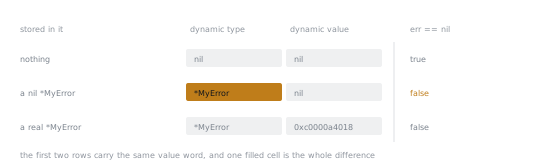
The first two rows carry the same value word. One filled cell is the whole difference, and the verdict follows it rather than following the pointer you put in.
How it reaches production
Almost always through a concrete error type used as a return variable:
func do() error {
    var err *MyError        // concrete type, this is the bug
    if somethingFailed() {
        err = &MyError{}
    }
    return err              // wrapped in a non-nil interface either way
}

if err := do(); err != nil {
    // always taken, even on success
}
On the success path err is a nil *MyError, and returning it produces a non-nil error. Every caller now takes the failure branch on a successful call. Nothing panics until something dereferences it, so the symptom appears far from the cause.
The same shape appears with any interface, not just error: a nil *bytes.Buffer returned as an io.Writer, a nil *Config returned as a Provider.
Three ways to not have this bug
Declare the variable as the interface type. This is the fix that generalises:
func do() error {
    var err error           // interface type, nil stays nil
    if somethingFailed() {
        err = &MyError{}
    }
    return err
}
Return literals on each path. Explicit return nil on success, return &MyError{} on failure, no shared variable to be careless with.
Never give a function a concrete error return type. func do() *MyError is the source of the whole family. Return error and let errors.As recover the type, which is what Lesson 9 gave you.
go vet has a nilness analyser that finds some cases, and staticcheck's SA4023 finds more. Neither catches all of them, so the rule is a habit rather than a tool.
The related surprise
A nil interface method call panics, but a nil pointer inside an interface does not, provided the method does not dereference it:
type T struct{}
func (t *T) Ping() string { return "pong" }

var t *T
var i interface{ Ping() string } = t
fmt.Println(i.Ping())   // "pong", the receiver is nil, and Ping never touches it
This is legitimate and occasionally useful: methods on nil receivers are how a nil *Tree can be a valid empty tree. It also means a nil check on an interface does not guarantee a usable value.
Practice
-
▢ Predict both printed values, then explain the difference in one sentence.
var p *MyError
var err error = p
fmt.Println(p == nil, err == nil)
Check
true false.
p is a nil pointer; err is an interface holding the type *MyError and a nil value, so it is not empty. The wrong instinct is to think the assignment "passes the nil through". It wraps it.
-
▢ Fix this function, and say why your fix works.
func validate(s string) error {
    var e *ValidationError
    if s == "" {
        e = &ValidationError{Field: "name"}
    }
    return e
}
Check
Declare e as error, or return literals:
func validate(s string) error {
    if s == "" {
        return &ValidationError{Field: "name"}
    }
    return nil
}
Both work because nothing ever converts a nil concrete pointer into the interface. In the original, return e performs that conversion on every path, including the success path.
-
▢ When is an interface value equal to
nil?- a) When the value it holds is nil
- b) When the type it holds is nil
- c) When both type and value are nil
- d) When it was never assigned to
Check
c) When both type and value are nil.
Option a is precisely the misconception this lesson exists to break. Option b cannot happen on its own: a type word with no value word is not a state you can produce by assignment. Option d is a true consequence rather than the rule, since an unassigned interface has both words nil.
- ▢ A handler returns 500 for every request, and the logged error line reads
<nil>. What do you look for first?
Check
A function returning a concrete error type, or assigning to a concrete-typed variable and returning it as error. The branch runs because the interface is non-nil; the <nil> comes from the value inside it.
That exact output is worth understanding, because it is not fmt printing a nil interface. fmt called Error() on a nil receiver, the method dereferenced a field and panicked, and fmt recovered and printed <nil> because the argument was a nil pointer. An error type whose Error() does not touch its fields prints its message normally, so a healthy-looking log line does not rule this out.
Grep for *SomeError in return positions and for var err *. This bug hides in exactly those two shapes.
- ▢ Interleaving Lesson 6: does this bug have anything to do with method sets?
Check
No, and separating them is worth doing explicitly. Method sets decide whether a type satisfies an interface, at compile time. This trap is about what an interface value contains once a type has been stored in it, at run time.
They meet only in that both come from the same fact: an interface holds a copy of a value along with its type. One consequence is checked by the compiler; the other is not checked at all.
Real-world reps
- [ ] Reproduce the bug in ten lines and run it. Then print
fmt.Printf("%T %v\n", err, err)on the returned error to see the type word and the value word separately. - [ ] Write a
*Treetype with aSum() intmethod that works on a nil receiver. It is the same mechanism used deliberately, and holding both in mind is what makes the rule stick. - [ ] Tomorrow: grep a codebase you work with for functions returning a concrete error type rather than
error. Each is a latent instance.
Going further
- Go FAQ: why is my nil error value not equal to nil?
- The Laws of Reflection, The Go Blog: the type/value pair, from the other direction
- Typed nils in Go 2, Dave Cheney
- Error Handling
- Resources
Not landing? Reread the primary source at the top, since this lesson compresses it and compression is where understanding leaks. Check the glossary for any term that felt slippery.
If the lesson itself is unclear rather than the material, that is a defect: open an issue.