Lesson 18. context and Cancellation
Mission link: Cancellation that propagates is the difference between a service that sheds load and one that piles up goroutines until it dies. Nothing in Java or Promise-land transfers cleanly.
Primary source: Go Concurrency Patterns: Context, The Go Blog
Prerequisites: Lesson 17
Warm-up
- ▢ Two
selectcases are ready. Which one runs?
Check
One chosen uniformly at random. Case order carries no priority.
- ▢ What does a
defaultcase do to aselect?
Check
Makes it non-blocking: it takes a ready case if there is one, otherwise default. It never waits.
Know this
context.Context is a value carrying three things down a call tree: a cancellation signal, a deadline, and request-scoped values. Its interface is four methods, and the one that matters is:
func (c Context) Done() <-chan struct{}
A channel that is closed when the work should stop. Closing broadcasts to every receiver at once, the property from Lesson 16, which is what makes one cancel reach a hundred goroutines.
The tree
Contexts derive from one another, forming a tree. Cancelling a node cancels its whole subtree, never its parent:
ctx, cancel := context.WithTimeout(r.Context(), 2*time.Second)
defer cancel()

rows, err := db.QueryContext(ctx, q)   // the query observes the same deadline
| Constructor | Cancels when |
|---|---|
WithCancel(parent) | you call cancel, or the parent is cancelled |
WithTimeout(parent, d) | after d, or you call cancel, or the parent is cancelled |
WithDeadline(parent, t) | at t, or you call cancel, or the parent is cancelled |
WithValue(parent, k, v) | never, it only carries a value |
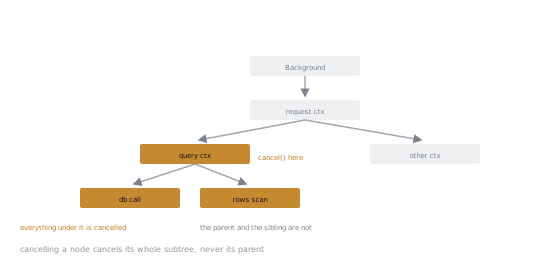
The shaded set is exactly the cancelled node and what hangs below it. Nothing above it and nothing beside it changes, which is why a handler can bound one query without touching the request it belongs to.
Always call cancel. defer cancel() immediately after the constructor is not optional politeness: until cancel runs, the child stays attached to the parent and the timer stays live. go vet's lostcancel check reports the ones it can see.
ctx.Err() says why it stopped, either context.Canceled or context.DeadlineExceeded, and both are matchable with errors.Is through any amount of wrapping.
The conventions
- First parameter, named
ctx, typedcontext.Context.func Get(ctx context.Context, id string) (*User, error). It goes first in every function that takes one. - Do not store it in a struct. A context describes one operation's lifetime; a struct outlives the operation. The narrow exception is a type whose whole purpose is one request, and it is rarer than people assume.
- Never pass nil. Use
context.Background()at the top ofmainand in tests, andcontext.TODO()to mark a call site you have not wired up yet. - Values are for request-scoped metadata, not for dependencies. A request id, a trace span, an authenticated subject. Not your database handle, your logger's configuration, or an optional argument. Those go in parameters or struct fields, where the compiler can see them.
- Keys must be an unexported type.
type ctxKey struct{}avoids collisions with other packages using the same string.
Cancellation is cooperative
Nothing is interrupted. A context being cancelled changes exactly one thing: a channel closes. Code that never checks keeps running to completion.
So every blocking operation needs a context-aware form, and the standard library provides them: db.QueryContext, http.NewRequestWithContext, net.Dialer.DialContext. A loop that computes rather than blocks has to check for itself:
for _, item := range items {
    if err := ctx.Err(); err != nil {
        return err
    }
    process(item)
}
This is where the Java instinct misleads. Thread.interrupt sets a flag the runtime honours at defined interruption points, and Future.cancel(true) acts on the task from the outside. A Go context has no reach into a running goroutine at all: cancellation propagates only as far as your code chooses to look.
Worth knowing
context.WithCancelCause (Go 1.20) attaches a reason, retrieved with context.Cause(ctx), so a timeout can say which timeout. context.WithoutCancel (Go 1.21) derives a context that keeps the values but drops the cancellation, for the audit write that must finish after the request is abandoned. context.AfterFunc (Go 1.21) registers a callback to run on cancellation, which is how you attach cleanup without a goroutine parked in a select.
Practice
-
▢ What is wrong with this?
ctx, _ := context.WithTimeout(context.Background(), time.Second)
rows, err := db.QueryContext(ctx, q)
Check
The cancel function is discarded, so the context stays attached to its parent and its timer stays live until the deadline passes. In a per-request path that accumulates into a leak, growing with traffic and disappearing when traffic stops, which makes it hard to reproduce.
Write ctx, cancel := ... followed by defer cancel(). go vet reports this one as lostcancel.
- ▢ A handler's context is cancelled when the client disconnects. Your handler is halfway through a 30-second CPU-bound loop. What happens?
Check
The loop runs to completion. Cancellation closes a channel; it does not interrupt anything.
To respond to it, the loop has to check ctx.Err(), or ctx.Done() in a select, at a granularity that makes sense for the work. This is the single most important difference from Thread.interrupt, which the runtime honours at defined points without the author writing anything.
-
▢ Which belongs in a
context.Value?- a) The database handle the request will query
- b) The trace id assigned to this request
- c) The retry count configured for this service
- d) The logger the handler should write to
Check
b) The trace id assigned to this request.
It is metadata about this one operation, it crosses layers that do not care about it, and no signature needs to mention it. The other three are dependencies or configuration: they belong in parameters or struct fields, where the compiler checks them and a reader can see them.
The rule of thumb: if leaving it out would be a compile error in a well-designed API, it does not belong in a context.
- ▢ A request times out after 2 seconds, but the goroutine it started keeps running for 30. Where is the bug?
Check
The goroutine was not given the context, or was given one derived from context.Background() instead of the request's.
Both break the tree, so cancellation stops at the boundary. Detaching is sometimes deliberate, for work that must outlive the request, and then the right tool is context.WithoutCancel(ctx), which says so explicitly and keeps the values.
- ▢ Interleaving Lesson 9:
db.QueryContextreturns an error after a timeout. How do you detect that it was the deadline?
Check
errors.Is(err, context.DeadlineExceeded). Drivers wrap it, so == fails and errors.Is walks the chain.
Distinguishing it matters operationally: a deadline means you gave up, and a context.Canceled usually means the client did. Those are different pages in a runbook, and the same 500 in a log if you do not separate them.
Real-world reps
- [ ] Write a handler that does a 5-second sleep in a loop, checking
ctx.Err()each second. Curl it and press ctrl-c mid-request. Watch it stop. - [ ] Remove the
ctx.Err()check and repeat. The handler now runs to completion after the client has gone. That is the shape of a service that cannot shed load. - [ ] Tomorrow: find a
go someWork()in a codebase you work with and check which context it receives. If it iscontext.Background(), ask whether that was a decision.
Going further
- Go Concurrency Patterns: Context, The Go Blog
contextpackage: read the package doc in full; it is short and it is the specification- Contexts and structs, The Go Blog: why it is a parameter and not a field
- Concurrency Patterns
- Resources
Not landing? Reread the primary source at the top, since this lesson compresses it and compression is where understanding leaks. Check the glossary for any term that felt slippery.
If the lesson itself is unclear rather than the material, that is a defect: open an issue.