Error Handling
Lookup sheet for lessons 8, 9, 10 and 12.
The interface
type error interface{ Error() string }
Error last in the result list. Checked immediately. No other result is valid when err != nil unless documented.
Creating
| Want | Write |
|---|---|
| fixed message | errors.New("connection closed") |
| formatted, no chain | fmt.Errorf("parse row %d: %v", i, err) |
| formatted, wrapped | fmt.Errorf("parse row %d: %w", i, err) |
| several at once | errors.Join(err1, err2), nil if all nil |
| sentinel | var ErrNotFound = errors.New("not found") |
Error strings: lowercase, no trailing punctuation. They get embedded in longer messages.
%w versus %v
| Situation | Verb |
|---|---|
| caller may match on the cause | %w |
| the cause is an implementation detail | %v |
| you are logging and stopping here | neither |
%w makes the wrapped error part of your API. Anything a caller can errors.Is or errors.As is a compatibility commitment.
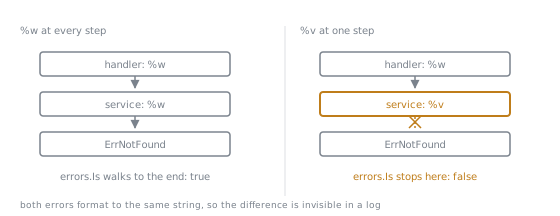
The chain is the whole mechanism, and %v is a pair of scissors. This is why the choice above is an API decision rather than a formatting one: both errors read the same in a log, print the same in a test failure, and differ only in an errors.Is result somewhere in a caller you may not own.
Matching
errors.Is(err, ErrNotFound)      // sentinel, anywhere in the chain

var verr *ValidationError
if errors.As(err, &verr) {       // note: pointer to the target variable
    use(verr.Field)
}
Never err == ErrNotFound: one added %w anywhere above breaks it silently.
errors.As panics if the second argument is not a pointer. That is deliberate.
Wrapping discipline
- Add context the error does not already carry: the operation and the identifier, not "failed to".
- Wrap once per meaningful layer, not once per function.
- Handle an error exactly once: either handle it and return nil, or return it and say nothing. Never log and return.
- Log where the error stops, in middleware or in
main.
Traps that compile
| Trap | Symptom | Fix |
|---|---|---|
| concrete error type in a return | err != nil always true | return error, declare var err error |
%v in a middle layer | errors.Is stops finding the sentinel | %w |
data, _ := ... | silent empty result | handle it, or comment why not |
return nil, nil | caller panics one line later | return a sentinel, or document it |
The nil interface trap
var p *MyError = nil
var err error = p
p == nil     // true
err == nil   // false, the interface holds a type
An interface is nil only when both its type word and value word are nil.
defer, panic, recover
- Arguments are evaluated at the
deferline; defer a closure to capture the variable. - Deferred calls run LIFO, on return and on panic.
deferis scoped to the function, not the block, so never in a loop over many resources.- A deferred closure can modify a named result. That is the idiom for annotating every error path at once.
Closeon a writer returns a real error; do not discard it.
func load(path string) (err error) {
    defer func() {
        if err != nil {
            err = fmt.Errorf("load %s: %w", path, err)
        }
    }()
    ...
}
panic is for programmer errors: impossible branches, startup invariants, template.Must. Not for expected failures.
recover works only in a function deferred directly by the panicking function, in the same goroutine. It cannot catch a fatal error (concurrent map writes, deadlock!).
Errors as HTTP status
One mapping function, not one per handler:
var verr *ValidationError
switch {
case errors.Is(err, store.ErrNotFound):
    return http.StatusNotFound
case errors.As(err, &verr):
    return http.StatusBadRequest
default:
    return http.StatusInternalServerError   // log the detail, do not return it
}
Translate third-party errors at the boundary. A repository returning sql.ErrNoRows puts database/sql in its API.