Slice and Map Mechanics
Lookup sheet for Lesson 3 and Lesson 4.
Slice header
| Word | Read with | Meaning |
|---|---|---|
| pointer | not exposed | where the elements start in the backing array |
| length | len(s) | how many elements this slice exposes |
| capacity | cap(s) | elements from the pointer to the end of the array |
s[low:high] → len = high-low, cap = cap(s)-low.
s[low:high:max] → len = high-low, cap = max-low.
Does an append alias the original?
| Condition | append behaviour | Original slice |
|---|---|---|
len(s) < cap(s) | writes into the existing array | modified |
len(s) == cap(s) | allocates, copies, returns new header | untouched |
Data-dependent, so never rely on it. Growth amount is unspecified and has changed between releases.
a := []int{1, 2, 3, 4, 5}
b := a[1:3]          // len 2, cap 4
b = append(b, 99)    // a is now [1 2 3 99 5]

c := a[1:3:3]        // len 2, cap 2
c = append(c, 99)    // allocates; a untouched
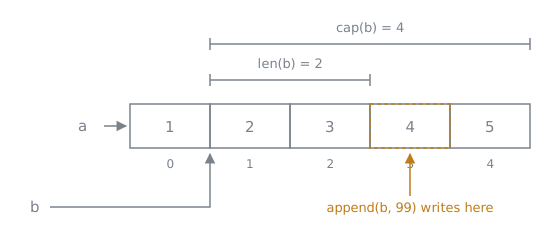
The spare capacity is the whole story: b may write four elements from where it starts, so the fourth one has somewhere to go, and that somewhere already belongs to a. The three-index form of c cuts the capacity to the length, which leaves no spare and forces the allocation.
Handing out a sub-slice safely
return s[0:2:2]        // capacity cut, caller's append must allocate
return slices.Clone(s[:2])  // always copies; costs an allocation
Slice operations
| Want | Write |
|---|---|
| copy elements | copy(dst, src), moves min(len(dst), len(src)) |
| independent copy | slices.Clone(s) |
| append another slice | s = append(s, other...) |
| delete index i | s = slices.Delete(s, i, i+1) |
| contains | slices.Contains(s, v) |
| sort | slices.Sort(s) or slices.SortFunc(s, cmp) |
| empty it, keep capacity | s = s[:0] |
Always s = append(s, x). The new length lives in the returned header.
nil versus empty slice
var s []int | s := []int{} | |
|---|---|---|
len, range, append | works | works |
s == nil | true | false |
| JSON marshal | null | [] |
| allocation | none | one |
Prefer nil. Return it for "no results".
Map rules
| Operation | nil map | Notes |
|---|---|---|
len(m) | 0 | safe |
m[k] | zero value | safe |
v, ok := m[k] | zero, false | safe |
range m | zero iterations | safe |
delete(m, k) | no-op | safe |
m[k] = v | panic | assignment to entry in nil map |
m := make(map[string]int)        // ready to write
m := make(map[string]int, 1000)  // pre-sized; a hint, not a capacity
Map gotchas
Iteration order is randomised per run. Sort for stable output:
for _, k := range slices.Sorted(maps.Keys(m)) { ... } // Go 1.23+
Elements are not addressable.
m["a"].N++          // compile error for map[string]Stat
m["a"]++            // fine, whole-element assignment
Fix with map[string]*Stat, or read-modify-write.
Concurrent access is a fatal error, not a recoverable panic:
fatal error: concurrent map writes
Best-effort detection: a clean run is not proof. Guard with a sync.Mutex.
Keys must be comparable. Numbers, strings, bools, pointers, channels, interfaces, and structs or arrays of those. Not slices, maps or functions. An interface key can panic at runtime if it holds a slice.
Map helpers
| Want | Write |
|---|---|
| keys as a sorted slice | slices.Sorted(maps.Keys(m)) |
| values | maps.Values(m), an iterator |
| copy | maps.Clone(m) |
| compare | maps.Equal(a, b) |
| empty it | clear(m) |