Lesson 2. Identity and Equality
Mission link: == on objects is the bug that passes every test on small input and fails in production, because the values that make it work are the ones a test happens to use.
Primary source: Object.equals, Java SE 25 API
Prerequisites: Lesson 1
Warm-up
- ▢ A method takes a
Listand callsclear()on it. Can the caller see that? Can the caller's variable be made to refer to a different list?
Check
Yes to the first: the method reaches the caller's object. No to the second: the parameter is a copy of the reference, so assigning to it changes nothing outside.
- ▢ What is a field of type
Stringset to before anything assigns to it?
Check
null. Fields get defaults, and the default for every reference type is null.
Know this
== compares what the variables hold (JLS 15.21.3). For primitives that is the value. For references that is the reference, so == asks "is this the same object" and nothing else.
equals is an ordinary method. Object's implementation is identity, so a class that does not override it gets == behaviour under a different name.
String a = new String("svc");
String b = new String("svc");
a == b          // false, two objects
a.equals(b)     // true, String defines equality by content
The string pool makes == look correct
String literals are interned: the compiler puts identical literals in a shared pool, so they are the same object.
String x = "svc";
String y = "svc";
x == y                          // true, both refer to the pooled literal

String z = new String("svc");
x == z                          // false, new String forces a distinct object

String w = "s" + "vc";          // constant-folded at compile time
x == w                          // true

String part = "s";
String v = part + "vc";         // built at run time
x == v                          // false
Every one of those lines is equals-true. The == results depend on whether the string happened to be created at compile time, which is not a property of your program's logic. Code that uses == on strings works until a value arrives from a file, a socket, or a database, and then it stops.
Integer caching makes == look correct too
Autoboxing turns an int into an Integer by calling Integer.valueOf, which is required to cache values from -128 to 127:
Integer small1 = 127, small2 = 127;
small1 == small2        // true, same cached object

Integer big1 = 128, big2 = 128;
big1 == big2            // false, two objects

big1.equals(big2)       // true
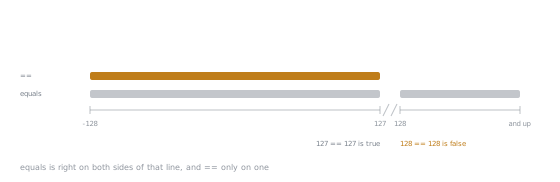
Two spans over the same line, and one of them ends. Where it ends is not a property of your data, it is where the cache stops.
So == on boxed integers is correct for small numbers and wrong for large ones. An id field is exactly where this bites, because ids grow past 127.
Mixing a boxed and a primitive type is different again: one operand is unboxed, so == compares numbers and behaves as you expect. That makes the rule harder to remember, not easier, so use the simple one: never write == between two reference types unless you mean identity.
The idioms to use instead
Objects.equals(a, b)                 // null-safe on both sides
"expected".equals(actual)            // constant first, so a null actual is false
status == Status.ACTIVE              // enums are singletons, so == is right here
Objects.equals returns true when both are null, false when exactly one is, and otherwise calls a.equals(b). It is the default choice.
For primitives, == is correct and the only option. For double, be aware that 0.1 + 0.2 == 0.3 is false, which is floating-point arithmetic rather than a Java quirk, and that Double.compare is what a comparator should use.
Practice
-
▢ Predict all four.
String a = "config";
String b = "config";
String c = new String("config");
String d = "con" + "fig";

System.out.println(a == b);
System.out.println(a == c);
System.out.println(a == d);
System.out.println(a.equals(c));
Check
true, false, true, true.
b and d are the pooled literal, since "con" + "fig" is folded by the compiler into a constant. c was explicitly constructed, so it is a distinct object with the same content.
The lesson is not the four answers. It is that three of them depend on how the string was built rather than on what it contains.
-
▢ Predict both, then say which line you would flag in review.
Integer x = 127, y = 127;
Integer p = 128, q = 128;
System.out.println(x == y);
System.out.println(p == q);
Hint
Autoboxing goes through Integer.valueOf, and that method has a documented cache with a documented range.
Check
true, then false.
Both lines get flagged. The first is worse than the second, because it works: a test written with small values passes, and the same code fails on real ids. Use x.equals(y), or better keep the values as int where no boxing happens at all.
-
▢ Which of these is safe when
inputmay benull?- a)
input.equals("yes") - b)
"yes".equals(input) - c)
Objects.equals(input, "yes") - d)
input == "yes"
- a)
Check
b) and c) are safe.
Option a throws NullPointerException. Option d does not throw and is wrong for a different reason: it compares identity, so it is false for any string that was not the pooled literal.
Between b and c, prefer c when either side may be null or when the constant-first form reads as a trick. Prefer b when you want no import and the constant is genuinely a constant.
- ▢ A cache is keyed by
Longaccount ids and misses constantly in production, while the unit tests pass. The lookup isif (key == cachedKey). Explain both halves of that: why the tests pass, and why production misses.
Check
The tests use small ids, in the range -128 to 127, where Long.valueOf returns cached objects, so == finds them equal.
Production ids are larger, so every boxing creates a distinct object and == is false however equal the numbers are. The fix is key.equals(cachedKey), or Objects.equals, or keeping the id as a long and comparing with == on primitives.
This shape, working on small input and failing on real input, is the reason the cache range exists as a trap at all.
- ▢ When is
==between two reference-typed expressions the correct thing to write?
Check
When identity is genuinely the question. Three real cases: comparing against null, comparing enum constants, and checking whether two references are the same object on purpose, for example to detect self-assignment or to short-circuit an expensive equals.
Enums are the one place == is idiomatic and preferred, because constants are singletons and == is null-safe where equals would need a guard.
Real-world reps
- [ ] Run the four string comparisons yourself, then add a fifth built by reading a line from standard input and compare it with
==andequals. Watching it fail on real input is the version that sticks. - [ ] Run the
Integerpair at127and128. Then read thevalueOfdocumentation and find where the cache range is stated. - [ ] Tomorrow: search code you know for
==next to aStringor a boxed type. Every hit is either a bug or an identity check that deserves a comment saying so.
Going further
Object.equals: the contract, which lesson 3 is entirely aboutInteger.valueOf: where the cache range is specifiedString: interning, and whatintern()actually does- JLS 15.21.3, Reference Equality Operators
- Equality, hashing and ordering: the reference sheet for this stage
- Resources
Not landing? Reread the primary source at the top, since this lesson compresses it and compression is where understanding leaks. Check the glossary for any term that felt slippery.
If the lesson itself is unclear rather than the material, that is a defect: open an issue.