Lesson 8. Records
Mission link: Modelling a domain in modern Java starts with reaching for a record before a class, since most immutable data is exactly a header plus a rule, and a record states that once instead of writing equals, hashCode and toString by hand.
Primary source: JEP 395: Records
Prerequisites: Lesson 3, Lesson 7
Warm-up
- ▢ What does the default
toStringa plain class inherits fromObjectprint, and why doesn't it tell you anything about the object's state?
Check
The class name followed by @ and the hash code in hexadecimal, for example Plain@2bea5ab4. It never mentions a field, because Object has no idea which fields exist or what they mean.
- ▢ In the
equals/hashCodecontract, what must be true ofhashCode()whenever two objects areequals()? Is the reverse also required?
Check
If x.equals(y) is true, x.hashCode() == y.hashCode() must also be true. The reverse is not required: two unequal objects may share a hash code. A record's generated hashCode satisfies this automatically, because it and equals are both derived from the same components.
Know this
The header generates a type
record Point(double x, double y) {}
That one line is the whole declaration, and the compiler expands it into a full type. Reflecting on the class shows exactly what appears:
field: private final double x
field: private final double y
ctor:  Point(double,double)
method: public final boolean Point.equals(java.lang.Object)
method: public final java.lang.String Point.toString()
method: public final int Point.hashCode()
method: public double Point.x()
method: public double Point.y()
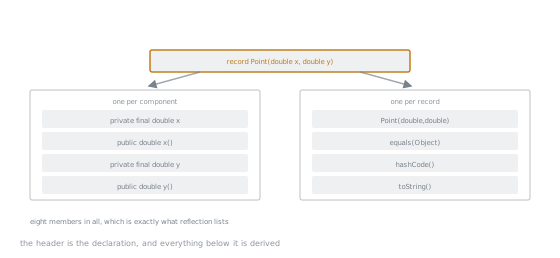
Four of the eight scale with the header's component list and four do not. Add a third component and the left column grows by two while the right column stays as it is.
A private final field per component, an accessor named for the component, never getX(), a canonical constructor taking every component in header order, and equals, hashCode and toString, all three declared final so nothing downstream can override just one of them. toString prints every component in header order, Point[x=1.0, y=2.0]. equals requires the same runtime type and every component equal; hashCode combines the components' hash codes, so equal records always hash the same. For a double component specifically, "equal" follows Double's boxed semantics rather than the == operator: two NaN values compare equal, and -0.0 does not equal 0.0, the opposite of what -0.0 == 0.0 gives as primitives. Every record also implicitly extends java.lang.Record, which is verifiable directly: Point.class.getSuperclass() reports class java.lang.Record. That is not a technicality, it is the reason a record cannot extend anything else, covered below.
The compact constructor: validate, then normalise
A compact constructor names no parameter list, because it reuses the header's, and it runs before the field assignments the compiler appends automatically:
record Range(int lo, int hi) {
    Range {
        if (lo > hi) throw new IllegalArgumentException(lo + " > " + hi);
        if (lo < 0) lo = 0;
    }
}
new Range(10, 1) throws, with the message 10 > 1 produced exactly as written. new Range(-5, 10) does not throw; it normalises, and lo() on the result reports 0. The line lo = 0 is doing the entire job: assigning to the parameter is what reaches the field, because the compiler's implicit this.lo = lo; runs after your code, using whatever the parameter holds by then. Writing this.lo = 0; instead does not work the way it looks like it should:
record Team(String name, List<String> members) {
    Team {
        this.members = List.copyOf(members);
    }
}
error: cannot assign a value to final variable members
        this.members = List.copyOf(members);
            ^
Inside a compact constructor the field is not yet assigned and is treated as a blank final you may not touch directly; only the implicit tail assignment may set it. The fix is to drop this.: members = List.copyOf(members);.
Static factories
A record's body can hold static methods exactly like a class's can, so a named construction path costs nothing extra:
static Range of(int lo, int hi) {
    return new Range(lo, hi);
}
There is nothing record-specific here beyond convenience: a factory can pick a more descriptive name than a bare constructor call, or centralise which overload gets used, without the caller ever seeing the canonical constructor directly.
What a record cannot do
A record is implicitly final: it cannot be subclassed, and nothing declares that explicitly. The grammar goes further and refuses an extends clause outright, a parse-level restriction rather than a later semantic check, record Bad(int x) extends Base {} fails with error: '{' expected at the point extends appears. That restriction exists because the single superclass slot is already spent on java.lang.Record. A record can implement interfaces, in the ordinary way:
interface Shape { double area(); }
record Circle(double r) implements Shape {
    public double area() { return Math.PI * r * r; }
}
A record also has no instance fields beyond its components. Declaring one is rejected, not silently ignored:
record BadRecord(int x) {
    private int y;
}
error: field declaration must be static
    private int y;
                ^
  (consider replacing field with record component)
A static field is fine; only per-instance state beyond the header is closed off.
The mutable-component trap
A record's generated equals compares components with their own equals, and for a reference component that is whatever that type defines, which is where an array component goes wrong: array equals is identity, not content.
record Holder(int[] data) {}

Holder h1 = new Holder(new int[]{1, 2, 3});
Holder h2 = new Holder(new int[]{1, 2, 3});
h1.equals(h2);              // false: different array objects
h1.toString();               // Holder[data=[I@7f010382]
Two holders built from separately allocated, identical-content arrays are not equal, and printing one shows the array's identity-based toString, not its contents. A record does not special-case arrays to fix either problem.
A List component fares better on comparison, since List.equals is structural, but it introduces a different failure: mutability that outlives construction. A defensive copy in the compact constructor closes the door the caller came in through, but not necessarily the one the accessor opens on the way out.
record Team(String name, List<String> members) {
    Team { members = List.copyOf(members); }   // unmodifiable snapshot
}

List<String> src = new ArrayList<>(List.of("Ann", "Bo"));
Team team = new Team("Core", src);
src.add("Cy");                        // mutate the source after construction
team.members();                       // [Ann, Bo], unaffected
team.members().add("Dee");            // throws UnsupportedOperationException
List.copyOf happens to close both leaks at once, because its result is both a snapshot and unmodifiable. Swap it for a plain defensive copy and the second leak reopens:
record LeakyTeam(String name, List<String> members) {
    LeakyTeam { members = new ArrayList<>(members); }   // copy, but still mutable
}

List<String> src2 = new ArrayList<>(List.of("Ann", "Bo"));
LeakyTeam leaky = new LeakyTeam("Core2", src2);
src2.add("Cy");                       // still doesn't show: [Ann, Bo]
leaky.members().add("Dee");           // succeeds: [Ann, Bo, Dee]
The constructor's copy stopped the caller's own list from reaching in. It did nothing to stop the generated accessor from handing back that same mutable list by reference, which is the remaining leak: whatever holds the reference members() returns can mutate the record after the fact. Closing it means the accessor has to change too, not just the constructor:
record SafeTeam(String name, List<String> members) {
    SafeTeam { members = new ArrayList<>(members); }
    public List<String> members() { return List.copyOf(members); }   // override
}
safeTeam.members().add(...) now throws, because every call hands out a fresh unmodifiable snapshot rather than the field itself. The same shape applies to an array component: a compact constructor that does data = data.clone(); still leaves the accessor returning the live internal array unless the accessor is overridden to clone on the way out too. This is a partial pattern for one trap, not the general immutability recipe, which is its own lesson.
Local records
A method body can declare a record scoped to that block, finalised alongside pattern matching for instanceof in the same release:
void main() {
    record Pair(int a, int b) {}
    Pair p = new Pair(1, 2);
    System.out.println(p);   // Pair[a=1, b=2]
}
Every generated member still applies; a local record is only a local record in the sense that its declaration is scoped, useful for a throwaway multi-value result or a grouping key that has no business existing outside one method.
When a record is the wrong choice
Three shapes push back on a record. Mutable state: a record has no setters and cannot grow them, every field is final, so a concept that genuinely changes in place after construction is fighting the type rather than being modelled by it. Identity that outlives the values: a database row or a long-lived entity where two objects sharing today's field values are not necessarily the same thing (its identity is a key, not its current state) wants the identity-flavoured equals a class gives you, not the structural one a record forces. Types that need subclasses: a record is implicitly final, so if the model genuinely needs to grow variants later, that door is already shut; a sealed interface of records is usually the shape that direction wants instead, and lesson 11 covers it.
Practice
-
▢ Predict the three outputs, and explain the last line against the first two.
record Point(double x, double y) {}
Point a = new Point(Double.NaN, 1.0);
Point b = new Point(Double.NaN, 1.0);
Point c = new Point(-0.0, 1.0);
Point d = new Point(0.0, 1.0);
System.out.println(a.equals(b));
System.out.println(c.equals(d));
System.out.println(-0.0 == 0.0);
Check
true, false, true.
Generated equals on a double component follows Double's boxed semantics, not the primitive == operator: NaN compares equal to NaN, and -0.0 does not compare equal to 0.0. The primitive == used directly on line three gives the opposite answer for the zeros, which is exactly why the two lines disagree.
-
▢ Find the bug, quote the message it produces, and give the one-line fix.
record Team(String name, List<String> members) {
    Team {
        this.members = List.copyOf(members);
    }
}
Hint
Inside a compact constructor, what is members before the compiler's own implicit assignment runs, and is this.members the same thing?
Check
error: cannot assign a value to final variable members. Inside a compact constructor the field behind this.members has not been assigned yet and cannot be assigned directly; only the compiler's implicit tail assignment may set it. The fix drops this.: members = List.copyOf(members);, assigning to the parameter, which the tail assignment then copies into the field.
-
▢ Predict what these two lines print.
record Holder(int[] data) {}
Holder h1 = new Holder(new int[]{1, 2, 3});
Holder h2 = new Holder(new int[]{1, 2, 3});
System.out.println(h1.equals(h2));
System.out.println(h1);
Hint
Compare what a record's generated equals does with two boxed Double components against what it does with two array components: both delegate to the component's own equals.
Check
false, then Holder[data=[I@...] with some hash suffix.
Array equals is identity, so two separately allocated arrays with the same content are never equal, and array toString never shows the contents either. A record does not special-case arrays to give either one deep behaviour.
-
▢
LeakyTeambelow copies itsmemberslist in the compact constructor, yet a caller can still mutate the stored list after construction. Name the one-line fix, and say why it has to touch the accessor rather than the constructor.record LeakyTeam(String name, List<String> members) { LeakyTeam { members = new ArrayList<>(members); } }
Check
Override the accessor to hand back a copy instead of the field itself: public List<String> members() { return List.copyOf(members); }. The constructor's copy only stops the caller's original list from reaching in; the generated accessor still returns the internal list by reference, so leakyTeam.members().add(...) mutates the record's own state. The constructor guards the door on the way in, the accessor is a separate door on the way out, and only overriding the accessor closes that one.
- ▢ A
Customertype carries a database-assignedidthat never changes and anamethat sometimes does. TwoCustomervalues with the sameidbut differentname(one stale, one freshly renamed) should be treated as the same customer. Is a record the right tool here? Justify the answer.
Check
No. A record's equals is structural, comparing every component, so a stale copy and a renamed copy of the same customer would compare unequal even though they represent one customer. What this type needs is identity keyed on id alone, which means writing equals and hashCode by hand around the key, the thing a record exists specifically to avoid writing. A record still works well for genuinely value-shaped pieces of the domain, such as an Address, just not for the entity whose identity outlives its current field values.
Real-world reps
- [ ] Find a class in code you own that is only a bag of fields with a hand-written
equals,hashCodeandtoString, and check whether every field could be a record component. - [ ] Write a record with a
Listcomponent, add a compact constructor that defensively copies it, then call the accessor directly and check whether the copy actually closed the leak. - [ ] Declare an instance field inside a record and read the compiler's rejection for yourself.
- [ ] Tomorrow: rewrite one real data-carrying class from your own code as a record, and note exactly which methods you got to delete.
Going further
- JEP 395: Records: the proposal that finalised records in Java 16
Record, Java SE 25 API: the implicit superclass every record extends- JLS §8.10, Record Classes: the exact rules the compiler enforces on a record header
- Modelling: the reference sheet for this stage
- Resources
Not landing? Reread the primary source at the top, since this lesson compresses it and compression is where understanding leaks. Check the glossary for any term that felt slippery.
If the lesson itself is unclear rather than the material, that is a defect: open an issue.