Lesson 20. Dates and Times
Mission link: Every service boundary carries a timestamp somewhere, a log line, a database column, a scheduled job, and reaching for the local-looking type when the job needed a point in time is how two machines that disagree about the time corrupt a customer's invoice without either one raising an exception.
Primary source: java.time, Java SE 25 API
Prerequisites: Lesson 14, Lesson 8
Warm-up
- ▢
LocalDate.of(2026, 8, 31).plusDays(10)does not change the object it was called on. What is a method shaped like that called, and what does the pattern buy a caller who never checks whether something else changed the date under them?
Check
It is a wither method: it returns a new instance with one part changed rather than mutating this one. The caller does not have to coordinate with anyone else holding a reference to the same object, because nothing holding that reference can ever observe it change.
- ▢ An enum's
values()method returns a fresh array on every call. Why does mutating the array you get back never affect the enum itself, and what does callingvalues()inside a loop cost?
Check
The array is a copy handed to you, not the enum's own storage, so nothing done to it reaches the constants. Calling values() inside a loop allocates a fresh array on every iteration, which is wasted work if the values were only ever going to be read.
Know this
Six types, six different questions
java.time gives you six point-in-time-shaped types, and the six exist because each answers a different question, not because six is a round number.
Instant: a count of seconds and nanoseconds since the epoch, with no calendar and no zone attached. This is what "a point in time" means once every human convention is stripped away, and it is the type to reach for whenever the question is when, exactly, on the one universal timeline.LocalDate: a calendar date with no time-of-day and no zone, such as a birthday or a public holiday, the same date everywhere because nobody asked what time it is where you are.LocalTime: a time-of-day with no date and no zone, such as "the shop opens at 09:00", true every day the shop is open, in whichever zone the shop happens to sit.LocalDateTime: a date and a time-of-day with no zone. It looks like a timestamp and is not one, which is the next section.ZonedDateTime: aLocalDateTimeplus aZoneId, a named region whose rules can change the offset on a date its legislature decides to change it. This is the type for what actually happened, in that place, correct across a daylight-saving transition.OffsetDateTime: aLocalDateTimeplus a fixedZoneOffset, with no region and no rules attached. Reach for it for a timestamp that needs a fixed offset for interchange, such as a log line or a wire format, where nobody downstream needs to know a region's daylight-saving rules.
The decision rule: universal instant, Instant. A date on a calendar with no time attached, LocalDate. A specific place's wall clock that has to keep meaning the same wall-clock moment across that place changing its clocks, ZonedDateTime. A timestamp that only needs a fixed offset for interchange, OffsetDateTime. LocalTime and LocalDateTime belong inside a day's schedule or a form field, never as the record of when something on a server actually happened.
The mistake LocalDateTime cannot warn you about
LocalDateTime is not a point in time, and this is the single most common mistake in this API, because the type reads like a timestamp and the compiler happily lets you build one, print it, and store it, right up until the moment you try to turn it into an Instant:
LocalDateTime ldt = LocalDateTime.now();
Instant i = ldt.toInstant();
error: method toInstant in interface ChronoLocalDateTime<D> cannot be applied to given types;
  required: ZoneOffset
  found:    no arguments
There is no zero-argument toInstant. LocalDateTime has no idea which timeline it sits on, so the compiler demands the missing piece rather than guessing it, and the required argument is itself the proof that a LocalDateTime alone was never enough. The same local reading means something different depending on where you stand:
LocalDateTime wall = LocalDateTime.of(2026, 6, 15, 12, 0);
Instant asLondon = wall.atZone(ZoneId.of("Europe/London")).toInstant();
Instant asTokyo = wall.atZone(ZoneId.of("Asia/Tokyo")).toInstant();
asLondon comes out as 2026-06-15T11:00:00Z and asTokyo as 2026-06-15T03:00:00Z, two different instants from one LocalDateTime, because "12:00" was never a claim about the universal timeline in the first place. Store a LocalDateTime as "when this happened" and every comparison across two services in different zones, or the same service after a deployment changes the default zone, is comparing numbers that were never on the same timeline to begin with.
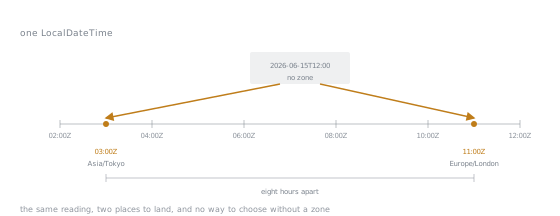
The reading itself is drawn off the line, because that is where it is: it names no point on the timeline until a zone is supplied, and the two zones here put it eight hours apart. The compiler's refusal above is that gap, caught before it becomes a stored value.
ZoneId against ZoneOffset
A ZoneOffset, such as +02:00, is a fixed difference from UTC and nothing else; it is also a ZoneId, since ZoneOffset extends ZoneId and an offset can be used anywhere a zone is asked for, confirmed with instanceof. A region-based ZoneId, such as America/New_York, is not fixed: it carries a table of rules that can hand back a different offset depending on the date asked about.
ZoneId ny = ZoneId.of("America/New_York");
ny.getRules().getOffset(LocalDateTime.of(2026, 1, 15, 12, 0));   // -05:00
ny.getRules().getOffset(LocalDateTime.of(2026, 7, 15, 12, 0));   // -04:00
Same zone, same method, two different offsets six months apart. A ZoneOffset alone can never do this, which is exactly why it is the wrong choice whenever daylight saving is part of the picture: it locks in whichever offset happened to be current when you wrote it down.
Duration against Period, and the day that was twenty-three hours long
Duration is an exact number of seconds and nanoseconds, the right unit for arithmetic on Instant and for measuring elapsed machine time. Period is years, months and days on a calendar, the right unit for arithmetic on LocalDate. Adding one calendar day is not the same operation as adding twenty-four hours, and a daylight-saving transition is where the difference stops being academic:
ZoneId ny = ZoneId.of("America/New_York");
ZonedDateTime start = ZonedDateTime.of(LocalDateTime.of(2026, 3, 8, 0, 30), ny);
ZonedDateTime byDuration = start.plus(Duration.ofDays(1));
ZonedDateTime byPlusDays = start.plusDays(1);
start is 2026-03-08T00:30-05:00. Clocks in America/New_York spring forward at 02:00 that night, so byDuration, which adds a genuine twenty-four hours of elapsed time, lands at 2026-03-09T01:30-04:00; byPlusDays, which adds one calendar day and keeps the same wall-clock reading, lands at 2026-03-09T00:30-04:00, one hour earlier. Between 00:30 on the 8th and 00:30 on the 9th, the wall clock in that zone only advanced twenty-three real hours, because one hour of it was skipped. plusDays and Period both follow the calendar and land on the same wall-clock time the next day; Duration follows the clock and does not care what the calendar called it.
The gap and the overlap
Springing forward creates a gap: a stretch of local time that never happens, because the clock jumped straight over it. Falling back creates an overlap: a stretch of local time that happens twice. ZonedDateTime.of(LocalDateTime, ZoneId) has to do something sensible with both.
LocalDateTime gapLocal = LocalDateTime.of(2026, 3, 8, 2, 30);
ZonedDateTime.of(gapLocal, ny);
// 2026-03-08T03:30-04:00[America/New_York]
02:30 on 8 March 2026 in America/New_York never happens, since the clock jumps from 02:00 straight to 03:00. Asked for it anyway, ZonedDateTime moves the requested time later by the length of the gap, one hour, and lands in the offset that applies after the jump.
LocalDateTime overlapLocal = LocalDateTime.of(2026, 11, 1, 1, 30);
ZonedDateTime.of(overlapLocal, ny);
// 2026-11-01T01:30-04:00[America/New_York]
01:30 on 1 November 2026 happens twice in that zone, once before the fall-back and once after, at offsets -04:00 and -05:00 respectively, both valid for that exact local reading. ZonedDateTime.of picks the earlier of the two, -04:00, as its documented default. withEarlierOffsetAtOverlap() and withLaterOffsetAtOverlap() exist for the cases where the default answer is the wrong one and the choice needs to be explicit rather than assumed.
Clock, so time is something you can inject
Instant.now() and LocalDate.now() read the system clock directly, which makes any code that calls them impossible to test without waiting for the calendar to cooperate. Every one of those now() methods has an overload that takes a Clock, and a class that asks for a Clock in its constructor rather than calling Instant.now() internally can be handed Clock.fixed in a test:
Clock fixed = Clock.fixed(Instant.parse("2026-01-01T00:00:00Z"), ZoneOffset.UTC);
LocalDate.now(fixed);   // 2026-01-01
Every run of that test sees the same instant, chosen by the test rather than by whichever moment happened to be current when it ran.
Formatting and parsing without reaching for a pattern
DateTimeFormatter has predefined constants, ISO_INSTANT, ISO_LOCAL_DATE, ISO_DATE_TIME and others, for the standard forms most interchange already uses, which is why a custom pattern is needed less often than it looks:
DateTimeFormatter.ISO_INSTANT.format(Instant.now());
// 2026-08-31T19:36:52.573162Z
Reach for DateTimeFormatter.ofPattern("...") for a genuinely custom shape, such as a display format for a user interface, and treat a hand-written pattern for anything that crosses a service boundary as a sign that one of the ISO constants was overlooked.
Instant.now(), and how precise it actually is in practice
Instant stores nanoseconds, but that is a claim about what the type can represent, not about what any given call to now() actually fills in. One observed run of Instant.now() produced a nano-of-second field ending in three zeros, 573162000, meaning the observed resolution that time was microseconds, not nanoseconds, even though the field has room for nanosecond precision. Treat the precision Instant.now() actually delivers as something to check where it runs rather than something the type's declared range promises.
Clamping at the end of the month
plusMonths clamps to the shorter month's last day when the starting day-of-month does not exist in the target month, and it does not remember the original day once it has clamped:
LocalDate.of(2025, 1, 31).plusMonths(1);                  // 2025-02-28
LocalDate.of(2025, 1, 31).plusMonths(1).plusMonths(1);     // 2025-03-28
31 January clamps to 28 February, since 2025 is not a leap year, and 28 February plus one month is 28 March, not 31 March: the second call has no memory of the 31st, only of the 28th it landed on. A recurring "last day of every month" job has to ask for that explicitly, with TemporalAdjusters.lastDayOfMonth(), rather than trust that repeated plusMonths calls will keep landing there.
java.util.Date and Calendar, named as legacy
java.util.Date and java.util.Calendar predate java.time (added in Java 8) and are mutable, badly named, thread-unsafe, and confuse a point in time with a calendar reading in ways java.time was written specifically to stop doing. They are still what some older APIs hand you or demand back, so the conversions matter more than the types themselves:
Date legacy = Date.from(instant);
Instant back = legacy.toInstant();
Calendar cal = GregorianCalendar.from(zonedDateTime);
Date.from and Date.toInstant() convert in both directions against Instant; GregorianCalendar.from(ZonedDateTime) and Calendar.toInstant() do the same for the calendar type. A Date, despite the name, is actually a thin wrapper around a single instant, which is worth knowing the one time it saves an argument about what the class is for.
Storing time
Store an instant, in UTC, as the fact of when something happened; Instant, or its equivalent as an epoch value, is what survives being read back on a different machine in a different zone with the same meaning intact. When the zone itself is part of the business rule, such as "run this job at 9am for this customer, in their zone, forever", storing a precomputed Instant is the wrong move, because the next daylight-saving transition moves 9am somewhere else while the stored instant stays put. Store the wall-clock time and the ZoneId separately, and recompute the ZonedDateTime, and the instant it resolves to, at the moment it is needed, so the daylight-saving rules that were current then are the ones applied.
Practice
-
▢ Predict what each line prints, and explain why they differ.
ZoneId ny = ZoneId.of("America/New_York");
ZonedDateTime start = ZonedDateTime.of(LocalDateTime.of(2026, 3, 8, 0, 30), ny);
System.out.println(start.plus(Duration.ofDays(1)));
System.out.println(start.plusDays(1));
Check
2026-03-09T01:30-04:00[America/New_York], then 2026-03-09T00:30-04:00[America/New_York].
Clocks in that zone spring forward one hour on the night of 8 March 2026. plus(Duration.ofDays(1)) adds a genuine twenty-four hours of elapsed time and lands an hour later on the wall clock than the calendar day would suggest. plusDays(1) follows the calendar instead, keeping the same wall-clock reading on the next date, which only took twenty-three real hours to arrive at because one hour of that night never happened.
-
▢ Find the bug.
LocalDateTime placedAt = LocalDateTime.now();
order.setPlacedAt(placedAt);
// later, on a different server, possibly in a different zone
if (order.getPlacedAt().isBefore(cutoff)) { ... }
Hint
Ask what LocalDateTime.now() actually knows about, and what it does not.
Check
LocalDateTime.now() reads the wall clock of whichever machine and default zone happen to be running the code, with no zone recorded alongside the reading, so placedAt and cutoff are only comparable if every server that ever touches this value runs in the same zone, forever. The fix is to record an Instant (Instant.now()) instead, which means the same point in time regardless of which server reads or writes it, and to convert to a local, zoned reading only at the edge where a human needs to see it in their own zone.
-
▢ Predict both lines.
LocalDate d = LocalDate.of(2025, 1, 31);
System.out.println(d.plusMonths(1));
System.out.println(d.plusMonths(1).plusMonths(1));
Check
2025-02-28, then 2025-03-28.
plusMonths clamps 31 January to the last day February actually has, 28 in 2025. The second call starts from that clamped 28th, not from the original 31st, so it lands on 28 March rather than 31 March. Clamping loses the original day-of-month rather than remembering it for later.
- ▢ A subscription has to renew at 9am local time for the customer, every month, forever, and the customer's zone observes daylight saving. Would you store the renewal moment as a precomputed
Instant, or as a wall-clock time plus aZoneId? Justify it.
Check
Store the wall-clock time and the ZoneId separately, and compute the ZonedDateTime, and the Instant it resolves to, at the point the job actually needs to run. A precomputed Instant freezes today's offset forever, so the first daylight-saving transition after it was stored moves the renewal to 8am or 10am on the customer's wall clock, which is exactly the failure this design is meant to avoid. The zone rules that matter are whichever ones are current at the moment the job runs, not whichever ones were current when the subscription was created.
- ▢
ZonedDateTime.of(LocalDateTime.of(2026, 3, 8, 2, 30), ZoneId.of("America/New_York"))is asked for a local time that does not exist, because the clock springs forward from 02:00 to 03:00 that night. Predict the result, and say what rule produced it.
Check
2026-03-08T03:30-04:00[America/New_York]. There is no valid offset for a local time inside the gap, so ZonedDateTime moves the requested reading later by the length of the gap, one hour, landing on the offset that applies after the transition rather than throwing or guessing at the offset before it.
Real-world reps
- [ ] Run the spring-forward comparison from practice 1 for a transition your own zone observes, and confirm which of
plus(Duration.ofDays(1))andplusDays(1)lands an hour ahead of the other. - [ ] Find a field in code you have named something like
createdAt,timestamporplacedAt, check its declared type, and decide whetherLocalDateTimeis quietly doing the job anInstantwas supposed to do. - [ ] Take a method that currently calls
Instant.now()orLocalDate.now()directly, change it to accept aClock, and write one test that passesClock.fixedinstead of waiting on the real calendar. - [ ] Tomorrow: pick a scheduled or recurring time in a system you own, a cron job, a renewal date, a reminder, and check whether it is stored the way practice 4 argues for.
Going further
java.time: the package overview, and the full list of types this lesson only covers six ofZonedDateTime: the gap and overlap rules, stated precisely, and the twowithXOffsetAtOverlapmethodsDateTimeFormatter: every predefined ISO constant, and the pattern letters for a custom one- Idiom and the library: the reference sheet for this stage
- Resources
Not landing? Reread the primary source at the top, since this lesson compresses it and compression is where understanding leaks. Check the glossary for any term that felt slippery.
If the lesson itself is unclear rather than the material, that is a defect: open an issue.