Equality, Hashing and Ordering
Lookup sheet for stage 1. The question it exists to answer: which comparison do I write, and what breaks if I get it wrong?
Which comparison to write
| Situation | Write | Not |
|---|---|---|
| two primitives | a == b | |
two double values, in a comparator | Double.compare(a, b) | a - b, a == b |
| two references, either may be null | Objects.equals(a, b) | a.equals(b) |
| a value against a constant | "active".equals(status) | status.equals("active") |
| two enum constants | a == b | a.equals(b) |
| checking for null | a == null | a.equals(null) |
| deliberate identity check | a == b, with a comment | |
two String or boxed values | Objects.equals(a, b) | a == b |
== on boxed types is correct for -128 to 127, because valueOf caches that range, and wrong above it. That is why it survives tests.
The equals contract
| Property | Requirement |
|---|---|
| reflexive | x.equals(x) is true |
| symmetric | x.equals(y) and y.equals(x) agree |
| transitive | equality chains |
| consistent | same answer while nothing relevant changes |
| null-rejecting | x.equals(null) is false, never throws |
Tied to it: x.equals(y) implies x.hashCode() == y.hashCode(). The reverse is not required.
| Violation | Symptom |
|---|---|
equals without hashCode | HashMap.get returns null for a key the map contains; HashSet holds duplicates |
constant hashCode | correct but every lookup degrades to a scan of one bucket |
non-final field in equals | entry stranded in the old bucket after a change |
instanceof plus a subclass with extra state | symmetry broken, collections disagree with themselves |
equals reads a null field without a guard | NullPointerException from a comparison |
Nothing in this table throws at the point of the mistake. That is what makes it a contract rather than a rule.
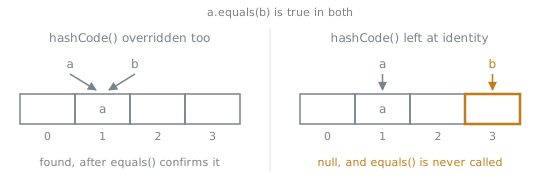
hashCode chooses the bucket and equals only compares what is already in it, so a wrong hashCode sends the lookup to a bucket the entry was never in. The comparison that would have said "yes" is never reached. That is why the first row of the table above fails silently: the map is not disagreeing with your equals, it is never asking it.
Keys
A hash key must be effectively immutable in every field equals and hashCode read.
| Candidate | Safe as a key |
|---|---|
record Id(long value) {} | yes |
String, boxed numbers, enum, LocalDate | yes |
record Tags(List<String> names) {} | no, the component is mutable |
any class with a non-final field in equals | no |
List, Set, Map | legal, and a mistake |
| a class that overrides neither | identity-keyed, rarely intended |
The ordering contract
For Comparable.compareTo and Comparator.compare, only the sign matters.
| Property | Requirement |
|---|---|
| antisymmetric in sign | sgn(compare(x, y)) == -sgn(compare(y, x)) |
| transitive | x > y and y > z implies x > z |
| consistent on ties | if compare(x, y) == 0, both compare alike against every z |
consistent with equals | recommended, not required, and see below |
| Violation | Symptom |
|---|---|
| ties between non-equal elements | TreeSet and TreeMap silently drop them as duplicates |
subtraction instead of compare | overflow reverses the result and breaks transitivity |
.reversed() at the end of a composed chain | reverses every key, not the last one |
| non-transitive comparator | IllegalArgumentException: Comparison method violates its general contract! |
| sorting by one comparator, searching with another | binarySearch returns nonsense, no exception |
Total order test: does the chain end in something unique per element? If not, a sorted collection loses data.
Composing comparators
Comparator.comparing(Order::customer)                     // by one key
          .thenComparing(Order::createdAt)                // tie-break
          .reversed();                                    // reverses BOTH keys

Comparator.comparing(Order::customer)
          .thenComparing(Order::createdAt,
                         Comparator.nullsLast(Comparator.reverseOrder()));
The two-argument thenComparing is how a reversal or a null policy applies to one key only.
Use comparingInt, comparingLong and comparingDouble to avoid boxing the extracted key.
Stability
| Sorting | Stable |
|---|---|
List.sort, Collections.sort | yes |
Arrays.sort on an object array | yes |
Arrays.sort on a primitive array | no, and unobservable |
Deciding in review
- Does the class override
equals? Then it must overridehashCode, and both must read only final fields. - Could it be a record? Then it probably should be, and the question becomes whether all components belong in equality.
- Is any instance of it used as a map key or a set member? Then apply the key table above.
- Does a comparator exist for it? Then check for a unique tie-breaker and for subtraction.
- Is anything sorted, then searched? Then check both operations use the same ordering.