Lesson 5. Collections Basics
Mission link: Lesson 2 established that val guarantees reference immutability, not object immutability, using a mutable list as the example without covering collections properly; this lesson is that coverage, and where Kotlin makes the object-mutability question explicit at the interface level instead of leaving it implicit.
Primary source: Docs: "Collections overview", Kotlin
Prerequisites: Lesson 2, Platform type
Warm-up
- ▢
val list = mutableListOf(1, 2, 3)followed bylist.add(4). Does this violateval's guarantee?
Check
No. val only guarantees list is never reassigned to point at a different list object; it says nothing about whether the object it points to can be mutated in place. Adding an element mutates the existing object rather than reassigning the reference.
- ▢ Why can Kotlin's basic types like
Intbe used as generic type arguments (List<Int>) the same wayStringcan?
Check
Because Int and the other basic types are real classes at the language level, not primitives, so they work as generic type arguments uniformly with String and any other type, with the JVM's boxing to java.lang.Integer hidden as a runtime detail.
Know this
Three collection shapes: List, Set, Map
List is an ordered collection accessed by integer index, and elements can repeat (a phone number's digits: ordered, repeats allowed). Set is a collection of unique elements with no significant order (lottery numbers: no duplicates, order doesn't matter). Map is a set of key-value pairs, with unique keys each mapping to exactly one value, though values themselves can repeat (an employee ID mapping to a position). Each shape fits a different question about the data: does order matter, can items repeat, do I need to look something up by a key.
Every collection type has a read-only interface and a mutable interface
Kotlin represents each of the three shapes as a pair of interfaces: a read-only interface (List, Set, Map) providing only element-access operations, and a mutable interface (MutableList, MutableSet, MutableMap) that extends the read-only one with write operations (adding, removing, updating elements). listOf(...) produces a read-only List; mutableListOf(...) produces a MutableList. This split is what makes "can this collection be mutated" a property of its declared type, checkable at the interface level, rather than something you have to infer from how a variable happens to be used elsewhere in the code.
A mutable collection held by val is still mutable, by design
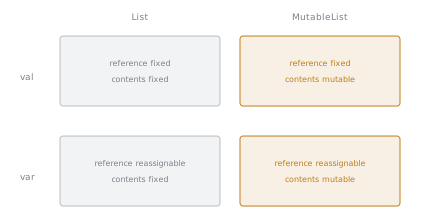
The Kotlin documentation is explicit about this, since it's a common point of confusion: a mutable collection doesn't need a var to remain mutable, and assigning one to val doesn't make its contents read-only. val protects the reference (this variable will always point to the same collection object); the mutable interface controls whether the object itself can be modified. The actual benefit of val nums: MutableList<Int> = mutableListOf(1, 2, 3) is narrower than it might look: it guarantees nobody reassigns nums to point at an entirely different list, while still allowing nums.add(4) throughout the code, exactly the composition lesson 2 introduced.
Read-only is not the same guarantee as immutable
A List (read-only interface) has no methods to add, remove, or update elements through that reference, but this doesn't mean the underlying collection can never change: if the same underlying collection is also reachable through a MutableList reference elsewhere (the same object, exposed through two different interface views), changes made through the mutable reference are visible through the read-only one too, since they're the same object. "Read-only" describes what a given reference's interface permits you to do, not an unbreakable guarantee that the data behind it never changes from anywhere in the program.
Practice
- ▢ Which collection shape fits "a group of unique tags applied to a post, where order doesn't matter," and which fits "the ordered sequence of steps in a recipe, where a step could repeat"?
Check
Unique tags with no meaningful order: Set. An ordered sequence where repeats are allowed and order matters: List.
- ▢ Why does declaring
val nums: MutableList<Int> = mutableListOf(1, 2, 3)still allownums.add(4)to compile and work?
Hint
Distinguish what val protects from what the mutable interface controls.
Check
val only guarantees nums is never reassigned to a different list object; whether the object's contents can be mutated is controlled entirely by its declared type being MutableList, which has an add method. The two are independent: val restricts reference reassignment, MutableList permits object mutation, and both apply simultaneously here.
- ▢ A function takes a parameter of type
List<Int>(read-only) and passes it around, relying on its contents never changing during the function's execution. Under what circumstance could this assumption still be wrong?
Check
If the same underlying collection object is also reachable through a MutableList reference elsewhere in the program (perhaps held by the caller, or another part of the code with access to the same object), a mutation made through that other reference is visible through the read-only List reference too, since they refer to the same object. The List interface only restricts what this particular reference can do; it doesn't guarantee the object itself is immutable everywhere.
- ▢ Contrast what
valguarantees with what theList/MutableListdistinction guarantees.
Check
val guarantees a reference is never reassigned to point at a different object; it says nothing about the object's own mutability. List versus MutableList guarantees whether a given reference's interface exposes methods to mutate the underlying object; it says nothing about reference reassignment. The two guarantees are independent and compose in all four combinations (val/var crossed with List/MutableList).
-
▢ Which claim correctly describes Kotlin's collection mutability model?
- a) Assigning a mutable collection to a
valmakes its contents read-only, the same as declaring it aList - b)
valrestricts reference reassignment;ListversusMutableListrestricts object mutation through a given reference; the two guarantees are independent and can be combined in any pairing - c) A
Listreference guarantees the underlying data can never change from any part of the program - d)
SetandMapdon't have a mutable counterpart, onlyListdoes
- a) Assigning a mutable collection to a
Check
b) That's the precise, composable pair of guarantees this lesson covers. (a) is false, and is exactly the common misconception the primary source calls out explicitly: val doesn't affect object mutability at all. (c) is false: a List reference only restricts what that specific reference can do, not whether the same underlying object is mutable via a different, MutableList reference to it. (d) is false: all three collection shapes have both a read-only and mutable interface pair (Set/MutableSet, Map/MutableMap).
Real-world reps
- [ ] Find a Kotlin function you've written or have access to that takes a
List,Set, orMapparameter. Confirm whether the read-only interface is actually sufficient for what the function does, or whether it secretly needs mutation and should take the mutable interface instead. - [ ] Find a
valholding aMutableList,MutableSet, orMutableMap. Confirm you can explain precisely what is and isn't guaranteed about it, without looking it up. - [ ] Tomorrow: read the primary source's section distinguishing collection types in full, and note one operation available on the mutable interface that isn't available on the read-only one for each of
List,Set, andMap.
Going further
Not landing? Reread the primary source at the top, since this lesson compresses it and compression is where understanding leaks. Check the glossary for any term that felt slippery.
If the lesson itself is unclear rather than the material, that is a defect: open an issue.