Lesson 33. Generics and Variance
Mission link: Stage 7 closes here. Shipping something typed means writing signatures other people rely on, and variance is the part of a signature that says what a caller may and may not do with it.
Primary source: Docs: "Generics: in, out, where", Kotlin
Prerequisites: Lesson 32, Lesson 16, Lesson 5
Warm-up
- ▢
viewModelScopeandLaunchedEffectboth give you a scope that cancels itself. What is the difference?
Check
Which lifetime each follows. viewModelScope is cancelled when the ViewModel is cleared. LaunchedEffect is tied to the composition: it starts when the composable enters, is cancelled when it leaves, and relaunches when a key changes. The two diverge whenever a composable leaves the screen while its ViewModel lives on, and the composition can also hold a composable the user cannot see.
- ▢ Why does a function that checks
x is Thave to beinlinewith areifiedtype parameter?
Check
Type arguments are erased, so an ordinary generic function has no T at runtime to test against. inline copies the body into the call site, where the concrete type is known, and reified tells the compiler to substitute it there. Erasure is the constraint the whole feature exists to work around, and it is about to matter again.
- ▢ What is the difference between
ListandMutableList, in terms of what each lets a holder do?
Check
List is the read-only interface: you can get elements and ask its size, but there is no add or set on it. MutableList adds those. Read-only is a property of the interface you hold rather than of the object, so a MutableList handed out as a List is still mutable by whoever kept the other reference.
Know this
Kotlin has no wildcards. The documentation is direct about it: the wildcard types are one of the trickiest parts of Java's type system, Kotlin does not have them, and what it has instead is declaration-site variance and type projections (Generics).
Start with why Java needed them. Java's generic types are invariant, so List<String> is not a subtype of List<Object>, and that invariance is protecting you: if the assignment were allowed you could add an Integer to a list of strings and get a ClassCastException on the way out. The cost is that a perfectly safe operation stops compiling, which is why Collection.addAll is not declared to take a Collection<E> but a collection with an extends-bound instead. The fix works, and it has to be written at every use site that wants the flexibility.
Declaration-site variance states the fact once, where the type is declared. If a type parameter is only ever produced by a class's members and never consumed, say so with out, and the compiler will both enforce it and reward it. The rule, as the docs put it: when a type parameter T of a class C is declared out, it may occur only in the out-position in the members of C, but in return C<Base> can safely be a supertype of C<Derived>.
So interface Source<out T> { fun nextT(): T } makes val objects: Source<Any> = strs legal for a Source<String>, with no annotation at the use site and nothing for the caller to remember. in is the mirror image, for a parameter that is only consumed: the standard library's Comparable<in T> is why a Comparable<Number> can be used where a Comparable<Double> is wanted.
The Java mnemonic still applies, and the docs quote it from Effective Java: Bloch names read-only objects Producers and write-only ones Consumers, and offers PECS, Producer-Extends Consumer-Super. Kotlin's version needs no mnemonic because the words are the keywords. A producer is out. A consumer is in.
This is also the answer to warm-up 3. Kotlin's List is declared with an out element type, which is why List<String> simply is a List<Any>, while MutableList has an add and therefore cannot be, so it stays invariant. The variance you have been relying on since lesson 5 was declared for you.
Type projections are the use-site tool, for when declaration-site is impossible. Some classes genuinely both produce and consume: Array<T> has a get and a set, so it can be neither co- nor contravariant, and consequently Array<Int> is not a subtype of Array<Any>. To pass one anyway, project the parameter at the point of use: fun copy(from: Array<out Any>, to: Array<Any>). from is now a restricted array on which only the methods returning T can be called, which corresponds to Java's extends-bounded wildcard while being, in the docs' words, slightly simpler. in projects the same way for the write-only direction.
Star projections, for when you know nothing about the argument. Foo<*> gives a projection that every concrete instantiation is a subtype of, and what it means depends on how the parameter was declared:
| Declaration | Foo<*> means | Which lets you |
|---|---|---|
Foo<out T : TUpper> | Foo<out TUpper> | Read values of TUpper |
Foo<in T> | Foo<in Nothing> | Write nothing safely |
Foo<T : TUpper> (invariant) | Foo<out TUpper> for reads, Foo<in Nothing> for writes | Read, but not write |
Each parameter projects independently, so for interface Function<in T, out U>, Function<*, String> means Function<in Nothing, String> and Function<Int, *> means Function<Int, out Any?>. The docs' own summary is the one to remember: star projections are very much like Java's raw types, but safe.
How to read the error message. When you use a projection, the compiler represents the unknown concrete type as a captured type, which you cannot write down yourself and will only meet in diagnostics as something like CapturedType(out X). Reads use the captured type's upper bound and writes use its lower bound, which is exactly why Array<out CharSequence> lets you call get and rejects set: the lower bound is Nothing, so no value is safe to write. Recognising that phrase in an error message turns a confusing diagnostic into a statement of what you asked for.
Constraints, briefly. An upper bound is the common one, fun <T : Comparable<T>> sort(list: List<T>), corresponding to Java's extends. The default upper bound is Any?, only one may sit inside the angle brackets, and further bounds need a where clause whose conditions must all hold at once.
Practice
- ▢
interface Repository<out T> { suspend fun findAll(): List<T> }. Say what theoutpromises, what it buys the caller, and what happens if someone addssuspend fun save(item: T).
Check
It promises that T appears only in out-positions: the interface produces T values and never accepts one. What it buys is subtyping, so a Repository<Dog> can be passed where a Repository<Animal> is expected, with nothing written at the call site. Adding save(item: T) puts T in an in-position and the declaration stops compiling, which is the useful part: the variance annotation is a constraint the compiler holds you to, so the day someone tries to turn a producer into a consumer, the build tells them what they are breaking rather than leaving every caller to find out.
- ▢
List<String>can be passed where aList<Any>is expected.MutableList<String>cannot be passed where aMutableList<Any>is expected. Why the difference?
Hint
Ask which of the two interfaces has a method that takes an element as a parameter.
Check
List declares its element type out, because it only ever produces elements: get returns one and nothing accepts one. That declaration makes List<String> a subtype of List<Any>. MutableList has add, which consumes an element, so its parameter cannot be out and the interface is invariant. The consequence is worth seeing concretely: if MutableList<String> were assignable to MutableList<Any>, you could add(1) through the second reference and then read an Int out of a list of strings. The read-only and mutable split from lesson 5 is not just about who may mutate; it is what makes one of the two safely covariant.
- ▢
val array: Array<out CharSequence> = arrayOf("Kotlin"). Predict what happens forarray.get(0)and forarray.set(0, "New value"), and explain both with one rule.
Check
get(0) compiles and gives you a CharSequence. set(0, "New value") does not compile: the receiver's type carries an out projection, which prohibits the member that takes T as a parameter. One rule covers both: the compiler represents the projected argument as a captured type and uses its upper bound for reads and its lower bound for writes. Here the upper bound is CharSequence, so reading gives you one, and the lower bound is Nothing, so no value at all is safe to write. Projecting with out is precisely a promise not to write, so the error is the promise being kept.
- ▢ For
interface Function<in T, out U>, what doFunction<*, String>,Function<Int, *>andFunction<*, *>each mean?
Check
Function<in Nothing, String>, Function<Int, out Any?>, and Function<in Nothing, out Any?>. Each parameter projects independently and each one projects according to how it was declared: a contravariant parameter becomes in Nothing, since with the type unknown there is nothing safe to pass in, and a covariant one becomes out its upper bound, since reading the most general type is always safe. That is what makes a star projection unlike a Java raw type despite the resemblance: the unknown is replaced by the safest bound rather than by a hole in the type system.
-
▢ Which claim about declaring
outon a type parameter is correct?- a) Declaring out on a type parameter lets the class produce and consume it
- b) Declaring out restricts the parameter to out-positions, and buys the subtyping in return
- c) Declaring out is Kotlin's spelling of a wildcard, written at each use site
- d) Declaring out has no effect on subtyping, and only documents the author's intent
Check
b) is the bargain exactly: accept the restriction and the compiler grants that C<Base> may be a supertype of C<Derived>. (a) inverts the restriction, which is the thing being given up. (c) confuses the two mechanisms: the use-site tool is a type projection, and the point of declaration-site variance is that it is stated once at the declaration instead. (d) demotes a checked constraint to a comment; the compiler both enforces it and rewards it, which is why adding a consuming method to an out parameter is a compile error rather than a style problem.
- ▢ Stage capstone. You are reviewing three types in a service.
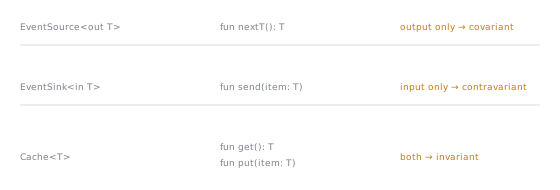
EventSource<T>only returns events.EventSink<T>only accepts them.Cache<T>both stores and returns them. For each, decide between declaration-site variance, a use-site projection, or staying invariant, and say what your choice promises the callers.
Check
EventSource<out T>. It only produces, so declare it once at the declaration: callers get EventSource<OrderEvent> usable wherever an EventSource<DomainEvent> is wanted, and the compiler stops anyone later adding a method that takes a T.
EventSink<in T>. It only consumes, so the mirror applies: a sink that accepts any DomainEvent is usable where a sink of OrderEvent is required, because anything you would hand it is already acceptable.
Cache<T>, invariant, with projections at the use site where a particular function needs one. It has both a get and a put, so it is Array all over again and neither annotation is available. A function that only reads takes Cache<out T>, a function that only writes takes Cache<in T>, and each of those signatures then documents which half of the cache it touches.
The general shape of the answer: variance is not a property you add for flexibility, it is a statement about direction, and the direction is decided by whether the type parameter appears in returns, in parameters, or in both. Get that question right and the annotation follows. Reach for a projection first and you end up writing the same wildcard at every call site, which is the Java situation the language was designed to avoid.
An answer worth challenging is one that makes Cache covariant "because we only read from it today". That is a promise about the current call sites, not about the type, and the first put will either break it or force it to be quietly removed.
Real-world reps
- [ ] Look up how
List,MutableList,ComparableandFunction1declare their type parameters in the standard library. For each, predict the annotation from what the interface does before you check. - [ ] Find a generic type in code you have access to whose parameter is used in only one direction. Decide whether adding
outorinwould break any existing call site, and what it would buy. - [ ] Tomorrow: find a compiler diagnostic in your own work that mentions a projection or a captured type. Rewrite the error in your own words as a statement about reads and writes, then check whether the fix follows from it.
Going further
Not landing? Reread the primary source at the top, since this lesson compresses it and compression is where understanding leaks. Check the glossary for any term that felt slippery.
If the lesson itself is unclear rather than the material, that is a defect: open an issue.