Lesson 6. Functions and Arguments
Mission link: The mutable default argument is the best-known trap in the language, and it is only the visible half. The other half is that every function receiving a container can change the caller's data.
Primary source: The Python Tutorial, Default Argument Values
Prerequisites: Lesson 1, Lesson 2, Lesson 5
Warm-up
- ▢ Why is
timeout = timeout or 30a bug when0is a legal timeout?
Check
or tests truthiness and 0 is falsy, so the explicit zero is replaced by the default. 30 if timeout is None else timeout asks the right question.
- ▢
backup = dict(config), thenconfig["tags"].append("x"). Doesbackupsee the new tag?
Check
Yes. dict(config) is a shallow copy, so both dictionaries refer to the same list.
Know this
Parameters follow the same rule as any other name: calling a function binds its parameter names to the caller's objects. Nothing is copied.
def add_one(items):
    items.append(1)         # mutates the caller's list

def replace(items):
    items = [1]             # rebinds a local name, caller unaffected
The first function changes the caller's data. The second does not, and the difference is exactly the one from lesson 1: mutation reaches the object, rebinding moves a name. A function that mutates its arguments is not wrong, but it is part of its contract, and it belongs in the docstring.
Default values are evaluated once
The default expression runs when the def statement executes, not on each call. One object is created and reused for the life of the function:
def append_to(item, target=[]):     # BUG
    target.append(item)
    return target

print(append_to(1))     # [1]
print(append_to(2))     # [1, 2]   the same list, still there
The list was created once, when the function was defined, and it accumulates across every call that omits the argument. The same applies to {}, to set(), and to anything else mutable.
The fix is always the same shape:
def append_to(item, target=None):
    if target is None:
        target = []
    target.append(item)
    return target
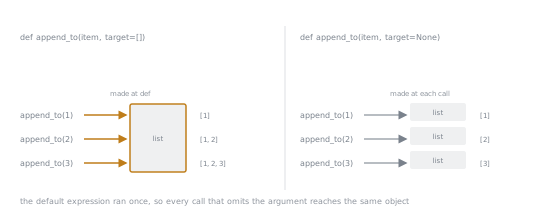
The convergence on the left is the bug drawn out: three calls, one object. Nothing in the body changed between the two versions except where the list comes from.
This is also why datetime.now() as a default is wrong: it is evaluated at import time, so every caller gets the moment the module loaded.
Immutable defaults are safe, because there is nothing to accumulate: def f(x=0), def f(name=""), def f(point=(0, 0)).
How arguments are matched
def send(body, *, retries=3, timeout=None):
    ...
- Positional or keyword by default:
send("hi")orsend(body="hi"). *in the signature makes everything after it keyword-only. Callers must writesend("hi", retries=5), which keeps a call site readable and lets you reorder those parameters later without breaking anyone./in the signature makes everything before it positional-only, which mostly matters when writing library code that mirrors built-ins.*argscollects extra positional arguments into a tuple,**kwargscollects extra keyword arguments into a dict.
At the call site, * and ** unpack instead of collecting:
args = ("hi",)
opts = {"retries": 5}
send(*args, **opts)         # same as send("hi", retries=5)
A useful default when designing: make anything optional keyword-only. send("hi", 5, None) tells a reader nothing, and send("hi", retries=5) tells them everything.
Closures capture names, not values
A function defined inside another function sees the enclosing variable itself, looked up when the inner function runs:
funcs = [lambda: i for i in range(3)]
print([f() for f in funcs])         # [2, 2, 2]
Every lambda refers to the same i, and by the time any of them is called the loop has finished with i at 2. This is called late binding, and it appears whenever functions are built in a loop: callbacks, handlers, retry wrappers.
Bind the value explicitly with a default argument, which is evaluated at definition time and therefore captures the current value:
funcs = [lambda i=i: i for i in range(3)]
print([f() for f in funcs])         # [0, 1, 2]
The two facts in this lesson combine here: the trap of default-evaluation-at-definition is also the tool that fixes late binding.
Practice
-
▢ Predict all three lines of output.
def collect(x, into=[]):
    into.append(x)
    return into

print(collect(1))
print(collect(2))
print(collect(3, into=[]))
Hint
Ask how many list objects this code creates, and when each one is created.
Check
[1], then [1, 2], then [3].
Two lists exist. The default was created once when def ran, and the first two calls share it. The third call passed its own list, so it is unaffected and the shared default still holds [1, 2].
-
▢ Which of these functions can change what the caller sees? Answer for each.
def a(items): items.append(1)
def b(items): items = items + [1]
def c(items): items += [1]
def d(items): items = list(items); items.append(1)
Check
a and c change the caller's list. b and d do not.
c is the one worth pausing on: += on a list extends in place, so it mutates the caller's object even though the line looks like an assignment. d shows the deliberate version, taking a copy first, which is how you write a function that promises not to touch its input.
-
▢ Rewrite this signature so that the two optional arguments cannot be passed positionally, and say what that buys.
def fetch(url, retries=3, timeout=10):
    ...
Check
def fetch(url, *, retries=3, timeout=10):
    ...
It buys two things. Call sites become self-describing, since fetch(url, retries=5) cannot be confused with fetch(url, 5) meaning something else. And the order of the keyword-only parameters stops being part of the API, so they can be reordered or extended without breaking callers.
-
▢ What does this print, and what is the minimal change that makes it print
0 1 2?handlers = [] for i in range(3): handlers.append(lambda: print(i, end=" ")) for h in handlers: h()
Check
It prints 2 2 2.
All three lambdas close over the same i, which is 2 once the loop has finished. The minimal change is lambda i=i: print(i, end=" "), which evaluates the default at definition time and captures each value.
functools.partial(print, i, end=" ") is the same idea with the intent stated more clearly, and it is what to reach for when the callback is a real function rather than a lambda.
-
▢ You are reviewing this function. Name two defects and the input that exposes each.
def register(name, tags=[], config={}):
    tags.append(name)
    config.setdefault("names", []).append(name)
    return tags, config
Check
Both defaults are mutable and shared. Calling register("a") and then register("b") returns (['a', 'b'], {'names': ['a', 'b']}) from the second call, because both defaults have accumulated across calls. Any two calls that omit the arguments expose it.
Both are also mutated in place, so a caller who does pass its own tags list has that list modified as a side effect. Passing a list you still hold elsewhere exposes that one.
The fix covers both: default to None, build a fresh object when it is None, and either document the mutation or copy the input.
Real-world reps
- [ ] Write the
collectfunction with the mutable default and call it four times without arguments. Then addprint(collect.__defaults__)and watch the default itself grow. Seeing where the list lives is what makes this permanent. - [ ] Reproduce the late-binding loop, fix it with
i=i, then fix it again withfunctools.partialand decide which you would rather read in six months. - [ ] Tomorrow: grep code you know for
=[]and={}in function signatures. Then look for functions that mutate an argument without saying so in the docstring, which is the same bug with no linter to catch it.
Going further
- Default Argument Values: the tutorial's warning, and the standard workaround
- Keyword-only arguments:
/and*in signatures, with the reasoning for each - Call by reference, in the FAQ: the official answer to "how does Python pass arguments"
- Resources
Not landing? Reread the primary source at the top, since this lesson compresses it and compression is where understanding leaks. Check the glossary for any term that felt slippery.
If the lesson itself is unclear rather than the material, that is a defect: open an issue.