Lesson 11. Context Managers
Mission link: Every resource that has to be released, every setting that has to be restored, and every temporary state that has to be undone is the same problem, and Python has one construct for all of them. Recognising the pattern is what stops try/finally from spreading.
Primary source: The Python Language Reference, The with statement
Prerequisites: Lesson 9, Lesson 10
Warm-up
- ▢ Lesson 10: what does
finallyguarantee that anexceptclause does not?
Check
It runs on every path out of the block: success, a handled exception, an unhandled one still propagating, and a return or break inside the try.
- ▢ Lesson 9 put a
with open(...)inside a generator. When does the file close if the caller abandons the generator halfway?
Check
When the generator is closed or collected, which CPython usually does promptly and does not promise. This lesson gives the deliberate version.
Know this
with is try/finally with a name. This:
with open(path) as f:
    data = f.read()
is this:
manager = open(path)
f = manager.__enter__()
try:
    data = f.read()
finally:
    manager.__exit__(*sys.exc_info())
Two methods make an object usable this way.
__enter__(self) runs on entry, and its return value is what as binds. That is worth stating separately, because it is not necessarily the manager. A file returns itself, so f is the file. threading.Lock.__enter__ returns the result of acquire, so with lock as x binds True, which is why nobody writes the as there.
__exit__(self, exc_type, exc, tb) runs on exit. The three arguments are None, None, None on a clean exit and describe the exception otherwise. Returning a truthy value suppresses that exception; returning None lets it propagate, which is what almost every __exit__ should do.
Writing one with a generator
The everyday way is a generator plus a decorator. Everything before the yield is entry, everything after is exit, and the yields value is what as binds:
from contextlib import contextmanager

@contextmanager
def timed(label):
    start = time.perf_counter()
    try:
        yield                          # the body of the with block runs here
    finally:
        log.info("%s took %.3fs", label, time.perf_counter() - start)
with timed("import"):
    run_import()
The try/finally inside is not optional. Without it, an exception in the caller's block propagates out of the yield and the cleanup never runs. That is the one thing to get right in a generator-based manager, and forgetting it produces a manager that works in every test and leaks in production.
To bind something, yield it:
@contextmanager
def temporary_table(conn, name):
    conn.execute(f"CREATE TEMP TABLE {name} (id bigint)")
    try:
        yield name
    finally:
        conn.execute(f"DROP TABLE {name}")
A generator-based manager is single-use. Each with needs a fresh call, because the generator it built is an iterator and lesson 9 applies. When a manager must be entered twice, or nested inside itself, write a class.
Writing one as a class
class Transaction:
    def __init__(self, conn):
        self.conn = conn

    def __enter__(self):
        self.conn.execute("BEGIN")
        return self.conn

    def __exit__(self, exc_type, exc, tb):
        if exc_type is None:
            self.conn.execute("COMMIT")
        else:
            self.conn.execute("ROLLBACK")
        return None                    # never swallow: the caller must know
The exc_type is None test is the reason to reach for a class: entry and exit differ by outcome, not just by cleanup. Note the explicit return None, and note how easy the bug is: return True here would roll back and then tell the caller everything succeeded.
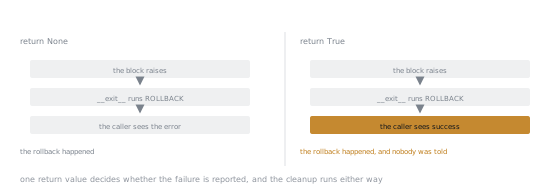
The first two steps are identical in both columns. The rollback is not what changes; what changes is whether anyone downstream is allowed to know it happened.
Several at once
with open(src) as fin, open(dst, "w") as fout:
    fout.write(fin.read())
Left to right on entry, right to left on exit, and the second open is protected by the first, so a failure there still closes fin. Parenthesised across lines is legal from Python 3.10:
with (
    open(src) as fin,
    open(dst, "w") as fout,
):
    ...
When the number is not known until runtime, ExitStack collects them:
from contextlib import ExitStack

with ExitStack() as stack:
    files = [stack.enter_context(open(p)) for p in paths]
    merge(files)                       # every file closed on the way out
ExitStack also solves the conditional case, where a resource is only sometimes needed, without an if around the whole block.
What contextlib already contains
| Tool | Use |
|---|---|
contextmanager | the decorator above |
suppress(ExcType) | a named narrow except: pass, from lesson 10 |
closing(thing) | wraps an object that has close but no __exit__ |
nullcontext(value) | a manager that does nothing, for the optional-resource branch |
redirect_stdout(f) | captures prints from code you cannot change |
chdir(path) | changes the working directory and restores it, from Python 3.11 |
ExitStack | a dynamic number of managers |
nullcontext is the one that removes real duplication:
with (open(path) if path else nullcontext(sys.stdin)) as f:
    process(f)
The pattern, stated once
Anything with a paired operation belongs in a context manager: open and close, acquire and release, begin and commit, set and restore, mkdir and remove, patch and unpatch, connect and disconnect. If the pair is spelled out at two different indentation levels in a function, a manager will delete more code than it adds.
Async has its own pair, __aenter__ and __aexit__, used through async with. Stage 6 covers it. The rules above transfer unchanged.
Practice
-
▢ What is wrong with this manager, and when does it show up?
@contextmanager
def locked(lock):
    lock.acquire()
    yield
    lock.release()
Check
No try/finally. If the with body raises, the exception propagates out of the yield and lock.release() never runs, so the lock is held forever and the next acquirer deadlocks.
It passes every test where the body succeeds, which is most of them.
@contextmanager
def locked(lock):
    lock.acquire()
    try:
        yield
    finally:
        lock.release()
-
▢ Predict the output.
class Quiet:
    def __enter__(self):
        return self
    def __exit__(self, exc_type, exc, tb):
        return True

with Quiet():
    print("before")
    raise ValueError("boom")
    print("after")
print("done")
Hint
What does a truthy return from __exit__ mean, and where does execution resume after it?
Check
before
done
__exit__ returned truthy, so the ValueError is suppressed. after never runs, because suppression does not resume the block: control leaves the with at the point of the exception and continues after it.
This is except Exception: pass wearing a class, with the same objection from lesson 10. Suppressing anything unconditionally in __exit__ is nearly always wrong; contextlib.suppress at least names the type.
-
▢ What does
xhold?with open("notes.txt") as f, threading.Lock() as x: ...
Check
True. Lock.__enter__ returns whatever acquire() returned, and as binds the return of __enter__, not the manager. Writing the as here suggests the lock is being used, which it is not, so drop it.
-
▢ Rewrite without
try/finally.original = os.environ.get("TZ") os.environ["TZ"] = "UTC" try: run_report() finally: if original is None: del os.environ["TZ"] else: os.environ["TZ"] = original
Check
@contextmanager
def env(name, value):
    original = os.environ.get(name)
    os.environ[name] = value
    try:
        yield
    finally:
        if original is None:
            del os.environ[name]
        else:
            os.environ[name] = original
with env("TZ", "UTC"):
    run_report()
The try/finally did not disappear, it moved once. The win is at the call sites: the second, third and tenth caller are one line each, and none of them can forget the restore.
-
▢ This opens a variable number of files. Why does the naive version leak, and what fixes it?
files = [open(p) for p in paths]
try:
    merge(files)
finally:
    for f in files:
        f.close()
Check
If open raises partway through the comprehension, the list never gets built, files is unbound, and every file already opened stays open. The finally cannot help, because it is not entered yet.
with ExitStack() as stack:
    files = [stack.enter_context(open(p)) for p in paths]
    merge(files)
enter_context registers each file the moment it opens, so a failure on the fifth open still closes the first four.
- ▢ Name two things in code you have seen that are paired operations written without a context manager.
Check
Common ones: cursor() and close(), begin and commit, chdir there and back, a feature flag set and unset in a test, setLevel(DEBUG) and back, a temporary directory created and removed, a signal handler installed and restored, monkeypatching in a test teardown.
The test for whether it is worth extracting: does the restore appear in more than one function, or is it ever conditional? Either answer is a yes.
Real-world reps
- [ ] Find a
try/finallyin code you own whosefinallyrestores something rather than closing something. Turn it into a context manager and convert two call sites. - [ ] Write the
timedmanager from this lesson from memory, including thetry/finally, and use it on something slow you already have. - [ ] Find a place that opens a resource and closes it in a different function, so the pairing is invisible. Decide whether a manager can bring them together, and write down why if it cannot.
- [ ] Tomorrow: read the
contextlibpage once. It is a list of problems you have already solved by hand.
Going further
- The
withstatement: the exact desugaring, including the multiple-manager form - With Statement Context Managers:
__enter__and__exit__as the data model states them contextlib: the decorator,ExitStack, and the ready-made managers- PEP 343, The "with" Statement: the rationale, and why suppression is opt-in
- Resources
Not landing? Reread the primary source at the top, since this lesson compresses it and compression is where understanding leaks. Check the glossary for any term that felt slippery.
If the lesson itself is unclear rather than the material, that is a defect: open an issue.