Lesson 24. Dunder Methods
Mission link: The mission asks when to implement a dunder method and when a plain function is better. The answer comes from knowing what each protocol actually promises, and which ones the interpreter derives from others for free.
Primary source: The Python Language Reference, Special method names
Prerequisites: Lesson 5, Lesson 8, Lesson 12
Warm-up
- ▢ Lesson 5: what does
if x:ask an object?
Check
Whether it is truthy, which for a container means "not empty". This lesson gives the two methods that decide it.
- ▢ Lesson 8: which single method is enough to make a class work with
for,list,sumandin?
Check
__iter__. This lesson explains why in comes for free with it.
Know this
A dunder method is how a type opts into a language construct. len(x) calls x.__len__(), a + b calls a.__add__(b), for calls __iter__. There are around eighty; six matter for most classes.
The one to always write
def __repr__(self) -> str:
    return f"Order(id={self.id!r}, amount={self.amount!r})"
__repr__ is for developers: it appears in tracebacks, debuggers, log lines, test failures and the interactive prompt. The default is <shop.Order object at 0x104e2b7d0>, which turns a failing assertion into a puzzle. Aim for something unambiguous, and ideally something that could be pasted back in as code.
__str__ is for users, and defaults to calling __repr__. Write it only when the two should differ, which for most internal classes they should not. @dataclass generates __repr__, which is one of its best arguments.
Equality and hashing, and their contract
def __eq__(self, other: object) -> bool:
    if not isinstance(other, Order):
        return NotImplemented              # not False
    return self.id == other.id

def __hash__(self) -> int:
    return hash(self.id)
Three rules, and breaking any of them produces a bug that takes days:
- Objects that compare equal must hash equal. The reverse is not required.
- A hash must not change while the object is in a dict or set, which is lesson 4's mutable-key bug.
- Defining
__eq__without__hash__sets__hash__ = None, so instances become unhashable. This is deliberate, and it is why@dataclassneedsfrozen=Trueto produce a usable key.
Return NotImplemented, not False, for an unrecognised type: Python then tries the other operand's __eq__ before falling back to identity, so comparing your class with a compatible one from another library still works.
For ordering, implement __lt__ and add functools.total_ordering, which derives __le__, __gt__ and __ge__:
@total_ordering
class Version:
    def __eq__(self, other): ...
    def __lt__(self, other): ...
Or use @dataclass(order=True), which compares the field tuple.
Truthiness, length, containment
def __len__(self) -> int: ...
def __bool__(self) -> bool: ...
def __contains__(self, item) -> bool: ...
The fallbacks are the interesting part:
| Construct | Tries | Then |
|---|---|---|
bool(x) | __bool__ | __len__ (zero is false) |
bool(x) with neither | always True | |
item in x | __contains__ | __iter__, comparing each item |
x[i] | __getitem__ | nothing |
for i in x | __iter__ | __getitem__ from 0 until IndexError |
So a class with __len__ and nothing else already answers if x: correctly, and a class with __iter__ already supports in at linear cost. Implement __contains__ when you can beat that, for example with a set inside.
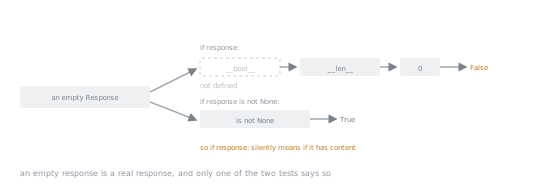
The same object goes into both tests. One of them walks a chain to a length and reports on the content; the other reports on the object.
The trap is a class with __len__ that can legitimately be empty and meaningful. An empty Response object is falsy, so if response: silently means "if it has content". Either define __bool__ returning True, or make callers write if response is not None:.
Calling, and context
class Retry:
    def __init__(self, attempts: int) -> None:
        self.attempts = attempts

    def __call__(self, func):        # instances become callable
        ...
__call__ is right when an object carries configuration and is then invoked repeatedly. A closure does the same thing in fewer lines; the class wins when it also needs __repr__, state you can inspect, or several methods.
__enter__ and __exit__ are lesson 11. __aenter__, __aexit__ and __await__ are stage 6.
The full map, by what you want to support
| Want | Implement |
|---|---|
| useful printing | __repr__ |
| user-facing text | __str__ |
==, and dict or set membership | __eq__ and __hash__ together |
| sorting and comparison | __lt__ plus @total_ordering |
len, and truthiness for free | __len__ |
for, list, sum, in | __iter__ |
x[key], and slicing | __getitem__ |
with | __enter__, __exit__ |
+, -, * | __add__, __sub__, __mul__, plus the __r*__ reflected forms |
+= in place | __iadd__, and return self |
f"{x:>10.2f}" | __format__ |
| attribute fallback | __getattr__, from lesson 22 |
| copying | usually nothing: the default works |
When a plain function is the answer
Operator overloading earns its place where the operation is genuinely the operator: money, vectors, matrices, paths, durations, sets. Order + Order is not addition, and config @ override is a puzzle. If a reader has to guess what the symbol means for your type, a method with a name is better.
The same test applies to the whole list: implement a protocol when your type is that kind of thing. A Playlist is a sequence, so __len__, __iter__ and __getitem__ are honest. A PaymentProcessor is not a container, and giving it __getitem__ because a dict was convenient is how a codebase becomes unreadable.
Practice
-
▢ Predict both, and explain the second.
class Bag:
    def __init__(self, items): self.items = list(items)
    def __len__(self): return len(self.items)

print(bool(Bag([1, 2])))
print(bool(Bag([])))
Check
True, then False.
bool finds no __bool__ and falls back to __len__, treating zero as false. That is usually what you want for a container, and it is a bug for any class where "empty" and "absent" mean different things.
-
▢ Find the two defects.
class Point:
    def __init__(self, x, y):
        self.x, self.y = x, y

    def __eq__(self, other):
        return self.x == other.x and self.y == other.y
Hint
Try Point(1, 2) == "not a point", and then try putting a point in a set.
Check
- Comparing against anything without
.xraisesAttributeErrorinstead of returningFalse. The fix is anisinstancecheck returningNotImplemented. - Defining
__eq__set__hash__ = None, so{Point(1, 2)}raisesTypeError: unhashable type: 'Point'.
def __eq__(self, other: object) -> bool:
    if not isinstance(other, Point):
        return NotImplemented
    return (self.x, self.y) == (other.x, other.y)

def __hash__(self) -> int:
    return hash((self.x, self.y))
Both are why @dataclass(frozen=True) is the better default: it generates both correctly.
-
▢ Which of these does a class with only
__iter__already support?- a)
for x in obj - b)
len(obj) - c)
5 in obj - d)
list(obj) - e)
obj[0] - f)
if obj:
- a)
Check
Supported: a, c, d.
- b) No.
lenneeds__len__and does not consume iterators. - e) No. Indexing needs
__getitem__. - f) It "works" and always returns
True, because with neither__bool__nor__len__every object is truthy. An empty iterable object being truthy is the bug hiding in that answer.
-
▢ Rank these by how defensible the operator is.
- a)
Money("10.00") + Money("2.50") - b)
Path("/etc") / "hosts" - c)
User + Permission - d)
Query & Filterfor combining query conditions
- a)
Check
a, b, d, c.
- a) Addition of two quantities of the same kind. Exactly what
+means. - b) Not division, and it is an established convention that
pathlibmade universal. Precedent counts. - d) Defensible:
&for conjunction is a known idiom in query builders, so a reader has seen it before. Document it. - c) Meaningless. Granting a permission is not addition, and
user.grant(permission)says what happens.
- ▢ Why
NotImplementedrather thanFalse?
Check
Returning NotImplemented tells Python the comparison was not handled, so it asks the other operand's __eq__, and only falls back to identity if that also declines. Returning False claims the objects are unequal, which prevents a compatible type from another library from ever matching yours.
The visible symptom is asymmetry: mine == theirs is False while theirs == mine is True, and which one you get depends on the order someone wrote the comparison.
- ▢ A class gets
__getitem__so thatconfig["timeout"]works, alongside its six methods. Argue against.
Check
It makes the class claim to be a mapping while implementing one operation of one. With __getitem__ alone, and _d holding the real dict:
len(config)            TypeError: object of type 'Config' has no len()
for k in config        KeyError: 0
"timeout" in config    KeyError: 0
The last two are the damaging ones. Both fall back to the old sequence protocol, which asks for index 0, and a dict-backed __getitem__ raises KeyError where the fallback expects IndexError. So in does not return False: it raises, from inside a construct that looks incapable of raising.
Either implement the whole protocol, by inheriting from collections.abc.Mapping and providing __getitem__, __iter__ and __len__, or expose config.get("timeout") as an ordinary method and let the class be what it is.
Real-world reps
- [ ] Add
__repr__to the three classes that appear most often in your logs and test failures, then read one failure and notice the difference. - [ ] Find a class with
__eq__and no__hash__, and decide which of the two it actually needs. Often the answer is@dataclass(frozen=True)and deleting both. - [ ] Look for
if some_object:in code you own where the object has a__len__. Check whether "empty" was meant to be falsy there. - [ ] Find any operator overload in a codebase you use and decide whether you could have guessed its meaning without reading the class.
- [ ] Tomorrow: subclass
collections.abc.MappingorSequencefor a class that pretends to be one, and see which methods it was missing.
Going further
- Special method names: all of them, with the fallback rules stated
object.__hash__: the contract, and what defining__eq__does to itfunctools.total_ordering: deriving the rest of the comparisonscollections.abc: the base classes that tell you which methods a protocol actually requires- Format Specification Mini-Language: what
__format__receives - Resources
Not landing? Reread the primary source at the top, since this lesson compresses it and compression is where understanding leaks. Check the glossary for any term that felt slippery.
If the lesson itself is unclear rather than the material, that is a defect: open an issue.