Lesson 26. Inheritance and the MRO
Mission link: super() does not mean "the parent class", and knowing what it does mean is what makes multiple inheritance predictable rather than mysterious. The same knowledge is what lets you say precisely why an inheritance chain in review is the wrong tool.
Primary source: The Python 2.3 Method Resolution Order
Prerequisites: Lesson 22, Lesson 25
Warm-up
- ▢ Lesson 22 said lookup walks "the class and its bases". In what order, for a class with two bases?
Check
A computed order, not left to right through each branch. This lesson is that computation.
- ▢ True or false:
super().method()calls the method on the class you inherited from.
Check
False, in general. It calls the next class after the current one in the instance's method resolution order, which may be a class the current one has never heard of.
Know this
Every class has a method resolution order, a flat list of classes searched in sequence:
class A: pass
class B(A): pass
class C(A): pass
class D(B, C): pass

[k.__name__ for k in D.__mro__]     # ['D', 'B', 'C', 'A', 'object']
Note where A sits: after both B and C, not immediately after B. The order is computed by C3 linearisation, which guarantees three properties:
- A class comes before all of its bases.
- Bases keep the order they were declared in.
- Every class appears exactly once.
When no order satisfies all three, the class cannot be created:
class Bad(B, A, C): pass
TypeError: Cannot create a consistent method resolution order (MRO) for bases A, C
A before C is required by the declaration, and C before A is required by rule one, since C is a base of nothing here but A is a base of B which precedes it. The error is the language refusing to guess.
super() walks the MRO, not the tree
class Base:
    def __init__(self, **kw): print("Base")

class M1(Base):
    def __init__(self, **kw): print("M1"); super().__init__(**kw)

class M2(Base):
    def __init__(self, **kw): print("M2"); super().__init__(**kw)

class Both(M1, M2): pass

Both()
M1
M2
Base
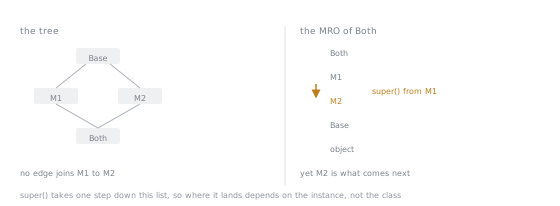
M1.__init__ called super(), and got M2, which is not its base. super() means "the next class after me in the MRO of the object being constructed", so what it resolves to depends on the instance, not on where the code was written. That is the mechanism that makes cooperative multiple inheritance work, and it is why every class in such a chain has to follow the same protocol:
- always call
super().__init__(**kwargs), exactly once; - accept and forward
**kwargs, since you do not know who comes next; - do not assume you are last, and do not assume you are first.
A class that skips its super() call silently truncates the chain, and the symptom appears in an unrelated mixin whose __init__ never ran.
Zero-argument super() works inside a class body only, using a compiler-provided reference to the class. super(M1, self) is the explicit form and is what you need outside a method body.
Mixins, and the one rule for them
A mixin adds behaviour and is not instantiated alone:
class TimestampMixin:
    def touch(self) -> None:
        self.updated_at = datetime.now(timezone.utc)

class Record(TimestampMixin, Base): ...
Rules that keep them usable: put mixins before the base class, so they precede it in the MRO and can intercept; keep them stateless or document what attributes they require; and give them one job. A mixin that requires self.updated_at to exist has a hidden dependency, which is the most common way mixins become unmaintainable.
Abstract base classes
from abc import ABC, abstractmethod

class Storage(ABC):
    @abstractmethod
    def save(self, order: Order) -> None: ...

    def save_all(self, orders: Iterable[Order]) -> None:   # shared implementation
        for order in orders:
            self.save(order)
ABC refuses instantiation while an abstract method is unimplemented, which turns a missing method into an error at construction rather than at call time. Use it when you own the implementations and they share code, which is lesson 17's table: shape only, no shared code, use a Protocol.
When inheritance is the wrong tool
The test is one question: is a subclass genuinely a kind of the base, everywhere the base is accepted? If a caller holding the base type could be surprised by the subclass, the relationship is not inheritance.
Three shapes that are almost always composition instead:
| Written as inheritance | Should be |
|---|---|
class OrderService(DatabaseConnection) | a service holding a connection |
class Cache(dict) | a class holding a dict, exposing the four methods it needs |
class Retry(HttpClient) | a wrapper taking a client |
Subclassing built-in containers deserves its own warning: dict, list and str do not route their internal operations through your overrides, so overriding __setitem__ on a dict subclass does not affect update, setdefault or the constructor. collections.UserDict, UserList and UserString exist for that, and holding a dict is usually better than either.
Composition costs one attribute and a few forwarding methods, and buys the ability to change the relationship later. Inheritance is the tighter coupling in the language: it exposes every base attribute, and the base can break you by adding a name.
Practice
-
▢ Give the MRO.
class A: pass
class B(A): pass
class C(A): pass
class D(B): pass
class E(D, C): pass
Check
E, D, B, C, A, object.
D and B come first, in declaration order down that branch, then C, and A only after both B and C, because both list it as a base. object is always last.
-
▢ Predict the output, then say which class is missing from it and why.
class Base:
    def setup(self): print("Base")

class Logging(Base):
    def setup(self): print("Logging"); super().setup()

class Caching(Base):
    def setup(self): print("Caching")

class Service(Logging, Caching, Base):
    def setup(self): print("Service"); super().setup()

Service().setup()
Hint
Write out the MRO first, then follow each super() call along it.
Check
Service
Logging
Caching
The MRO is Service, Logging, Caching, Base, object. Caching.setup does not call super(), so Base.setup never runs and the chain stops there.
This is the defect to recognise: the missing call is in Caching, and the symptom appears as Base being skipped, which the reader of Service cannot see. In a cooperative hierarchy, every override calls super().
-
▢ Why does this fail, and what is the minimal change?
class Reader: pass
class Writer(Reader): pass
class ReadWrite(Reader, Writer): pass
Check
TypeError: Cannot create a consistent method resolution order (MRO) for bases Reader, Writer
The declaration asks for Reader before Writer, and rule one requires Writer before Reader, because Writer is a subclass of it. No order satisfies both.
Minimal change: reverse them, class ReadWrite(Writer, Reader), at which point Reader is redundant and class ReadWrite(Writer) says the same thing.
-
▢ For each, choose inheritance, composition,
Protocol, orABC.- a)
SqliteStorageandPostgresStorage, both needing the samesave_allloop - b)
RetryingClientthat wraps any HTTP client and repeats failed calls - c) A parameter that accepts anything with
readandclose, including third-party objects - d) A
CaseInsensitiveDictused everywhere a dict is expected
- a)
Check
- a)
ABC. You own both, andsave_allis shared code an abstract base can hold. - b) Composition. It takes a client and forwards, which is what lets it wrap clients it was not written for.
- c)
Protocol. Structural, and it reaches classes you do not own. - d) Composition, or
collections.UserDict. Subclassingdictdoes not routeupdate,setdefaultor the constructor through an overridden__setitem__, so the case-insensitivity silently applies to some operations and not others.
- ▢ A mixin needs to know the model's table name. Compare two ways of arranging that.
Check
Implicit: the mixin reads self.table_name and documents that subclasses must define it. Cheap to write, and it fails at run time in whichever method touches it first, with an AttributeError that names the mixin rather than the class that forgot.
Explicit: the mixin declares it and validates at class creation.
class TableMixin:
    table_name: ClassVar[str]

    def __init_subclass__(cls, **kwargs) -> None:
        super().__init_subclass__(**kwargs)
        if not getattr(cls, "table_name", None):
            raise TypeError(f"{cls.__name__} must set table_name")
The annotation lets a checker catch it, and the hook from lesson 25 catches it at import time in the class that is wrong. That combination is what makes a mixin's requirement a contract rather than a note in a docstring.
- ▢
class OrderService(DatabaseConnection)passes every test. Argue for changing it.
Check
The service now exposes every method of the connection, so callers can commit, roll back, execute arbitrary SQL or close the connection through the service, and some of them will. Every public name the connection library adds in a future version lands in your service's namespace, and a collision with one of your method names is a silent override.
It also fails the substitution question: code expecting a DatabaseConnection would accept an OrderService, which is not a connection in any useful sense.
Composition costs one attribute:
class OrderService:
    def __init__(self, conn: DatabaseConnection) -> None:
        self._conn = conn
and buys a boundary: the service's public interface is what it chose to expose, and a test can pass a fake without subclassing anything.
Real-world reps
- [ ] Print
SomeClass.__mro__for the most-inherited class in a codebase you use. If the list surprises you, that class is where a bug will eventually be. - [ ] Grep for overrides that do not call
super(), in hierarchies that have mixins. Each one is a truncated chain. - [ ] Find a class inheriting from
dict,listorstrand check whether the overridden method is bypassed byupdate,extendor the constructor. - [ ] Take one inheritance relationship in your code and ask the substitution question out loud. Convert one that fails it to composition.
- [ ] Tomorrow: replace an abstract base class whose subclasses share no implementation with a
Protocol, and delete the inheritance.
Going further
super: what the zero-argument form does, and when to write the explicit one- The Python 2.3 Method Resolution Order: C3 linearisation, worked through in full, by the person who implemented it
- Customizing class creation: where the MRO is computed, and the hooks around it
abc:ABC,abstractmethod, and registering virtual subclassescollections.UserDict,UserList,UserString: the subclassable versions of the built-in containers- Resources
Not landing? Reread the primary source at the top, since this lesson compresses it and compression is where understanding leaks. Check the glossary for any term that felt slippery.
If the lesson itself is unclear rather than the material, that is a defect: open an issue.