Lesson 27. Metaclasses, and Why Not
Mission link: The mission asks you to name precisely why someone's metaclass is the wrong tool. That requires knowing what a metaclass does, what the cheaper hooks do, and the small set of cases where nothing else works.
Primary source: The Python Language Reference, Metaclasses
Prerequisites: Lesson 25, Lesson 26
Warm-up
- ▢ Lesson 25 gave a hook that runs once per subclass at class-creation time. Which, and what did it replace?
Check
__init_subclass__, which covers registration and subclass validation without a metaclass.
- ▢ What is
type(Order), for an ordinary classOrder?
Check
type. A class is an object, and its type is its metaclass. That is the whole idea this lesson is about.
Know this
A class statement is not a declaration; it is code that runs. Roughly:
class Order:
    currency = "GBP"
    def total(self): ...
is:
namespace = {}                        # execute the body into a dict
exec(class_body, globals(), namespace)
Order = type("Order", (), namespace)  # call the metaclass to build the class
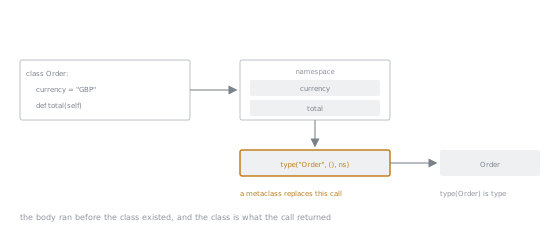
The namespace holds exactly the names the body defined, and it exists before any class does. What comes out of the call is the class, which is why replacing the call is all a metaclass has to do.
type is the default metaclass. Calling it with three arguments, name, bases and namespace, builds a class, which is why type(Order) is type and why classes can be created at run time.
A metaclass replaces that call:
class Meta(type):
    def __new__(mcls, name, bases, namespace, **kwargs):
        cls = super().__new__(mcls, name, bases, namespace, **kwargs)
        return cls

class Order(metaclass=Meta): ...
Now type(Order) is Meta, and Meta gets to inspect or alter every class that uses it, including subclasses.
The four hooks that come first
Almost every real use of a metaclass is one of these, and each has a cheaper answer:
| Goal | Hook | Lesson |
|---|---|---|
| register every subclass | __init_subclass__ | 25 |
| require subclasses to define something | __init_subclass__ | 25 |
| tell a class attribute its own name | __set_name__ | 23 |
| refuse instantiation until a method exists | abc.ABC with @abstractmethod | 26 |
generate __init__, __eq__, __repr__ | @dataclass, or a class decorator | 12 |
| add or wrap methods after class creation | a class decorator | this lesson |
A class decorator is the one to reach for when the change happens after the class exists:
def slots_checked(cls):
    if not hasattr(cls, "__slots__"):
        raise TypeError(f"{cls.__name__} must define __slots__")
    return cls

@slots_checked
class Point:
    __slots__ = ("x", "y")
It runs once, it is visible directly above the class, it composes by stacking, and it does not change the class's type. Compared with a metaclass it gives up exactly one thing: it does not apply automatically to subclasses.
That single difference is the honest decision rule. If subclasses must be affected without opting in, you need __init_subclass__ or a metaclass. Otherwise a decorator does it.
What only a metaclass can do
Four things, and they are recognisable:
- Control the class body's namespace before it executes, via
__prepare__. This is how a framework makes a class body record declaration order in something other than a dict, or rejects duplicate names. - Change what
isinstanceandissubclassanswer, via__instancecheck__and__subclasshook__on the metaclass.abcitself is built this way. - Customise the class object's own behaviour: attributes on the class rather than on instances, a
__repr__for the class, a__call__that changes whatOrder(...)does before__new__is reached, or__getattr__for class-level attribute access. - Apply behaviour to a whole hierarchy the base class did not anticipate, because a metaclass is inherited and
__init_subclass__requires the base to have been written with the hook.
These are framework problems. abc, enum, and ORMs use metaclasses correctly, and they all exist to make ordinary code not need one.
The costs, concretely
- Type conflicts. Two bases with different metaclasses cannot be combined:
TypeError: metaclass conflict. This shows up as a library being uncombinable with another library, and there is no fix on the user's side. - Invisible action at a distance. A reader of the subclass sees no indication that anything happens; the behaviour lives in a class they may not know exists.
- Tooling. Checkers, editors and refactoring tools reason poorly about attributes a metaclass creates, so a codebase built this way loses the stage-3 benefits.
- Debuggability. The stack trace at class-creation time is at import time, and the failure often surfaces as a missing attribute much later.
Reading one
You will meet metaclasses in other people's code, so recognise the shape:
class Meta(type):
    @classmethod
    def __prepare__(mcls, name, bases, **kwargs):
        return {}                            # the namespace the body executes into

    def __new__(mcls, name, bases, namespace, **kwargs):
        return super().__new__(mcls, name, bases, namespace)

    def __init__(cls, name, bases, namespace, **kwargs):
        super().__init__(name, bases, namespace)

    def __call__(cls, *args, **kwargs):      # runs when the class is called
        return super().__call__(*args, **kwargs)
__prepare__, then the body executes, then __new__, then __init__. The cls in the last two methods is the class being built, and mcls is the metaclass. __call__ is the one that surprises people: it intercepts instance creation before __new__ from lesson 25 is reached, which is where singleton metaclasses live.
Two lines answer most questions about unfamiliar code: type(SomeClass) names the metaclass, and SomeClass.__mro__ shows what it inherited.
The rule, stated once
Write a metaclass when you are building a framework whose users must not have to opt in, and you have checked that __init_subclass__, __set_name__, abc and a class decorator cannot do it. Otherwise the metaclass is a cost paid by every future reader for a feature that had a simpler spelling.
Practice
-
▢ Rewrite without a metaclass.
class RegistryMeta(type):
    registry = {}
    def __new__(mcls, name, bases, ns, **kw):
        cls = super().__new__(mcls, name, bases, ns)
        if bases:
            RegistryMeta.registry[name.lower()] = cls
        return cls

class Handler(metaclass=RegistryMeta): ...
class CsvHandler(Handler): ...
Check
class Handler:
    registry: ClassVar[dict[str, type["Handler"]]] = {}

    def __init_subclass__(cls, **kwargs) -> None:
        super().__init_subclass__(**kwargs)
        Handler.registry[cls.__name__.lower()] = cls

class CsvHandler(Handler): ...
Identical behaviour, fewer concepts, type(Handler) is still type, and the registry lives in the class a reader already has open. The if bases guard disappears too, because __init_subclass__ does not run for the class that defines it.
-
▢ Decorator or
__init_subclass__?- a) Validate that a class defines
__slots__, applied to twelve specific classes - b) Ensure every subclass of
Modelin the codebase, present and future, registers its table - c) Add
__repr__to a handful of legacy classes - d) Require every subclass written by another team to implement
handle
- a) Validate that a class defines
Check
- a) Decorator. Twelve explicit opt-ins are a feature, not a limitation.
- b)
__init_subclass__. "Future subclasses without opting in" is exactly the line where a decorator stops working. - c) Decorator, or write the method. The set is closed and small.
- d)
__init_subclass__, orabc.ABCwith@abstractmethodif the check should happen at instantiation instead of at class creation. The other team cannot forget to apply a hook they never see.
- ▢ Two libraries each provide a base class, and combining them fails. What does the error say, and what can a user do?
Hint
What has to be true of the type of the new class, with respect to the types of both bases?
Check
TypeError: metaclass conflict: the metaclass of a derived class must be a
(non-strict) subclass of the metaclasses of all its bases
The user's options are all bad: write a third metaclass inheriting from both, if they happen to be compatible, which requires understanding two libraries' internals; drop one of the two bases and reimplement its behaviour by composition; or open an issue and wait.
This is the concrete cost of a metaclass in a published library, and it is why frameworks that can use __init_subclass__ should.
-
▢ Which of these genuinely needs a metaclass?
- a) A singleton, so
Connection()always returns the same object - b) A class body that must record the order in which fields were declared
- c) Changing what
isinstance(x, Shape)answers for classes that merely have the right methods - d) Generating
__init__from annotations
- a) A singleton, so
Check
- a) No. A module-level factory with
functools.cache, or explicit lifetime management by the caller, and lesson 25 gave the bug a singleton__new__produces. - b) No longer. Class bodies have executed into an ordered dict since Python 3.7, so
__init_subclass__or a decorator can read the order.__prepare__is needed only for a namespace that is not a plain dict, such as one rejecting duplicates. - c) Yes.
__instancecheck__and__subclasshook__live on the metaclass, which is howabcandProtocoldo it. Prefer usingabcorProtocolrather than writing your own. - d) No.
@dataclassis a decorator, and that is the proof it does not need one.
- ▢ You inherit a codebase and a class behaves in a way its body does not explain. Give the two lines you run first.
Check
type(SomeClass)          # names the metaclass, if any
SomeClass.__mro__        # names every base, in lookup order
The first says whether class creation was intercepted. The second says which base a surprising attribute or method actually came from. After those, SomeClass.__dict__ versus the same on each base separates what this class defines from what it inherited, and inspect.getsource(type(SomeClass)) shows the metaclass itself.
- ▢ A colleague proposes a metaclass so that all models automatically validate their fields on assignment. Give a fuller answer than "no".
Check
Name what the requirement actually is, then price the options.
Validation on assignment is a descriptor's job, from lesson 23: one Field descriptor with __set__, declared per attribute. If the objection is that every model must get it without writing the descriptors out, __init_subclass__ can walk the annotations and install descriptors, which needs no metaclass because the models all inherit a base you control.
If the models should be immutable instead, a frozen dataclass validating in __post_init__ removes the whole problem, since there is no assignment to intercept.
The metaclass wins only if the models must not inherit from a common base, which for a codebase's own models is rarely a real constraint. And it costs the metaclass conflict from question 3 the first time a model also needs a base from another library.
Real-world reps
- [ ] Run
type(cls)over the classes in one dependency you use heavily. The ones that are nottypeare where the framework's magic lives. - [ ] Find a metaclass in any codebase and decide which of the four legitimate capabilities it uses. Most use none.
- [ ] Take one metaclass, if you have one, and try rewriting it as
__init_subclass__plus a class decorator. Keep whichever version a new reader would understand faster. - [ ] Read the first thirty lines of
enum.pyorabc.pyin the standard library. Both are metaclasses done for a reason, and both exist so your code does not need one. - [ ] Tomorrow: write a class decorator that adds one thing, and stack two of them, to see how composition works where inheritance of metaclasses does not.
Going further
- Metaclasses:
__prepare__, the creation sequence, and the conflict rule - PEP 487, Simpler customisation of class creation: the explicit argument for the hooks over metaclasses
abc: a correct metaclass, and__subclasshook__type: the three-argument form that builds a classinspect: reading the source of whatever is doing the magic- Resources
Not landing? Reread the primary source at the top, since this lesson compresses it and compression is where understanding leaks. Check the glossary for any term that felt slippery.
If the lesson itself is unclear rather than the material, that is a defect: open an issue.