Lesson 31. Test Doubles
Mission link: The mission asks what deserves a mock and what does not. Most of the pain in a slow, brittle suite comes from mocking the wrong layer, and most of the confusion comes from one rule about where patch points.
Primary source: The Python Standard Library, unittest.mock
Prerequisites: Lesson 13, Lesson 29
Warm-up
- ▢ Lesson 13: after
from settings import TIMEOUT, why does settingsettings.TIMEOUT = 30not change what the importing module sees?
Check
The from import bound a second, independent name to the same object. Rebinding one does not touch the other. This lesson is that fact with consequences.
- ▢ What is the difference between replacing a payment gateway and replacing a dict?
Check
One is a boundary you do not control and cannot call in a test; the other is fast, deterministic and already correct. Only the first is a candidate.
Know this
The five kinds, and the two worth using
| Name | Is |
|---|---|
| dummy | a value passed to satisfy a signature and never used |
| stub | returns canned answers, asserts nothing |
| fake | a real, working, simplified implementation |
| spy | records how it was called, and still does the real thing |
| mock | records calls, and the test asserts on them |
In practice: fakes for boundaries you own the interface to, stubs for values you need to control, and mocks only when the call itself is the behaviour under test. A test asserting "the email was sent" needs a mock, because sending is the outcome. A test asserting "the total is 90" needs neither.
patch points at the name that is used
This is the rule that costs people the most time, and lesson 13 already explained why.
# pkg/clock.py
def now(): return "real"

# pkg/report_from.py
from pkg.clock import now
def stamp(): return f"at {now()}"

# pkg/report_mod.py
from pkg import clock
def stamp(): return f"at {clock.now()}"
with patch("pkg.clock.now", return_value="fake"):
    report_from.stamp()      # 'at real'   <- patch had no effect
    report_mod.stamp()       # 'at fake'

with patch("pkg.report_from.now", return_value="fake"):
    report_from.stamp()      # 'at fake'
Patching where the function is defined does nothing to a module that did from ... import, because that module holds its own binding. Two consequences:
- The patch target is
where.it.is.used, notwhere.it.is.defined. - Importing modules rather than names,
from pkg import clockthenclock.now(), makes the patch target stable and the code easier to test. That is a design argument for theimport modulestyle, not just a testing trick.
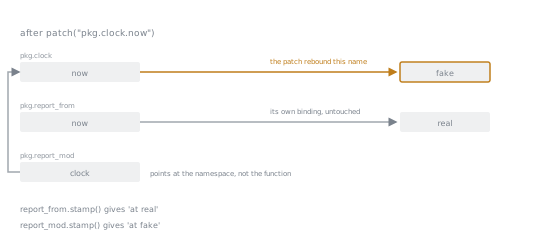
Two of the three arrows end on an object and one ends on a namespace, and that is the whole difference between the import styles. Follow them and the two results fall out: report_from reaches real directly, report_mod reaches pkg.clock first and finds whatever now is bound to at that moment.
monkeypatch.setattr("pkg.report_from.now", fake) from lesson 29 does the same job with automatic undo, and is the pytest-native spelling.
Mock believes everything
m = Mock()
m.chrage(1, 2, 3, 4, nonsense=True)     # <Mock name='mock.chrage()'>
m.whatever.deeply.nested                # <Mock name='mock.whatever.deeply.nested'>
A bare Mock accepts any attribute, any call, any arguments, and returns another Mock. So a test using one keeps passing after you rename the method, change its signature, or delete it. The suite is green and the code is broken, which is the worst outcome available.
create_autospec, or patch(..., autospec=True), builds the double from the real object's signature:
gateway = create_autospec(Gateway, instance=True)

gateway.charge(10, "GBP")               # fine
gateway.charge(10)                      # TypeError: missing a required argument: 'currency'
gateway.chrage(10, "GBP")               # AttributeError: Mock object has no attribute 'chrage'
gateway.charge(10, "GBP", "extra")      # TypeError: too many positional arguments
Use autospec by default. Without it, the double drifts away from the thing it stands for and nothing tells you.
Then assert on the interaction only when the interaction is the point:
gateway.charge.assert_called_once_with(10, "GBP")
Do not mock what you do not own
The rule has a reason: a mock of a third-party client encodes your belief about that library's API, and a mock cannot be wrong about it. When the library changes, or when your belief was mistaken from the start, the test still passes.
The alternative is a thin layer you own:
class PaymentGateway(Protocol):          # your interface, from lesson 17
    def charge(self, amount: Decimal, currency: str) -> str: ...

class StripeGateway:                     # the only code that touches the library
    def charge(self, amount, currency): ...

class FakeGateway:                       # for tests: real, simple, in memory
    def __init__(self): self.charges = []
    def charge(self, amount, currency):
        self.charges.append((amount, currency))
        return "ch_test_1"
Now the tests use FakeGateway, which is a working implementation you can assert against, and exactly one class needs an integration test against the real service. The library's shape is checked in one place instead of asserted in forty.
What to replace, and what to leave
| Replace | Leave alone |
|---|---|
| network calls | pure functions |
| a payment or email provider | dicts, lists, dataclasses |
| the current time and time zone | your own domain logic |
| randomness and generated ids | a fast in-memory database |
the filesystem, sometimes: tmp_path is usually better | another module in the same package |
| a slow or rate-limited third-party service | anything already deterministic and fast |
Mocking inside your own package is the smell that matters. If a unit test needs four patches to run, it is not the test that is wrong: the code under test is calling out to four collaborators it should have been handed. Passing dependencies in as arguments removes the patches.
Time and randomness
def total_due(order, *, today: date) -> Decimal:       # injected
    ...
Injecting the clock is better than patching it, because the function becomes deterministic for every caller rather than only for tests. When injection is not practical, patch the one place that reads the clock:
def test_overdue(monkeypatch):
    monkeypatch.setattr("shop.billing.today", lambda: date(2026, 1, 31))
The same applies to uuid4 and random. freezegun and time-machine exist for the cases where time is read from many places, and needing one is a signal about the code.
Asserting on calls, carefully
gateway.charge.assert_called_once_with(10, "GBP")   # exact, positional matters
gateway.charge.assert_any_call(10, "GBP")           # among several
assert gateway.charge.call_count == 2
assert gateway.charge.call_args.kwargs["currency"] == "GBP"
Two failure modes. assert_called_once_with pins the exact argument form, so switching a caller from positional to keyword breaks a test that cares about neither. And assert_called_with on a mock that was never configured with autospec will happily accept a method name that no longer exists, which is the drift above.
Also: mock.assert_called_once() exists, and misspelling it as assert_called_once on a bare Mock, or inventing assert_called_twice, silently creates a new attribute and asserts nothing. autospec and Mock(spec=...) prevent that too.
Practice
-
▢ The patch has no effect. Why, and give both fixes.
# shop/billing.py
from shop.clock import today
def is_overdue(order): return today() > order.due_date

# tests
with patch("shop.clock.today", return_value=date(2026, 1, 31)):
    assert is_overdue(order)
Hint
How many names refer to the function, and which one did the patch replace?
Check
shop.billing holds its own binding, created by the from import at import time. Patching shop.clock.today replaces the name in shop.clock and leaves shop.billing.today pointing at the original.
Fix one, in the test: patch("shop.billing.today", ...), the name where it is used.
Fix two, in the code: from shop import clock and call clock.today(), so there is only one binding and the patch target is stable. That version is also easier to read, because the call says where the function comes from.
-
▢ This test passes after
chargeis renamed tocapture. Explain, and fix it.def test_charges_the_card(): gateway = Mock() checkout(order, gateway) gateway.charge.assert_called_once_with(Decimal("90"), "GBP")
Check
It does not pass, and that is the point worth being precise about: assert_called_once_with fails because the renamed code calls capture, so charge was never called. What silently passes is the reverse direction, and every call into the mock:
gateway.chrage(...)          # typo in the code under test: accepted, returns a Mock
gateway.charge(1, 2, 3, 4)   # wrong signature: accepted
So the mock hides defects in the code it stands for, and the assertion only catches the specific rename it names.
gateway = create_autospec(PaymentGateway, instance=True)
Now a call with the wrong name raises AttributeError and a call with the wrong arity raises TypeError, at the moment the code under test makes it.
-
▢ Fake, stub, or nothing at all?
- a) An HTTP client for a third-party address-lookup service
- b) A function computing VAT from a country code
- c)
datetime.now(), in a function that decides whether an invoice is overdue - d) A
Repositoryclass that talks to a real database, in a unit test of pricing logic - e) A
dictof feature flags
Check
- a) Fake, behind an interface you own. Do not mock the library directly.
- b) Nothing. It is pure, fast and deterministic, and replacing it would test the replacement.
- c) Inject the date as a parameter. Failing that, a stub via
monkeypatchon the one place that reads it. - d) Fake, or restructure so the pricing function takes the data rather than the repository. If the pricing logic needs a repository at all, that is the finding.
- e) Nothing. Construct the dict the test wants.
- ▢ A unit test needs four
patchdecorators. What does that tell you, and what is the fix?
Check
That the function under test reaches out to four collaborators it looks up itself, usually via module-level imports or global singletons. The patches are compensating for the design.
The fix is dependency injection: the function takes its collaborators as parameters, and the test passes fakes directly with no patching at all. That also makes the function's dependencies visible in its signature, which a checker can then verify.
Where the collaborators genuinely belong at module level, such as a logger, they do not need patching in the first place.
- ▢ Why is a fake usually better than a mock for a repository?
Check
A fake is a working implementation, so it enforces the interface's semantics: an object saved can be read back, an id that does not exist raises, and two saves of the same id behave the way the real one does. Tests then assert on outcomes, assert repo.get(1).amount == 90, which is what the caller actually cares about.
A mock asserts on calls, repo.save.assert_called_once_with(order), which couples the test to how the code is written rather than to what it achieves. Refactoring two saves into one breaks the test without changing behaviour, and the test passes when save is called with an object that the real repository would reject.
The cost of a fake is that it is code, and it can drift from the real implementation. A shared contract test, parametrised over the fake and the real one from lesson 30, is what keeps them honest.
- ▢ A colleague says "we mock the database so unit tests are fast; the integration suite covers the real thing". What is right and what is missing?
Check
Right: fast, isolated tests for logic are worth having, and something has to stand in for the database.
Missing: three things. The mock encodes assumptions about the driver's behaviour that only the integration suite can check, so those assumptions need to be exercised somewhere and usually are not. An in-memory database, or a real one in a container, is often fast enough that the trade was unnecessary. And most importantly, if the pricing logic needs a database mock at all, the logic and the persistence are entangled; separating them removes the question rather than answering it.
Real-world reps
- [ ] Grep your tests for
patch(andMock(and addautospec=Trueorcreate_autospecto each. Anything that starts failing was a drifted double. - [ ] Find a patch target that points at where a function is defined rather than where it is used, and check whether the test was ever effective.
- [ ] Take one unit test with more than two patches and rewrite the function under test to accept its dependencies.
- [ ] Replace one mocked repository with a small in-memory fake, and see how many assertions become statements about outcomes instead of calls.
- [ ] Tomorrow: find every place your code reads the current time, and count them. That number is why time is hard to test.
Going further
unittest.mock:Mock,patch,create_autospecand the assertion methods- Where to patch: the documentation's own statement of the rule in this lesson
- Autospeccing: what it checks, and its limitations
monkeypatch: the pytest-native patching with automatic undo- Resources
Not landing? Reread the primary source at the top, since this lesson compresses it and compression is where understanding leaks. Check the glossary for any term that felt slippery.
If the lesson itself is unclear rather than the material, that is a defect: open an issue.