Lesson 37. asyncio
Mission link: The mission asks for async code that does not stall and an explanation of what a blocking call inside an event loop does. Both come from one fact: there is a single thread, and it only moves when a coroutine yields at an await.
Primary source: The Python Standard Library, asyncio
Prerequisites: Lesson 9, Lesson 10, Lesson 34
Warm-up
- ▢ Lesson 9: what does a generator do at a
yield?
Check
Freezes its frame, hands a value out, and resumes on the next line when asked. A coroutine at an await does the same, and the event loop is what asks.
- ▢ Lesson 35 got an eight-fold speedup from eight threads on eight waits. What does
asyncioadd?
Check
Scale, without a thread each. Eight is nothing; ten thousand concurrent waits is where the model pays.
Know this
async def fetch(i: int) -> int:
    await asyncio.sleep(0.2)         # stands in for a network call
    return i
Calling fetch(1) runs nothing: it builds a coroutine, exactly as calling a generator function builds a generator. Something has to drive it, and that something is the event loop, started by asyncio.run.
await in a loop is sequential
Measured, eight waits of 0.2 seconds:
await in a loop (8 x 0.2s)     1.62s
asyncio.gather                 0.20s
asyncio.TaskGroup              0.20s
results = [await fetch(i) for i in range(8)]         # 1.62s: one at a time
results = await asyncio.gather(*(fetch(i) for i in range(8)))   # 0.20s
await means "suspend until this finishes". It creates no concurrency by itself. Concurrency comes from having several tasks in flight, and a task is created by gather, TaskGroup, or create_task.
This is the most common async bug, and it is invisible: the code is correct, uses async throughout, and runs eight times slower than intended.
TaskGroup over gather
async with asyncio.TaskGroup() as tg:
    tasks = [tg.create_task(fetch(i)) for i in range(8)]
results = [t.result() for t in tasks]
TaskGroup, from Python 3.11, is the one to reach for. The difference is failure behaviour, and it is the whole argument:
- If one task raises, the group cancels the others and waits for them, then raises an
ExceptionGroup. - Nothing is left running when the block exits, so there are no orphaned tasks.
- With
gather, a failure leaves the other tasks running unless you passreturn_exceptions=Trueand inspect the results by hand.
Measured, with one task raising ValueError:
TaskGroup raised ExceptionGroup containing ['ValueError']
Which is why except* from lesson 10 exists: a plain except ValueError does not catch a ValueError inside a group.
try:
    async with asyncio.TaskGroup() as tg:
        ...
except* ValueError as eg:
    ...
Cancellation and timeouts
async with asyncio.timeout(0.1):
    await slow()
slow(): saw CancelledError, cleaning up
timeout raised TimeoutError
Two facts to hold together. Cancellation is delivered as CancelledError raised at the await where the coroutine is suspended, so cleanup in a finally or a with runs normally. And asyncio.timeout converts that into TimeoutError for the caller.
The rules that follow:
- Never swallow
CancelledError. Catch it only to clean up, thenraise. A coroutine that returns normally after being cancelled breaks the shutdown of everything above it. - A coroutine with no
awaitcannot be cancelled, because there is no point at which the exception can be delivered. - Cleanup that must complete during cancellation goes in
finally, and if it needs toawait, wrap it inasyncio.shieldor accept that it may be cancelled too.
The blocking call
blocking sleep inside async    1.65s        (time.sleep in eight tasks)
asyncio.to_thread              0.21s
Eight tasks, each calling time.sleep(0.2) instead of await asyncio.sleep(0.2), took as long as doing them one at a time, because there is one thread and a blocking call does not release it to the loop. Nothing raises, nothing warns, and the concurrency silently disappears.
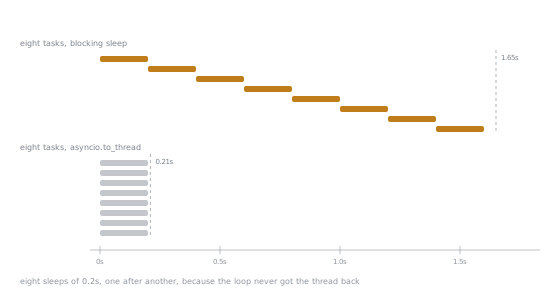
Both runs are the same eight sleeps of the same length, drawn on the same axis. The staircase is what "one thread" looks like when nothing gives it back.
Everything in this category behaves the same way: requests.get, a synchronous database driver, open(...).read() on a slow disk, subprocess.run, hashlib over a large file, a tight computation loop. In a server, one such call in one handler adds its full duration to the latency of every other request in flight.
Three fixes, in order:
- Use the async library:
httpxoraiohttpinstead ofrequests, an async driver instead of a synchronous one. - Offload it:
await asyncio.to_thread(blocking_fn, *args), which is a thread pool behind anawait. Correct for a blocking call you cannot replace. - Offload CPU work to a process:
loop.run_in_executor(ProcessPoolExecutor(), fn, ...), since a thread would not help per lesson 34.
To find them, run with debug mode on, which logs callbacks that take too long:
PYTHONASYNCIODEBUG=1 python -m myapp
Executing <Task finished name='Task-2' coro=<bad() done ...>> took 0.210 seconds
The rest of the everyday API
| Need | Use |
|---|---|
| run an async program | asyncio.run(main()) |
| many things at once, with failure handling | asyncio.TaskGroup |
| many things at once, tolerating failures | gather(..., return_exceptions=True) |
| a deadline | async with asyncio.timeout(seconds) |
| a blocking function | await asyncio.to_thread(fn, *args) |
| a background task that outlives the caller | task = asyncio.create_task(...), and keep a reference |
| bounded concurrency | asyncio.Semaphore(n) |
| a queue between tasks | asyncio.Queue |
| a lock between tasks | asyncio.Lock, never threading.Lock |
| per-task context | contextvars, not threading.local |
Two traps in that table. A task created with create_task and not stored can be garbage collected mid-flight, so keep the reference or use a TaskGroup. And threading.Lock in a coroutine blocks the whole loop rather than yielding, which turns a lock into a stall.
What asyncio does not fix
It does not make CPU-bound code faster: one thread, one interpreter, per lesson 34. It does not remove races, since a task can be suspended at any await, so check-then-act across an await has exactly the bug from lesson 34, without needing another thread. And it does not simplify anything: it colours every function in the call chain, because only a coroutine can await, so adopting it partway through a codebase means duplicating interfaces or bridging with to_thread and asyncio.run.
Choose it when the concurrency is large and the work is waiting. For eight requests, threads are simpler and just as fast.
Practice
-
▢ Why does this take 1.6 seconds rather than 0.2?
async def main():
    results = []
    for url in urls:                 # eight urls
        results.append(await fetch(url))
    return results
Check
await suspends until that one fetch completes, then the loop starts the next. There is only ever one request in flight, so the total is the sum.
async def main():
    async with asyncio.TaskGroup() as tg:
        tasks = [tg.create_task(fetch(url)) for url in urls]
    return [t.result() for t in tasks]
Now eight are in flight and the total is the slowest one. The tell in review: an await inside a for body, with nothing else in the loop that depends on the previous result.
-
▢ Find the stall.
async def handle(request):
    user = await db.fetch_user(request.user_id)
    avatar = requests.get(user.avatar_url).content     # 300 ms
    return render(user, avatar)
Hint
Which of those two calls releases the event loop, and what are the other requests doing meanwhile?
Check
requests.get is synchronous. For 300 milliseconds the single event-loop thread is inside C code doing a socket read, so no other handler runs, no other await resumes, and every concurrent request's latency grows by 300 milliseconds.
Fixes: await httpx.AsyncClient().get(...) if you can change the dependency, or await asyncio.to_thread(requests.get, user.avatar_url) if you cannot. Do not leave it, and do not "fix" it by adding more workers, which multiplies processes rather than removing the stall.
PYTHONASYNCIODEBUG=1 finds these: it logs any callback that occupies the loop too long.
-
▢
TaskGrouporgather?- a) Fetch three resources; if any fails, the request fails
- b) Notify twelve webhooks; failures are logged and ignored
- c) Two queries whose results are both required
- d) A background metrics flusher that runs for the process's life
Check
- a)
TaskGroup. One failure cancels the rest, which is exactly right when partial results are useless. - b)
gather(..., return_exceptions=True), then inspect each result. ATaskGroupwould cancel the remaining webhooks on the first failure. - c)
TaskGroup, same reason as a. - d) Neither, quite: it outlives any block.
asyncio.create_taskwith the reference stored somewhere that lives as long as the app, plus cancellation on shutdown. An unreferenced task can be collected while running.
-
▢ What is wrong with this cleanup?
async def worker():
    try:
        await do_work()
    except asyncio.CancelledError:
        log.info("cancelled")
        return
Check
It swallows the cancellation. The caller that cancelled this task sees it complete normally, so a TaskGroup above it believes the shutdown succeeded, asyncio.timeout may not raise, and code waiting for everything to stop proceeds while this coroutine's callers think it finished its work.
except asyncio.CancelledError:
    log.info("cancelled")
    raise
Catch it to clean up, then re-raise, always. If the cleanup itself must await and must not be interrupted, asyncio.shield protects that one operation, at the cost of delaying the shutdown.
-
▢ Does this race, in a single-threaded event loop?
async def get_or_create(key):
    if key not in cache:
        cache[key] = await build(key)
    return cache[key]
Check
Yes, and it is the same bug as lesson 34's with no threads involved. The await is a suspension point: task A checks, finds nothing, suspends inside build; task B checks, also finds nothing, and also calls build. Measured with eight concurrent callers for one key:
unsafe: builds for one key = 8
with an asyncio.Lock: builds = 1
locks: dict[str, asyncio.Lock] = defaultdict(asyncio.Lock)

async def get_or_create(key):
    if key in cache:
        return cache[key]
    async with locks[key]:
        if key not in cache:                 # check again, holding the lock
            cache[key] = await build(key)
    return cache[key]
The lesson generalises: an await is exactly as dangerous as a thread switch for any invariant spanning it. Single-threaded does not mean atomic; it means the switch points are visible, which is genuinely easier to review.
- ▢ A team proposes converting a synchronous service to
asynciofor performance. It handles 50 concurrent requests, each spending 95 per cent of its time on database queries. Advise them.
Check
Fifty concurrent waits is well within what threads handle: lesson 35's measurement scaled linearly, and a thread pool of fifty is unremarkable. The conversion buys little throughput here.
What it costs: every function in the request path becomes a coroutine, so the whole codebase is coloured; the database driver must be replaced with an async one, along with its migration and pooling story; every synchronous library still in use needs to_thread, which reintroduces the thread pool they were trying to avoid; and the failure modes are new, including stalls that only appear under load.
Where the answer flips: tens of thousands of mostly-idle connections, such as websockets or long polling, where one thread per connection does not fit. That is the workload asyncio is for.
What to do instead: measure the 95 per cent. Connection pool size, a missing index, and one query per row are the usual answers, and none of them are fixed by changing the concurrency model.
Real-world reps
- [ ] Time an
awaitinside aforloop against the same work in aTaskGroup. The factor is the number of items, and seeing it once fixes the habit. - [ ] Run an async program with
PYTHONASYNCIODEBUG=1and read what it reports. Every slow callback is a blocking call. - [ ] Grep an async codebase for
requests.,time.sleep,open(, andsubprocess.runinsideasync def. Each is a stall. - [ ] Find every
except asyncio.CancelledErrorand confirm each one re-raises. - [ ] Find every
create_taskand confirm the task is referenced somewhere that outlives it. - [ ] Tomorrow: write the check-then-act across an
awaitfrom practice 5 and observe the duplicate build, so the single-threaded-is-not-atomic point lands.
Going further
asyncio: the whole library, with the low-level parts marked as such- Coroutines and Tasks:
TaskGroup,gather,timeout,to_thread, and cancellation - Developing with asyncio: debug mode, and the documented list of what blocks the loop
- PEP 654, Exception Groups and
except*: how aTaskGroupreports several failures contextvars: per-task context, since a thread-local is shared by every task- Resources
Not landing? Reread the primary source at the top, since this lesson compresses it and compression is where understanding leaks. Check the glossary for any term that felt slippery.
If the lesson itself is unclear rather than the material, that is a defect: open an issue.