Testing
Lookup sheet for stage 5. The question it exists to answer: what should this test do, and why is the suite not telling me the truth?
Anatomy
def test_rejects_negative_discount():          # name states the behaviour
    order = an_order(amount=Decimal("100"))    # arrange

    with pytest.raises(ValueError, match="must not be negative"):
        order.apply_discount(Decimal("-5"))    # act and assert
- One behaviour per test, not one assertion.
- No
ifand no loop in the body: that is a second implementation of the code under test. - Expected values as literals, even when repetitive.
pytest.raisesalways narrowed, withmatch=or an assertion onexc_info.value.- A message argument on
assertreplaces the introspection. Omit it.
Command lines
| Command | Does |
|---|---|
pytest -q | one line per file |
pytest -vv | full diffs, no truncation |
pytest -k discount | tests whose name matches |
pytest -x | stop at the first failure |
pytest --lf | only what failed last time |
pytest --durations=10 | the ten slowest tests |
pytest "f.py::test_x[case-id]" | one parametrised case |
[tool.pytest.ini_options]
testpaths = ["tests"]
addopts = "-ra --strict-markers"
xfail_strict = true
pythonpath = ["src"]        # or install the package editable instead
-ra surfaces skips and xfails. --strict-markers makes a misspelled marker an error. xfail_strict makes an unexpected pass a failure, which is what stops stale marks accumulating.
Fixtures
@pytest.fixture
def temp_table(connection):          # composes by requesting another fixture
    connection.execute("CREATE TEMP TABLE orders (id bigint)")
    yield "orders"                   # teardown runs however the test ends
    connection.execute("DROP TABLE orders")
| Scope | Created once per | Safe if |
|---|---|---|
function (default) | test | always |
class | test class | nothing mutates it |
module | file | nothing mutates it |
package | directory | nothing mutates it |
session | run | immutable, or reset by a narrower fixture |
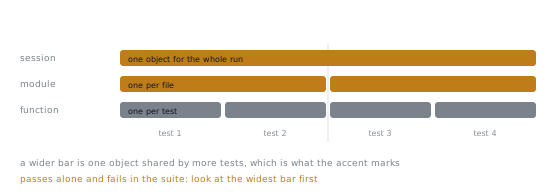
A test that passes alone and fails in the suite is shared mutable state. Check fixture scopes first, then module-level globals.
The table's middle column is the number of bars and its right column follows from their width. function needs no condition because no second test ever sees the object; every scope above it needs one because some later test will. Nothing about a fixture's code says which of these it is, only the scope argument does, which is why the scope is the first thing to read when a suite fails and a single test does not.
| Built-in | Gives |
|---|---|
tmp_path | a fresh directory, named after the test |
monkeypatch | setattr, setitem, setenv, chdir, all undone automatically |
capsys | captured stdout and stderr |
caplog | captured log records |
request | metadata, for request.param |
Factory fixture, the highest-value pattern:
@pytest.fixture
def make_order():
    def _make(**kwargs):
        return Order(**({"id": 1, "amount": Decimal("100"), "country": "GB"} | kwargs))
    return _make
conftest.py fixtures are available without import, nearest directory wins. Put nothing else in it. Use autouse only for global state, frozen time, or warning capture.
Parametrisation
@pytest.mark.parametrize("country, expected", [
    pytest.param("GB", 0.20, id="united-kingdom"),
    pytest.param("ZZ", 0.0, id="not-implemented",
                 marks=pytest.mark.xfail(strict=True, reason="rate table incomplete")),
])
def test_vat_rate(country, expected): ...
- Each case is a separate test: named, individually re-runnable, and a failure does not stop the others.
- The failure output prints the arguments above the body.
- Ids come from the values; containers get useless ids like
value3, so name those withpytest.param. - Stacking decorators produces the cartesian product. Two lists of five is 25 tests.
ids=lambda c: c.namewith a frozen dataclass per case beats a tuple of six fields.list(SomeEnum)as the parameter list makes a new member fail the suite.
Worth parametrising: lookup tables, boundaries, the falsy set, formats that must all parse, inputs that must all be rejected, every enum member.
Not worth it: a parameter that changes which behaviour is tested. If the body needs if expected_error:, it is two tests.
Test doubles
| Kind | Is |
|---|---|
| dummy | passed to satisfy a signature, never used |
| stub | returns canned answers |
| fake | a real, simplified, working implementation |
| spy | records calls and still does the real thing |
| mock | records calls, and the test asserts on them |
Patch where the name is used, not where it is defined. Verified:
# report_from.py did:  from pkg.clock import now
patch("pkg.clock.now", ...)          # no effect on report_from
patch("pkg.report_from.now", ...)    # works

# report_mod.py did:   from pkg import clock
patch("pkg.clock.now", ...)          # works
Importing the module rather than the name makes the target stable.
Use autospec. A bare Mock accepts any attribute, any arity, any arguments:
gateway = create_autospec(Gateway, instance=True)
gateway.charge(10)                # TypeError: missing a required argument: 'currency'
gateway.chrage(10, "GBP")         # AttributeError: Mock object has no attribute 'chrage'
gateway.charge(10, "GBP", "x")    # TypeError: too many positional arguments
| Replace | Leave alone |
|---|---|
| network, payment and email providers | pure functions |
| the clock, randomness, generated ids | dicts, lists, dataclasses |
| slow or rate-limited third-party services | your own domain logic |
the filesystem, when tmp_path will not do | anything already fast and deterministic |
Do not mock what you do not own: wrap it in an interface you own, and fake that. More than two patches in a unit test is a statement about the design, not the test.
Properties
@given(st.text(), st.integers(min_value=0, max_value=50))
def test_truncate_respects_limit(s, n):
    assert len(truncate(s, n)) <= n
| Shape | Assertion |
|---|---|
| round trip | decode(encode(x)) == x |
| idempotence | f(f(x)) == f(x) |
| invariant | a bound that must always hold |
| oracle | fast implementation agrees with the obvious slow one |
| metamorphic | a relation between two calls |
- Put preconditions in the strategy (
min_size=1), not inassume; heavy filtering raisesFailedHealthCheck. @example(...)pins a counterexample the search found, permanently.st.from_type(Order)works on an annotated dataclass, so a typed domain needs almost no strategy code.- Defaults are hostile on purpose:
st.text()yields empty and non-Latin strings,st.floats()yieldsnanand-0.0. - Failing examples are cached in
.hypothesis/, so a local failure reproduces and a fresh CI container may not. - Keep examples too: properties find bugs, examples document intent.
Coverage
Name                  Stmts   Miss Branch BrPart  Cover   Missing
src/shop/pricing.py      12      5      6      1    56%   8-11, 14
[tool.coverage.run]
branch = true
source = ["src"]
branch = true or the number is misleading: an if with no else counts as covered from one path. source or a module no test imports is absent from the report entirely.
100 per cent proves nothing. Verified: three parametrised tests calling a function with no assertion reach 100 per cent statements and branches while the function returns double what it should.
| The number is good for | Not for |
|---|---|
the Missing column: what never ran | proving correctness |
| coverage of the lines a change touched | a CI target, which produces assertion-free tests |
| finding dead code | comparing teams or projects |
| a ratchet that forbids going down | a percentage in a report |
To find out whether tests detect anything: change an operator and see what fails; write the regression test before the fix; or run mutation testing on one module.
Flaky tests, in diagnostic order
- Run it alone, repeatedly. Passes alone, fails together: shared state, so check fixture scopes.
- Randomise test order. Order-dependent confirms it.
- Look for real time:
sleep, timeouts,now(), cache expiry. - Look for unordered data compared as ordered: sets, queries without
ORDER BY, directory listings. - Look for concurrency in the code under test. Then the code has a race and the test found it.
Layers
| Layer | Answers | Should be |
|---|---|---|
| unit | does this function behave? | nearly all, milliseconds each |
| integration | do the pieces talk to a real database or service correctly? | few, and genuinely real |
| end to end | does the system do the user's task? | very few |
An integration test whose collaborators are all mocks is a unit test of the wiring. Name it as one.