Lesson 12. Iterators and Closures
Mission link: Most idiomatic Rust code touching a collection is an iterator chain, and its closures obey lesson 3's borrow rule exactly, which is why a broken-looking chain is usually a borrow held one adapter too long.
Primary source: std::iter
Prerequisites: Lesson 3, Lesson 9
Warm-up
- ▢ Lesson 3's rule: many shared borrows or one mutable borrow, never both, and a borrow ends at its last use. A closure capturing a local by mutable reference is bound by it too. State the rule from memory.
Check
Many shared borrows or exactly one mutable borrow, never both, valid for as long as used. A closure that mutates a captured local is just another mutable borrow.
- ▢ Lesson 9's
Option<T>has two variants, present and absent. An iterator'snextreturns exactly that type. Which variant means no elements are left?
Check
None. Some(item) means there was one more; None means the sequence is exhausted, lesson 9's enum doing its usual job.
Know this
What an iterator is
An iterator is any type implementing the Iterator trait, which asks for exactly one method: fn next(&mut self) -> Option<Self::Item>. That return type is lesson 9's Option: Some(item) means there was one, None means the sequence is over.
let v = vec![1, 2, 3];
let mut it = v.iter();
println!("{:?}", it.next());
println!("{:?}", it.next());
println!("{:?}", it.next());
println!("{:?}", it.next());
This prints Some(1), Some(2), Some(3), None. A for loop is exactly that call, wrapped: for x in v.iter() { ... } desugars to
let mut it = v.iter().into_iter();
loop {
    match it.next() {
        Some(x) => { /* body */ }
        None => break,
    }
}
both print the identical 1 2 3.
A collection hands you an iterator three ways, each different for ownership. iter borrows each element, leaving v usable afterwards. iter_mut borrows mutably: for x in v.iter_mut() { *x *= 2; } doubles every element in place and v still prints as [2, 4, 6]. into_iter takes ownership of the collection itself, moving every element out, and the collection is gone once the loop is written:
let v = vec![1, 2, 3];
for x in v.into_iter() {
    print!("{x} ");
}
println!("{v:?}");
error[E0382]: borrow of moved value: `v`
   --> src/main.rs:6:16
    |
  2 |     let v = vec![1, 2, 3];
    |         - move occurs because `v` has type `Vec<i32>`, which does not implement the `Copy` trait
  3 |     for x in v.into_iter() {
    |                ----------- `v` moved due to this method call
...
  6 |     println!("{v:?}");
    |                ^ value borrowed here after move
Trimmed of a help suggestion to clone. into_iter moved v into the loop, and nothing is left at that name by the time println! runs. The honest fix is rarely clone: reach for iter or iter_mut unless the loop genuinely means to consume the collection.
Laziness, proven rather than asserted
Building a chain does no work at all; only a call that asks for values, a consumer, runs anything inside it.
let mut log = Vec::new();
let v = vec![1, 2, 3];
let chain = v.iter().map(|x| {
    log.push(*x);
    x * 2
});
drop(chain);
println!("{log:?}");
This prints []. The closure passed to map never ran, since chain was dropped without anything calling next on it. Finishing the same shaped chain with .collect() instead changes that completely:
let result: Vec<i32> = v.iter().map(|x| {
    log.push(*x);
    x * 2
}).collect();
println!("{log:?}, {result:?}");
This prints [1, 2, 3], [2, 4, 6]; collect called next three times, running the closure once each time.
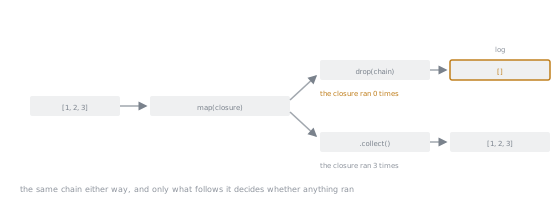
Both endings hang off the same two boxes. The log is not a property of the chain, it is a property of what was asked of it.
That closure captured log by mutable reference, and the borrow lasts as long as the chain does, lesson 3's rule again. Read the captured local before the borrowing chain is done, and the borrow is still live:
let mut side_effects = Vec::new();
let v = vec![1, 2, 3];
let chain = v.iter().map(|x| {
    side_effects.push(*x);
    x * 2
});
println!("{side_effects:?}");
let result: Vec<i32> = chain.collect();
error[E0502]: cannot borrow `side_effects` as immutable because it is also borrowed as mutable
 --> src/main.rs:8:16
  |
4 |     let chain = v.iter().map(|x| {
  |                              --- mutable borrow occurs here
5 |         side_effects.push(*x);
  |         ------------ first borrow occurs due to use of `side_effects` in closure
...
8 |     println!("{side_effects:?}");
  |                ^^^^^^^^^^^^ immutable borrow occurs here
9 |     let result: Vec<i32> = chain.collect();
  |                            ----- mutable borrow later used here
This is E0502 from lesson 3, not a new iterator-specific code. chain is still alive because it is used again on the next line, so its mutable borrow of side_effects has not ended, and the rule is the one lesson 3 named: many shared borrows or one mutable borrow, never both. Moving the read below the collect fixes it by ending the borrow before the conflicting use, rather than fighting it.
The adapters worth knowing
Each adapter changes what a chain will produce, without running anything yet. map asks what you want instead of each element: mapping [1, 2, 3] by doubling yields 2, 4, 6. filter asks which elements to keep: filtering 1..=6 by evenness keeps [2, 4, 6]. filter_map does both, keeping only what a closure turns into Some: parsing ["1", "x", "3"] and dropping failures gives [1, 3] in one step. enumerate pairs each element with its index: (0, 1), (1, 2), (2, 3) for [1, 2, 3]. zip pairs two sequences in step, stopping at the shorter: [1, 2, 3] zipped with ['a', 'b', 'c'] gives (1, 'a'), (2, 'b'), (3, 'c'). take and skip keep or drop from the front: over 1..=6 they give [1, 2, 3] and [4, 5, 6]. chain joins a second iterator onto the first's end: [1, 2] then [3, 4] gives [1, 2, 3, 4]. flat_map flattens as it maps: [[1, 2], [3], [4, 5]] gives one flat [1, 2, 3, 4, 5]. rev needs a known end and gives the back first: reversing 1..=6 gives [6, 5, 4, 3, 2, 1]. peekable answers what none of the others can, what comes next without taking it: peeking [1, 2, 3] returns Some(1) without advancing, so .next() still returns Some(1).
Consuming the chain is where the rest of the vocabulary lives. collect gathers everything into whatever type is named. sum and count reduce to one number, the total or the length: 21 and 6 for 1..=6. fold runs a computation from a seed: folding 1..=6 with 0 and addition gives 21. any and all ask yes or no, stopping once settled: over 1..=6, any even is true, all even is false. find returns the first match as an Option, Some(5) for the first over 4 in 1..=6; position gives the index instead, Some(4). min_by_key and max_by_key take the extreme by a derived key: over 1..=6, maximum by value is Some(6), minimum by distance from 3 is Some(3). for_each runs a closure on every element and keeps nothing; a plain for loop is usually clearer, needing no closure at all.
collect, and what it collects into
collect does not know what to build until told, since several types can be assembled from an iterator and one has to be chosen. The same chain of uppercased words collects into a Vec<String> with an annotation on the binding,
let shout: Vec<String> = words.iter().map(|s| s.to_uppercase()).collect();
or with a turbofish on the call instead, which says exactly the same thing without touching the binding:
let shout = words.iter().map(|s| s.to_uppercase()).collect::<Vec<String>>();
Both give ["AB", "CD", "EF"] for ["ab", "cd", "ef"]. The identical call, annotated String instead, collects the same chain into one concatenated String, since String can be built from an iterator of Strings: "ABCDEF", one string rather than three.
Collecting into a Result changes what the chain does, not just where it lands. ["10", "20", "oops", "40"].iter().map(|s| s.parse::<i32>()).collect::<Result<Vec<i32>, _>>() gives Err(ParseIntError { kind: InvalidDigit }) and stops there, never even parsing "40". The same mapping collected as a plain Vec<Result<i32, _>> keeps every attempt: [Ok(10), Ok(20), Err(ParseIntError { kind: InvalidDigit }), Ok(40)]. Which is right is the question lesson 10 raised for a whole input, whether one bad element should sink the batch, and collect's target type is how that gets decided.
Closures, and the three traits
A closure is checked against three traits, Fn, FnMut and FnOnce, chosen by what its body does to what it captured. A closure that only reads a capture implements Fn:
let x = 10;
let read_only = || x + 1;
A closure that mutates a capture implements FnMut instead, needing a mut binding to be called more than once:
let mut count = 0;
let mut increment = || { count += 1; count };
calling it twice gives 1 then 2. A closure that moves a captured value out implements only FnOnce, since a second call would need that value again:
let s = String::from("owned");
let consume = move || s;
FnOnce is the floor every closure meets; Fn and FnMut are earned by never moving anything out.
move changes what gets captured, not which trait results: every capture is taken by value, which is why a closure outliving its own scope, such as one handed to a thread, needs it. Calling a FnOnce closure twice is worth compiling on purpose:
let s = String::from("owned");
let consume = move || s;
println!("{}", consume());
println!("{}", consume());
error[E0382]: use of moved value: `consume`
 --> src/main.rs:5:20
  |
4 |     println!("{}", consume());
  |                    --------- `consume` moved due to this call
5 |     println!("{}", consume());
  |                    ^^^^^^^ value used here after move
  |
note: closure cannot be invoked more than once because it moves the variable `s` out of its environment
The first call moved s out of consume; the second needs s again and there is none left. This is E0382, the same used-after-move code lesson 9 met on a struct field.
Rust 2021 changed what a closure captures. Before that edition, naming one field captured the whole struct, so a closure failed to compile if another field was already moved out or mutably borrowed elsewhere, even untouched; the workaround was cloning the field, or the struct, just for something independent. Since Rust 2021, a closure captures only the fields it names:
struct Point { left: i32, right: i32 }
let mut p = Point { left: 1, right: 2 };
let mut touch_left = || { p.left += 1; };
touch_left();
println!("{}", p.right);
touch_left borrows only p.left, so p.right prints 2 while it is still alive, and calling it again leaves p.left at 3. The release announcement says it plainly: "Starting in Rust 2021, closures will only capture the fields that they use."
When a loop is the better answer
An iterator chain is not automatically the clearer choice. A computation needing an index, a running mutation, and an early exit all at once is usually easier to read as the loop it would otherwise be. Finding how far into a list of byte counts the running total first exceeds a budget, stopping as soon as it does, is a for loop that simply returns:
fn first_over(bytes: &[u64], budget: u64) -> Option<(usize, u64)> {
    let mut total = 0u64;
    for (i, &b) in bytes.iter().enumerate() {
        total += b;
        if total > budget {
            return Some((i, total));
        }
    }
    None
}
Reaching for fold to avoid writing that loop needs a tuple threaded through every step to fake the early exit fold does not have, since fold always runs to the end regardless of what its accumulator already holds: a (total, done, found) tuple, a check for done on every element after the answer already sits in found, and the same Some((2, 600)) for a budget of 500 over [100, 200, 300, 900], bought at the cost of a closure nobody would call readable. This is a style, not an improvement: write the loop when the chain would fight fold's shape just to say what return already says.
Practice
-
▢ Predict which of these two blocks compile.
// A
let mut v = vec![1, 2, 3];
for x in v.iter_mut() {
    *x *= 2;
}
println!("{v:?}");

// B
let v = vec![1, 2, 3];
for x in v.into_iter() {
    print!("{x} ");
}
println!("{v:?}");
Check
A compiles, printing [2, 4, 6]: iter_mut only borrows. B does not: E0382, since into_iter moved v, leaving nothing at that name for the final println!.
-
▢ Predict what
visitedandfirst_twohold once this runs, then compile it.let mut visited = Vec::new(); let v = vec![1, 2, 3, 4, 5]; let first_two: Vec<i32> = v .iter() .map(|x| { visited.push(*x); x * 10 }) .take(2) .collect();
Hint
take(2) only asks next for two values. Work out how many times map's closure can run before that.
Check
visited is [1, 2] and first_two is [10, 20]. take(2) stops the chain after two elements, so map never runs on 3, 4 or 5; laziness bounds how much of a chain runs, not just whether it runs.
-
▢ These collect the same mapping over
["10", "20", "oops", "40"]two ways. Predict both outputs, then compile and run it.let entries = ["10", "20", "oops", "40"]; let as_result: Result<Vec<i32>, _> = entries.iter().map(|s| s.parse::<i32>()).collect(); let as_vec_of_results: Vec<Result<i32, _>> = entries.iter().map(|s| s.parse::<i32>()).collect();
Check
as_result is Err(ParseIntError { kind: InvalidDigit }), stopping at the first failure. as_vec_of_results is [Ok(10), Ok(20), Err(ParseIntError { kind: InvalidDigit }), Ok(40)], keeping every attempt. Same mapping; the target type decides the behaviour.
-
▢ Predict whether this compiles, naming the error code if not, then compile it.
let s = String::from("owned");
let consume = move || s;
println!("{}", consume());
println!("{}", consume());
Hint
Work out which trait consume implements from what its body does to s, then ask what a second call would need.
Check
Does not compile: E0382, use of a moved value. consume moves s out on its first call, so it implements only FnOnce; a second call has nothing left to move.
-
▢ Judgement call, not a compile check.
first_over_foldcomputes the same answer as thefirst_overloop above. Say which version you would rather maintain, and why.fn first_over_fold(bytes: &[u64], budget: u64) -> Option<(usize, u64)> { let (_, _, found) = bytes.iter().enumerate().fold( (0u64, false, None), |(total, done, found), (i, &b)| { if done { (total, done, found) } else { let total = total + b; if total > budget { (total, true, Some((i, total))) } else { (total, false, found) } } }, ); found }
Check
The loop. fold has no early exit, so this version carries a done flag through the accumulator and keeps checking it after the answer is already known, purely to imitate a return the loop gets for free.
Real-world reps
- [ ] Rewrite whichever loop in your
logsumproject tallies requests, notes, blanks and rejected lines as one iterator chain, and keep whichever version reads better, saying why. - [ ] Reproduce this lesson's laziness demonstration against a chain of your own: log to a
Vecinside a closure, drop the chain unconsumed, then build it again and finish with.collect(). - [ ] Tomorrow: without looking back, name the three closure traits and what distinguishes each, then check against this lesson.
Going further
- Closures: capturing the environment, and the three
Fntraits - Processing a Series of Items with Iterators: the
Iteratortrait, laziness, and adapters versus consumers - Iterator: the trait, with every method's exact signature
- The Plan for the Rust 2021 Edition: the release behind disjoint field capture
- Data and control: the stage 2 reference sheet
- Resources
Not landing? Reread the primary source at the top, since this lesson compresses it and compression is where understanding leaks. Check the glossary for any term that felt slippery.
If the lesson itself is unclear rather than the material, that is a defect: open an issue.