Lesson 14. Propagating Errors
Mission link: A function stacking several fallible calls behind hand-written match arms is either long enough that a reviewer stops reading closely, or it quietly narrows every error down to one string; ? collapses that stack to one call each, but only once the signature names an error type that can absorb every failure it meets.
Primary source: Recoverable Errors with Result
Prerequisites: Lesson 10, Lesson 9
Warm-up
- ▢ Lesson 10 wrote
s.parse::<i32>()?inside a function returningResult<i32, ParseIntError>, in place of a four-linematch. In plain words, what does that one character do on theOkcase and on theErrcase?
Check
On Ok(v) it unwraps to v and execution carries on as if you had written the value directly. On Err(e) it returns from the enclosing function immediately, handing back the error. Lesson 10 stopped there and called it a shortcut for match; this lesson opens up what happens to e on the way out, which is the one detail that decides whether ? compiles at all.
- ▢ Lesson 9's
ok_orturnsNoneintoErr(e)for whatevereyou supply, and leavesSome(x)asOk(x). If one step of aResult-returning function only has anOptionto work with, what doesok_orlet you do before you can reach for?on that step?
Check
ok_or supplies the missing error value up front, turning the Option into a Result you can call ? on directly. ? only understands Result inside a function that returns Result; ok_or, or ok_or_else when computing the error costs something, is the bridge that gets an absence there, which is exactly the mismatch this lesson runs into further down.
Know this
The step ? hides: unwrap, or convert and return
Lesson 10 used ? to shorten a match but never opened up what it does. On a Result, expr? behaves like this, written out by hand rather than as a macro:
// let n = expr?; desugars to roughly:
let n = match expr {
    Ok(v) => v,
    Err(e) => return Err(From::from(e)),
};
Two functions built from the two forms give identical results for every input: s.parse::<i32>()? and the hand-written match above both give Ok(42) for "21" and Err(ParseIntError { kind: InvalidDigit }) for "x". The unwrapping half, Ok(v) => v, is the part everyone remembers about ?. The half worth fixing in your head instead is Err(e) => return Err(From::from(e)): ? does not hand the Err value back unchanged, it hands back whatever the function's own error type converts it into through From. Every consequence in the rest of this lesson follows from that one conversion step, not from the unwrapping.
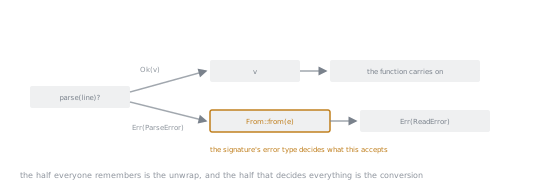
Only one of the two paths has a box on it, and the two error types on that path are different ones. That box is the whole of the rest of this lesson.
The conversion requirement, met head-on
Lesson 10 already showed this once with its own MyError, so here is the same mechanism against a fresh function, reading the byte count out of a line with the crate's own parse:
#[derive(Debug)]
struct ReadError(String);

fn read_bytes(line: &str) -> Result<u64, ReadError> {
    let (_path, bytes) = errprobe::parse(line)?;
    Ok(bytes)
}
error[E0277]: `?` couldn't convert the error to `ReadError`
 --> src/bin/read.rs:5:47
  |
4 | fn read_bytes(line: &str) -> Result<u64, ReadError> {
  |                              ---------------------- expected `ReadError` because of this
5 |     let (_path, bytes) = errprobe::parse(line)?;
  |                          ---------------------^ the trait `From<ParseError>` is not implemented for `ReadError`
  |                          |
  |                          this can't be annotated with `?` because it has type `Result<_, ParseError>`
  |
note: `ReadError` needs to implement `From<ParseError>`
There are exactly three ways past this. The first is a real From<ParseError> implementation for ReadError, so ? has a conversion to call; writing one well, for every error a type needs to absorb, is lesson 16's subject, named here rather than built. The second is map_err at the call site, needing no From at all: errprobe::parse(line).map_err(|e| ReadError(e.to_string()))? compiles and gives Err(ReadError("missing field bytes")). The third drops the local error type and widens the signature to Result<u64, Box<dyn std::error::Error>>; with that return type the original errprobe::parse(line)? compiles unchanged, and a caller prints the boxed value with {} to get missing field bytes straight out. That third option costs something specific: a caller who wants to branch rather than just print has to guess a concrete type and ask for it back with downcast_ref, verified working when the guess matches and giving None when it does not. That guessing game is exactly what a library should not hand a caller, so the From implementation is what to reach for there; map_err is a fine stopgap for one or two call sites, and Box<dyn Error> earns its keep at a binary's edge, where nothing downstream needs to match on the failure.
One function, two kinds of failure
A function that reads a count and then a field fails in two unrelated ways, and ? needs telling how both convert. Written with map_err at each site and no shared error type:
fn read_record_a(count: &str, line: &str) -> Result<(i32, String), String> {
    let n: i32 = count.parse().map_err(|e| format!("bad count: {e}"))?;
    let (path, _) = errprobe::parse(line).map_err(|e| format!("bad line: {e}"))?;
    Ok((n, path.to_string()))
}
This gives Err("bad count: invalid digit found in string") and Err("bad line: missing field bytes") for the two bad inputs, and it costs nothing to read locally: each line states its own failure in English on the spot. It costs the caller everything: String carries no structure, so telling the two failures apart means parsing prose. The alternative gives both calls one error type to convert into:
#[derive(Debug)]
enum RecordError {
    Count(std::num::ParseIntError),
    Line(errprobe::ParseError),
}

fn read_record_b(count: &str, line: &str) -> Result<(i32, String), RecordError> {
    let n: i32 = count.parse()?;
    let (path, _) = errprobe::parse(line)?;
    Ok((n, path.to_string()))
}
With From<ParseIntError> and From<errprobe::ParseError> written for RecordError, this gives Err(Count(ParseIntError { kind: InvalidDigit })) and Err(Line(MissingField { field: "bytes" })). It costs two small From implementations up front, boilerplate lesson 16 automates, but the signature now names two variants a caller can match on with an ordinary match, rather than a sentence they have to parse back apart.
? on Option, and where it stops
? works the same way in a function returning Option, unwrapping Some and returning None early with nothing to convert: s.chars().last()? inside a function returning Option<char> gives Some('h') for "teach" and None for "". It does not, on its own, cross into a function returning Result:
fn first_char_checked(s: &str) -> Result<char, String> {
    let c = s.chars().next()?;
    Ok(c)
}
error[E0277]: the `?` operator can only be used on `Result`s, not `Option`s, in a function that returns `Result`
 --> src/bin/mismatch.rs:2:29
  |
1 | fn first_char_checked(s: &str) -> Result<char, String> {
  | ------------------------------------------------------ this function returns a `Result`
2 |     let c = s.chars().next()?;
  |                             ^ use `.ok_or(...)?` to provide an error compatible with `Result<char, String>`
The compiler's own suggestion is the fix from the warm-up: s.chars().next().ok_or("empty string".to_string())? compiles and gives Err("empty string"). ok_or_else takes a closure instead of a value, useful when the error is worth building lazily: s.chars().next().ok_or_else(|| format!("{s:?} is empty"))? gives Err("\"\" is empty") for the same input.
? in main, and which form of the error it prints
Lesson 10 already showed fn main() -> Result<(), E> failing with Error: followed by the error's printed form; the part worth adding is which form that is. Printing the same ParseError value both ways side by side, println!("{e}") gives missing field bytes, its Display, while println!("{e:?}") gives MissingField { field: "bytes" }, its Debug. Running a main whose ? fails on that same value prints Error: MissingField { field: "bytes" } on standard error and exits with status 1: the line after Error: is the Debug form, not the friendlier Display one. That is worth knowing on its own terms, because it means an error type wants a Debug a reader can make sense of, not just a good Display; a plain #[derive(Debug)] that dumps every field is often enough for that, but it is a decision, not an accident.
Where ? cannot go
Three shapes reject ? with the same diagnostic, each for a different reason. A closure passed to map that returns i32 rather than a Result or Option, as in .map(|s| { let n = s.parse::<i32>()?; n * 2 }), fails because the closure itself must return Result or Option; the fix is to make it return one and collect the whole chain into a Result, .map(|s| s.parse::<i32>().map(|n| n * 2)). A function returning () fails the same way, needing a Result or Option return type to hand the early return to; the fix is Result<(), Box<dyn std::error::Error>> at a binary's edge, or a named error type in a library. A #[test] function, which returns () by default, fails identically, and the fix is the same: fn my_test() -> Result<(), Box<dyn std::error::Error>>, ending with Ok(()). None of these three is a case for reaching past Result into panic! instead; whether a failure deserves a Result or a panic is a separate call, and lesson 17 is where that rule lives.
Practice
-
▢ Predict whether this compiles, and if not, predict the diagnostic's code.
#[derive(Debug)]
struct LoadError;

fn load_count(s: &str) -> Result<u32, LoadError> {
    let n = s.parse::<u32>()?;
    Ok(n)
}
Check
It fails with E0277, because ? needs LoadError: From<ParseIntError> and LoadError implements no such thing. The message is the same shape every time this mistake happens: it names the trait that is missing rather than anything wrong with the parsing itself.
- ▢ Fix the previous function with
map_errinstead of aFromimplementation, givingLoadErrora field to carry the message, then compile and run it against"12"and"x".
Hint
map_err goes between the fallible call and the ?, not after it: s.parse::<u32>().map_err(|e| LoadError(e.to_string()))?.
Check
#[derive(Debug)]
struct LoadError(String);

fn load_count(s: &str) -> Result<u32, LoadError> {
    let n = s.parse::<u32>().map_err(|e| LoadError(e.to_string()))?;
    Ok(n)
}
This gives Ok(12) and Err(LoadError("invalid digit found in string")). Nothing about ? changed; only the Result it now receives already has the right error type.
-
▢ Predict what this prints for
"teach"and for"", then compile and run it.fn last_char(s: &str) -> Option<char> { let c = s.chars().last()?; Some(c) }
Check
Some('h') and None. ? on an Option inside a function returning Option is the unwrap-or-return-early behaviour with nothing to convert, since there is no Err payload on either side.
-
▢ This test has no return type, so it is
()by default. Predict the diagnostic, then fix it so the test compiles and passes.#[test] fn parses_bytes() { let n = "1200".parse::<u64>()?; assert_eq!(n, 1200); }
Hint
The fix is the same one the compiler suggests for a plain function: give the test a return type ? can work with, and end it with Ok(()).
Check
It fails with E0277, because a test with no return type is exactly that: a function returning (), and ? needs a Result or Option return type to hand its early return to. Giving it -> Result<(), Box<dyn std::error::Error>> and a final Ok(()) fixes it, and the fixed version compiles and passes.
- ▢ Two versions of a record reader exist, one with
map_errat each call and one with a sharedRecordErrorenum both calls convert into. A teammate wants tomatchon which of the two calls failed without inspecting a string. Which version does that, and what did the other version's author have to write that this one's did not?
Hint
Look at what a caller receives from each: a String built by format!, or an enum with a variant per failure.
Check
The shared-RecordError version supports that match, because its two variants carry the original errors rather than a sentence describing them. Its author had to write, once, a From implementation for each error the two calls can produce; the map_err version's author wrote no From implementation at all, at the cost of a caller who can only compare strings.
Real-world reps
- [ ] Replace every hand-written
matchon aResultin your summariser's line-parsing and record-reading functions with?and one shared error type, then write, in a sentence, what the resulting signature now promises a caller that a barematchreturning aStringnever did. - [ ] Make your summariser's
mainreturnResult<(), Box<dyn std::error::Error>>, so a line your parser cannot handle stops the run with a printed error instead of a silently wrong count or a panic. - [ ] Tomorrow: find one call in your summariser where a callee's error type does not already match its caller's, and note whether you reached for
map_error a shared error type to make?compile there, and why that was the right stopgap or the right fix.
Going further
- E0277: the trait-not-implemented diagnostic behind every failed
?conversion - Option in std::option:
ok_orandok_or_else, the two bridges fromOptiontoResult - Result in std::result:
map_err, the call-site conversion that needs noFromimplementation - Operator expressions: the Reference's rule for what
?desugars to and what it requires, under the name it now carries - Errors and API shape: the stage 3 reference sheet
- Resources
Not landing? Reread the primary source at the top, since this lesson compresses it and compression is where understanding leaks. Check the glossary for any term that felt slippery.
If the lesson itself is unclear rather than the material, that is a defect: open an issue.