Lesson 21. Traits as Shared Behaviour
Mission link: Two unrelated types in a codebase that both need to report progress, or both need to compare equal, either get that behaviour copied by hand into each one or get it named once as a trait and implemented per type, and the second choice is the one every later lesson in this stage assumes you can already make.
Primary source: Defining Shared Behavior with Traits
Prerequisites: Lesson 7, Lesson 15
Warm-up
- ▢ Lesson 7 gave a struct's own methods a home inside an
implblock, written for exactly one type. A trait also declares methods, but not for any one type yet. What changes about a method once it moves from a plainimplblock into a trait's own declaration, before that trait has been implemented for anything?
Check
Nothing about how the method reads, its receiver and its body still work the same way. What changes is ownership of the name: a plain impl block's method belongs to the one type it is written on, while a trait's declaration names behaviour that any number of types can later promise to provide, each with its own impl Trait for Type block.
- ▢ Lesson 15 had you implement
std::error::Errorby hand on your own error enum, including asourcemethod, and later callerr.source()on a value of that enum.sourceis declared onError, not on your enum. Beyond writing theimpl, what has to be true wherever.source()is called for that call to compile?
Check
std::error::Error itself has to be in scope at the call site, usually through use std::error::Error;, and lesson 15's examples already had it in scope without dwelling on the requirement. This lesson makes that requirement explicit and shows exactly what happens when it is missing.
Know this
A trait names behaviour, and a default can lean on what is required
A trait declaration lists methods without saying which type provides them yet. A required method has only a signature; a default method has a body, and that body can call a required method the same way any method calls another:
trait Announce {
    fn kind(&self) -> &'static str;
    fn announce(&self) -> String {
        format!("this is a {}", self.kind())
    }
}
kind is required: any type implementing Announce must supply it. announce is a default: it calls self.kind() without knowing yet which type's kind that will turn out to be. Two types can implement the same trait and treat that default differently, one leaving it alone and one replacing it:
struct Bike;
struct Car;

impl Announce for Bike {
    fn kind(&self) -> &'static str {
        "bike"
    }
}

impl Announce for Car {
    fn kind(&self) -> &'static str {
        "car"
    }

    fn announce(&self) -> String {
        format!("vroom, a {}", self.kind())
    }
}
Bike's impl block never mentions announce, so it inherits the default, and Car's overrides it. Calling both directly, with no generic function and no dyn anywhere in sight, shows each behaviour:
println!("{}", Bike.announce());
println!("{}", Car.announce());
this is a bike
vroom, a car
Bike.announce() runs the default body, which itself called Bike's kind; Car.announce() runs the version Car wrote instead. Both are ordinary method calls on ordinary types: nothing here needed a type parameter or a trait object, because the caller always knew, at the call site, exactly which concrete type it was calling through.
The trait has to be in scope
This is the single most common confusion about traits, and it has nothing to do with the trait itself being wrong. A method declared on a trait is only callable with dot syntax where that trait is in scope, even when the impl exists and the type is right there. Split a trait and its impl into one module and call the method from another, without importing the trait:
mod shapes {
    pub trait Shape {
        fn area(&self) -> f64;
    }

    pub struct Square {
        pub side: f64,
    }

    impl Shape for Square {
        fn area(&self) -> f64 {
            self.side * self.side
        }
    }
}

mod report {
    use crate::shapes::Square;

    pub fn show(sq: Square) {
        println!("{}", sq.area());
    }
}
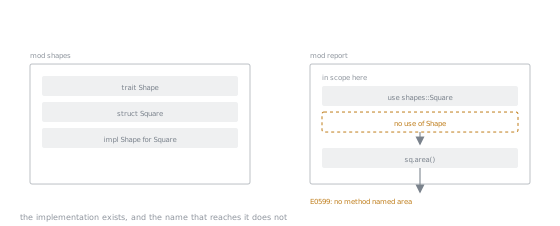
Everything the call needs exists, and one of the two things it needs here does not. The empty slot is drawn in the position the missing import would occupy.
report imports Square but not Shape, and that omission is the whole bug:
error[E0599]: no method named `area` found for struct `Square` in the current scope
   |
 3 |         fn area(&self) -> f64;
   |            ---- the method is available for `Square` here
...
21 |         println!("{}", sq.area());
   |                           ^^^^ method not found in `Square`
   |
   = help: items from traits can only be used if the trait is in scope
help: trait `Shape` which provides `area` is implemented but not in scope; perhaps you want to import it
   |
18 +     use crate::shapes::Shape;
   |
The compiler already knows the fix: it points at the trait's own declaration to say the method exists for this type, then names the exact rule, items from traits can only be used if the trait is in scope, then suggests the precise use line. Adding use crate::shapes::Shape; to report, alongside the existing import of Square, is enough, and the same sq.area() call now compiles and prints 9. Nothing about Square or Shape changed; the only difference is that the trait providing area is now nameable from where area is called. A struct's own methods, from lesson 7, never had this problem, because they were never routed through a trait's name in the first place; this is the one new failure mode a trait introduces, and it reads as a scope problem rather than a design problem the moment you know to look for it.
Writing Display by hand, deriving the rest
Some standard-library traits are worth implementing by hand, because the implementation is a decision, and some are worth deriving, because the implementation is mechanical. Display is the first kind: formatting a value for a person is a choice about what that person needs to see, so the standard library gives you no derive for it at all. Trying one fails before it even reaches type checking:
error: cannot find derive macro `Display` in this scope
 --> src/main.rs:1:10
  |
1 | #[derive(Display)]
  |          ^^^^^^^
There is simply no macro named Display to find; the standard library only ever expects you to write fmt by hand:
use std::fmt;

struct Tally {
    requests: u64,
    rejected: u64,
}

impl fmt::Display for Tally {
    fn fmt(&self, f: &mut fmt::Formatter<'_>) -> fmt::Result {
        write!(f, "{} requests, {} rejected", self.requests, self.rejected)
    }
}
Debug, Clone and PartialEq are the opposite case: each has an obvious, mechanical definition, so derive writes it precisely, one line per trait:
#[derive(Debug, Clone, PartialEq, Default)]
struct Tally {
    requests: u64,
    rejected: u64,
}
Default belongs on this list only where a sensible zero already exists, and it does here: no requests and no rejections is a legitimate starting Tally, not a value invented to satisfy the compiler. Deriving it requires every field to implement Default in turn, which u64 does, and Tally::default() then builds one without you writing a constructor for the empty case. Compiling all four derives together and exercising each confirms they cooperate: println!("{:?}", tally.clone()) prints the fields, tally == tally.clone() is true, and Tally::default() prints as Tally { requests: 0, rejected: 0 }.
Display gives you ToString for free
The standard library ships impl<T> ToString for T where T: Display + ?Sized, one blanket implementation covering every type that implements Display. Writing fmt::Display by hand for Tally is therefore the only work needed before .to_string() also works on it:
let report = Tally { requests: 10, rejected: 2 };
let line: String = report.to_string();
line is "10 requests, 2 rejected", produced by a method this lesson never defined; it comes from ToString, satisfied automatically the moment Display is. A type with no Display has no such method, and the two ways of asking for one fail differently. println!("{}", value) on a #[derive(Debug)]-only type fails at the format string itself:
error[E0277]: `Sensor` doesn't implement `std::fmt::Display`
 --> src/main.rs:8:20
  |
8 |     println!("{}", s);
  |               --   ^ `Sensor` cannot be formatted with the default formatter
  |
  = note: in format strings you may be able to use `{:?}` (or {:#?} for pretty-print) instead
while value.to_string() on the same type fails as an ordinary missing method:
error[E0599]: `Sensor` doesn't implement `std::fmt::Display`
   |
 2 | struct Sensor {
   | ------------- method `to_string` not found for this struct because it doesn't satisfy `Sensor: ToString` or `Sensor: std::fmt::Display`
...
 9 |     println!("{}", s.to_string());
   |                      ^^^^^^^^^ method cannot be called on `Sensor` due to unsatisfied trait bounds
   |
   = note: the following trait bounds were not satisfied:
           `Sensor: std::fmt::Display`
           which is required by `Sensor: ToString`
A further note in that second diagnostic points into the standard library's own source by an absolute filesystem path; it is trimmed here, and the fact it names, that Display is the trait to_string needs, is already stated in the lines kept.
Trait methods and inherent methods can share a name
A type can have an inherent method, one written in a plain impl block on that type, with the same name as a method it also gets through a trait. Method-call syntax resolves this in one direction only, favouring the inherent method:
trait Countdown {
    fn start(&self) -> &'static str {
        "counting down from the trait"
    }
}

struct Timer;

impl Timer {
    fn start(&self) -> &'static str {
        "counting up from the inherent method"
    }
}

impl Countdown for Timer {}
println!("{}", Timer.start());
println!("{}", Countdown::start(&Timer));
counting up from the inherent method
counting down from the trait
Timer.start() finds the inherent method before it ever looks at any trait Timer implements, silently, with no warning that a trait method by the same name was shadowed. The trait's version is not gone, only unreachable through dot syntax on this type; naming the trait explicitly, Countdown::start(&Timer), reaches it directly. An inherent method is written closer to the type than any trait can be, and that is exactly why it wins first.
Practice
-
▢ Predict what
Nightingale.call()andCrow.call()each print, given a trait with a default and one type that overrides it.trait Bird { fn sound(&self) -> &'static str; fn call(&self) -> String { format!("a bird says {}", self.sound()) } } struct Nightingale; struct Crow; impl Bird for Nightingale { fn sound(&self) -> &'static str { "a song" } } impl Bird for Crow { fn sound(&self) -> &'static str { "a caw" } fn call(&self) -> String { format!("a crow just went {}", self.sound()) } }
Check
Nightingale.call() prints a bird says a song, running the inherited default with its own sound. Crow.call() prints a crow just went a caw, running the version Crow wrote instead, which still calls self.sound() internally.
-
▢ A trait
Loudand a structDrumimplementing it live in a moduleinstruments; a second moduleplayerimportsDrumand callsd.shout(). Name the error code before compiling, then add the one import that fixes it.mod instruments { pub trait Loud { fn shout(&self) -> String; } pub struct Drum; impl Loud for Drum { fn shout(&self) -> String { String::from("BOOM") } } } mod player { use crate::instruments::Drum; pub fn play(d: Drum) { println!("{}", d.shout()); } }
Hint
player imports the type Loud is implemented for, but not Loud itself.
Check
It is E0599, the same shape as this lesson's centrepiece: no method named shout found for struct Drum in the current scope, with a help suggesting use crate::instruments::Loud; alongside the existing import of Drum. Adding it compiles and prints BOOM.
- ▢ Predict whether
#[derive(Display)]on a struct compiles, and if not, what kind of error it is before the compiler even checks the struct's fields.
Check
It does not compile: error: cannot find derive macro Display in this scope, with no error code at all. Display has no derive macro anywhere in the standard library, since formatting for a person is always a decision, not a mechanical transformation of a type's fields.
-
▢
Sensorbelow derivesDebugonly. Predict what happens for each of the two lines, and whether they fail with the same error.#[derive(Debug)] struct Sensor { id: u32, } fn main() { let s = Sensor { id: 7 }; println!("{}", s); println!("{}", s.to_string()); }
Hint
One line asks the formatting machinery for a trait Sensor does not have; the other calls a method that only exists because of that same trait.
Check
Both fail, but differently. println!("{}", s) gives E0277, Sensor doesn't implement std::fmt::Display, reported against the format string itself. s.to_string() gives E0599, an ordinary missing-method error, because ToString's blanket implementation needs Display and Sensor has only Debug.
-
▢
Cuphas an inherentfilland also implements a traitContainerwith a defaultfill. Predict whatCup.fill()prints, and what would need to change to reach the trait's version instead.trait Container { fn fill(&self) -> &'static str { "filled by the trait" } } struct Cup; impl Cup { fn fill(&self) -> &'static str { "filled by the inherent method" } } impl Container for Cup {}
Check
Cup.fill() prints filled by the inherent method: an inherent method always wins over a trait method of the same name in dot-call syntax, with no warning that the trait's version was shadowed. Reaching the trait's version needs fully qualified syntax instead, Container::fill(&Cup), which prints filled by the trait.
Real-world reps
- [ ] Give your
logsumproject's summary type a hand-writtenDisplayimplementation covering every count and every per-path total it already tracks, so that printing the finished report becomes oneprintln!instead of a sequence of them. - [ ] Derive
Defaultfor the accumulator your summariser builds up while it reads lines, and replace whatever manual zero-value construction that accumulator used since stage 2 withAccumulator::default(), or your own type's name in its place. - [ ] Tomorrow: leave a note above the summary type saying that a later rep in this stage will change what the summariser reads from, to anything that yields lines rather than one concrete type; do not make that change now, since a different lesson owns it.
Going further
- Appendix C: Derivable Traits: what
derivegenerates forDebug,Clone,PartialEqandDefault, and whyDisplayis deliberately absent from the list - ToString in std::string: the blanket implementation over every
Displaytype, and the panic it documents ifDisplayitself misbehaves - E0599: the diagnostic behind a missing method, whether the trait providing it is merely out of scope or never implemented at all
- Display in std::fmt: the trait behind
{}, and the onefmtmethod it requires - Traits and lifetimes: the stage 4 reference sheet
- Resources
Not landing? Reread the primary source at the top, since this lesson compresses it and compression is where understanding leaks. Check the glossary for any term that felt slippery.
If the lesson itself is unclear rather than the material, that is a defect: open an issue.