Lesson 23. Associated Types
Mission link: A trait whose method needs a placeholder type forces a choice about who fills it in, the implementer once or the caller every call, and getting it backwards either boxes every implementer into one type or makes every call site repeat itself, the choice Iterator settles by declaring Item an associated type rather than a parameter.
Primary source: Iterator
Prerequisites: Lesson 12, Lesson 22
Warm-up
- ▢ Lesson 12 said an iterator is any type implementing
Iterator, which asks for exactly one method,fn next(&mut self) -> Option<Self::Item>. Without looking ahead, say whatSelf::Itemstands in for, and why the signature is notfn next<T>(&mut self) -> Option<T>.
Check
Self::Item names the one type this implementer's iterator produces, fixed when Iterator is implemented rather than supplied by whoever calls next. A generic T would let the same call site ask for a different type each call, which is not what an iterator does: the same value always yields the same kind of thing.
- ▢ Lesson 22 showed that a generic function bounded by a trait, called with two concrete types, produces two separate copies in the compiled binary, while the same function taking
&dyn Traitcompiles once and dispatches at runtime. Name the compiler technique behind the generic version's duplication.
Check
Monomorphisation: the compiler generates one specialised copy per concrete type the generic function is called with, rather than one shared copy that decides at runtime. The &dyn Trait version is the other side of that trade, a single compiled copy that pays with a vtable lookup.
Know this
One choice per type, not one choice per call
An associated type is a placeholder a trait declares once, filled in exactly once by each implementer, and it is easy to reach for a generic parameter instead since both look like a slot for a concrete type. Iterator declares type Item; rather than trait Iterator<Item>: a generic parameter lets the same type implement a trait many times, once per value a caller supplies, while an associated type is chosen once by the implementer and every caller sees the same answer. Writing Iterator<u32> as though Item were a parameter does not compile:
error[E0107]: trait takes 0 generic arguments but 1 generic argument was supplied
  --> src/bin/e0107.rs:1:18
   |
 1 | fn takes_iter<I: Iterator<u32>>(_it: I) {}
   |                  ^^^^^^^^ expected 0 generic arguments
   |
help: turn the generic argument into an associated item binding
   |
 1 | fn takes_iter<I: Iterator<Item = u32>>(_it: I) {}
   |                           ++++++
A note line normally follows, quoting the trait's declaration by pointing at the standard library's own source file with a full path into the installed toolchain; it is trimmed here, since that path names one machine's toolchain install and tells a reader nothing. The help is the whole story: Iterator takes zero generic arguments, and what looked like one is an associated item waiting for a Name = Type binding instead.
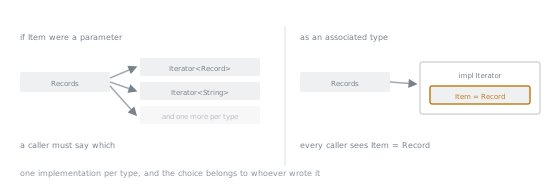
Same type on both sides, and the only thing that changes is how many implementations it can have. On the right there is one, and the binding inside it is the answer every caller gets.
Going the other way, a trait object that never says what Item is fails just as directly, because &dyn Iterator needs one concrete shape for its vtable:
error[E0191]: the value of the associated type `Item` in `Iterator` must be specified
 --> src/bin/e0191.rs:1:22
  |
1 | fn describe(it: &dyn Iterator) {
  |                      ^^^^^^^^
  |
help: specify the associated type
  |
1 | fn describe(it: &dyn Iterator<Item = /* Type */>) {
  |                              +++++++++++++++++++
The help inserts the missing binding. Both errors are one fact seen twice: Item is not a knob a caller turns per call, it is a decision the implementer already made, and the compiler needs it settled first.
Implementing Iterator for your own type
The project's parsing step hands back one parsed line at a time out of a loop; turning that into an Iterator means writing the one method the trait asks for and choosing Item once, after which the rest of the iterator vocabulary follows unasked. Records below wraps whatever already yields owned lines and owns every String it reads, deliberately: teaching it to borrow the line instead is lesson 27's job, not this one's.
struct Record {
    path: String,
    status: u16,
    bytes: u64,
}

struct Records {
    lines: std::vec::IntoIter<String>,
}

fn parse_record(line: &str) -> Option<Result<Record, String>> {
    if line.is_empty() || line.starts_with('#') {
        return None;
    }
    let mut parts = line.split_whitespace();
    let (Some(path), Some(status), Some(bytes)) = (parts.next(), parts.next(), parts.next())
    else {
        return Some(Err(format!("missing field in {line:?}")));
    };
    let (Ok(status), Ok(bytes)) = (status.parse(), bytes.parse()) else {
        return Some(Err(format!("{line:?} is not a number")));
    };
    Some(Ok(Record { path: path.to_string(), status, bytes }))
}

impl Iterator for Records {
    type Item = Result<Record, String>;

    fn next(&mut self) -> Option<Self::Item> {
        loop {
            let line = self.lines.next()?;
            if let Some(result) = parse_record(&line) {
                return Some(result);
            }
        }
    }
}
next returns Option<Self::Item>, and here Item is Result<Record, String>: a blank line or a comment is skipped without producing anything, a request line that parses becomes Ok, and a request-shaped line that fails to parse becomes Err rather than being silently dropped. Choosing Item to be a Result rather than a bare Record is still one choice made once for every consumer; nothing in Iterator's declaration stops an associated type from being a compound type like this one.
Nothing else about Records needed writing. Over the project's seven-line sample input, three requests, a comment, a blank line and two malformed lines, .count() walks the chain once and returns 5, one entry per line that was neither blank nor a comment. Calling .filter_map(Result::ok).map(|r| r.bytes).sum::<u64>() on the same input keeps only the successes and totals their bytes, 2090. Neither count, filter_map nor sum is written anywhere in Records: they are default methods declared once on Iterator itself, defined in terms of next, and every type that supplies next inherits all of them for free. That is the trade a hand-written loop never offered: write one honest method and the whole vocabulary lesson 12 covered, map, filter_map, sum, count and the rest, works on the new type with no further code.
Naming the associated type in a bound
A function generic over something that implements Iterator usually needs to say what item it produces, using the same Name = Type binding the E0107 help suggested:
fn sum_of<I: Iterator<Item = u32>>(it: I) -> u32 {
    it.sum()
}
calling sum_of(vec![1u32, 2, 3].into_iter()) gives 6. The same binding names what an impl Trait return type produces, without naming the concrete iterator type underneath it:
fn paths(records: Vec<Record>) -> impl Iterator<Item = String> {
    records.into_iter().map(|r| r.path)
}
collecting it into a Vec<String> gives ["/index", "/index", "/login"] for the three parsed requests above; the caller learns only that it yields owned Strings, not that the real type is a Map over std::vec::IntoIter.
Most of the time I::Item is all a signature needs, but that shorthand breaks once a type is bound by two traits that each declare an associated type of the same name:
trait Labelled {
    type Item;
}

fn describe<I: Iterator + Labelled>(_first: I::Item) {}
error[E0221]: ambiguous associated type `Item` in bounds of `I`
 --> src/bin/e0221.rs:5:45
  |
2 |     type Item;
  |     --------- ambiguous `Item` from `Labelled`
...
5 | fn describe<I: Iterator + Labelled>(_first: I::Item) {}
  |                                             ^^^^^^^ ambiguous associated type `Item`
  |
  = note: associated type `Item` could derive from `Iterator`
help: use fully-qualified syntax to disambiguate
  |
5 - fn describe<I: Iterator + Labelled>(_first: I::Item) {}
5 + fn describe<I: Iterator + Labelled>(_first: <I as Labelled>::Item) {}
  |
Naming Iterator's Item specifically needs the fully qualified form the help is built from: <I as Iterator>::Item. Writing fn describe<I: Iterator + Labelled>(_first: <I as Iterator>::Item) {} compiles cleanly, since <Type as Trait>::Item says which trait's associated type is meant, instead of leaving the compiler to guess.
IntoIterator, and looping over a reference
A for loop does not call Iterator::next directly; lesson 12's desugaring called .into_iter() first, a method belonging to a different trait, IntoIterator, which every Iterator gets for free through a blanket implementation that hands back itself. A type that already implements Iterator, such as Records, needs nothing more for a for loop, but a type that owns a collection and is not itself an iterator has to say what looping over it means, and can do that for a reference to itself so the original value survives the loop:
struct Playlist {
    tracks: Vec<String>,
}

impl IntoIterator for &Playlist {
    type Item = String;
    type IntoIter = std::vec::IntoIter<String>;

    fn into_iter(self) -> Self::IntoIter {
        self.tracks.clone().into_iter()
    }
}
let list = Playlist { tracks: vec!["a".to_string(), "b".to_string()] };
for track in &list {
    println!("track = {track}");
}
println!("tracks still owned = {:?}", list.tracks);
prints track = a, track = b, then tracks still owned = ["a", "b"]: the loop borrowed list rather than consuming it, so list.tracks is still readable afterwards. Returning a truly borrowed Item, &String rather than owned String, would need a lifetime connecting the borrow to the iterator built from it, exactly what lessons 26 to 28 introduce; for now into_iter clones each track on the way out, an honest trade since a lifetime is not on offer yet. IntoIterator is the trait a for loop asks for, Iterator is what makes a type iterable, and implementing IntoIterator by hand for &Playlist is what a type reaches for when the thing worth looping over is a view onto it, not the type itself.
One sensible choice, or several
The choice between an associated type and a generic parameter has a plain rule: use an associated type when an implementation has exactly one sensible answer, and a generic parameter when several are legitimate and the caller should say which. Iterator is the associated-type case seen throughout this lesson: a Records value produces one kind of item, decided once when Iterator is implemented, and next never asks which kind this time. The standard library's generic-parameter case sits next to it: Add is declared trait Add<Rhs = Self>, and its documentation implements Add for Point with the default Rhs = Self, then separately implements Add<Meters> for Millimeters, choosing a different, equally sensible right-hand side for the same left-hand type. A single type could not implement Iterator twice for two different Items the way Millimeters implements Add twice for two different Rhss; the trait's declaration decides which shape is available before an implementer writes a line. Deref, declared type Target: ?Sized;, is another associated-type case: a smart pointer dereferences to exactly one target type, never a caller's choice.
Practice
-
▢ Predict which error code this fails with, then compile it.
fn double_all<I: Iterator<i64>>(_it: I) {}

fn main() {
    double_all(vec![1i64, 2, 3].into_iter());
}
Check
It fails with E0107, the lesson's opening mistake again: i64 needs to be written as Iterator<Item = i64>.
-
▢ Predict whether this compiles, and which error code it gives if not.
struct Boxed {
    it: Box<dyn Iterator>,
}
Hint
A struct field's type is checked the same way a function parameter's is; ask what a dyn Iterator needs before it has a fixed shape.
Check
It fails with E0191: a trait object needs its associated type specified, so the field must read Box<dyn Iterator<Item = /* Type */>> with a concrete type filled in.
- ▢ Implement
Iteratorforstruct Countdown(u8);sonextdecrements towards zero and yields the value before each decrement. PredictCountdown(3).collect::<Vec<u8>>(), then compile and check.
Check
It produces [3, 2, 1]: each call returns Some of the value still held, then decrements, until the field reaches 0 and next returns None.
-
▢ Predict what happens when
headis compiled as written, then fix it so the returned item isIterator's, notTagged's.trait Tagged { type Item; } fn head<I: Iterator + Tagged>(mut it: I) -> Option<I::Item> { it.next() }
Hint
Two traits in the same bound both declare an Item; I::Item alone cannot say which one is meant.
Check
As written it fails with E0221, ambiguous between Iterator's Item and Tagged's; writing the return type as Option<<I as Iterator>::Item> names Iterator's explicitly and compiles.
- ▢ Judgement call, not a compile check.
Vec<i32>implements bothExtend<i32>andExtend<&'a i32>, one collection absorbing two different kinds of item depending on whichimpla caller's iterator matches. WouldExtend'sAfit better as an associated type or as the generic parameter it already is?
Check
A generic parameter fits, which is why Extend<A> is declared that way: one type absorbing more than one kind of item, one impl per kind, is the several-sensible-choices case this lesson's design rule describes, the same shape as Add<Rhs> rather than Iterator's single Item.
Real-world reps
- [ ] Replace the loop in your
logsumproject that turns lines into records with aRecordstype implementingIterator, choosingtype Itemand writing onenext, so summarising becomes a chain over records rather than a loop over lines. - [ ] Call two methods on your new
Recordsvalue that you never wrote, one used before this lesson and one not, and note in a comment which defaultIteratormethod each is. - [ ] Tomorrow: without looking back, write
Iterator's two required pieces from memory, then check them against this lesson.
Going further
- Advanced Traits: associated types versus generic parameters, through
IteratorandAdd, plus fully qualified syntax - IntoIterator: the trait a
forloop actually calls, and its blanket implementation for everyIterator - E0221: the diagnostic for an associated type that could come from more than one trait
- Associated items: the Reference's rule for how an associated type is declared and fulfilled
- Traits and lifetimes: the stage 4 reference sheet
- Resources
Not landing? Reread the primary source at the top, since this lesson compresses it and compression is where understanding leaks. Check the glossary for any term that felt slippery.
If the lesson itself is unclear rather than the material, that is a defect: open an issue.