Lesson 33. Mutex, RwLock and Poisoning
Mission link: Lesson 32 closed by pointing here: the type that does RefCell's job across threads pays for the crossing with an actual lock. Knowing what that lock buys is what separates a program that serialises only what must be serialised from one that serialises everything, and the difference is a single decision about how long a guard stays alive.
Primary source: std::sync::Mutex
Prerequisites: Lesson 32, Lesson 31
Warm-up
- ▢ Lesson 32 closed by saying
RefCell's borrow counter is not built for two threads at once, and that the type doing its job across threads uses a lock instead.RefCellcatches a conflict by panicking. What should a lock do differently when a second thread wants access while a first still holds it?
Check
Wait rather than refuse. Overlapping RefCell borrows is always a bug, so panicking is correct; two threads wanting a lock is ordinary, so the second should get its turn once the first is done. Waiting, not a panic, is what a lock adds beyond a borrow counter.
- ▢ Lesson 31 charged
Arcan atomic increment perclone, but itsDerefonly ever hands out&T. If two threads each hold anArc<Vec<i32>>and both want to push onto it, what hasArcmade safe, and what has it left unaddressed?
Check
Only the sharing: the count guarantees the vector is freed exactly once. Mutating through the handle is untouched, since &Vec<i32> never yields &mut Vec<i32>, so neither thread can push yet, safely or otherwise. Coordinating a write between threads is the gap this lesson closes.
Know this
The data lives inside the lock
Elsewhere, a mutex often stands beside the data it guards, so nothing stops code touching the data and forgetting the lock. Rust's Mutex<T> stores the T inside itself: "the data can only be accessed through the RAII guards returned from lock and try_lock, which guarantees that the data is only ever accessed when the mutex is locked," in the standard library's words. lock returns Result<MutexGuard<'_, T>, ...>, the Err case being poisoning, covered below; the guard Derefs to &T and &mut T, and dropping it unlocks.
use std::sync::{Arc, Mutex};
use std::thread;

fn main() {
    let counter = Arc::new(Mutex::new(0u32));
    thread::scope(|s| {
        for _ in 0..4 {
            let counter = Arc::clone(&counter);
            s.spawn(move || {
                for _ in 0..1000 {
                    *counter.lock().unwrap() += 1;
                }
            });
        }
    });
    println!("{}", *counter.lock().unwrap());
}
Four scoped threads add one thousand times each; all ten runs printed 4000. Each iteration takes the lock once for the whole read-modify-write, leaving nothing for two threads to interleave badly.
The guard's scope is the whole design decision
A guard held past its mutation makes everything else done while holding it something every other thread waits for. Two threads increment a counter; thread A sleeps, standing in for unrelated work, before dropping its guard:
fn held_too_long(counter: &Mutex<u32>) {
    thread::scope(|s| {
        s.spawn(|| {
            let mut guard = counter.lock().unwrap();
            *guard += 1;
            thread::sleep(Duration::from_millis(200));
            println!("A: work done, dropping guard");
        });
        thread::sleep(Duration::from_millis(20));
        s.spawn(|| {
            let mut guard = counter.lock().unwrap();
            *guard += 1;
            println!("B: acquired the lock");
        });
    });
}
Across three runs, B: acquired the lock printed only after A: work done, every time. Dropping A's guard before the sleep instead:
s.spawn(|| {
    { let mut guard = counter.lock().unwrap(); *guard += 1; }
    thread::sleep(Duration::from_millis(200));
    println!("A: work done");
});
Across three more runs, B: acquired the lock printed before A: work done, every time: B now only waits for the increment, and its own unrelated work overlaps A's. Both versions leave the same final count; a guard's scope is the boundary of what the rest of the program queues for, not a style choice.
Not reentrant: locking twice hangs, it does not error
lock's documentation refuses to commit to one behaviour: "the exact behavior on locking a mutex in the thread which already holds the lock is left unspecified. However, this function will not return on the second call (it might panic or deadlock, for example)." A Mutex has no notion of "this thread already owns me," so a second lock on the same thread queues as if a stranger asked.
fn main() {
    let m = Mutex::new(0u32);
    let _outer = m.lock().unwrap();
    println!("locked once, about to lock again on the same thread");
    let _inner = m.lock().unwrap(); // never returns
}
Under a six-second watchdog, this hung in three of three attempts: one line printed, then nothing, until the watchdog killed it. The same happens one call away, a guard alive when a method it calls locks the same value again:
impl Store {
    fn total(&self) -> u32 {
        self.values.lock().unwrap().iter().sum() // &self, looks harmless
    }

    fn push_and_report(&self, value: u32) {
        let mut guard = self.values.lock().unwrap();
        guard.push(value);
        let total = self.total(); // hangs: guard above is still held
        println!("should not get here: {total}");
    }
}
push_and_report also hung in three of three attempts. total's &self signature hides the danger. The fix is always ending the outer borrow before a call that might lock the same value again; std's Mutex has no reentrant mode to fall back on.
RwLock: many readers or one writer, decided by the workload
RwLock<T> relaxes Mutex's all-or-nothing exclusion where most access reads: "this type of lock allows a number of readers or at most one writer at any point in time," through separate read and write methods.
fn main() {
    let data = RwLock::new(vec![1, 2, 3]);
    thread::scope(|s| {
        for i in 0..3 {
            let data = &data;
            s.spawn(move || {
                let guard = data.read().unwrap();
                println!("reader {i}: sees {:?}", *guard);
                thread::sleep(Duration::from_millis(100));
                println!("reader {i}: releasing");
            });
        }
        thread::sleep(Duration::from_millis(20));
        s.spawn(|| {
            let mut guard = data.write().unwrap();
            guard.push(4);
            println!("writer: wrote {:?}", *guard);
        });
    });
}
Across three runs, all three "sees" lines always printed before any "releasing" line, confirming concurrent holding rather than turns, and the writer's line always printed last, after every reader released. RwLock is not automatically faster for allowing concurrent readers: every access pays reader-count bookkeeping Mutex does not need, and a write-heavy workload gets none of that benefit while still paying the cost, which can leave RwLock slower than a plain Mutex. The decision comes from the actual read-to-write ratio, not the name.
Poisoning: what a panic while holding a guard leaves behind
A Mutex cannot know whether a panicking thread left its data's invariant intact, so it stops guessing: the moment a thread panics while holding a guard, the mutex is poisoned, and every later lock returns Err.
fn main() {
    let mutex = Arc::new(Mutex::new(vec![1, 2, 3]));
    let c_mutex = Arc::clone(&mutex);
    let _ = thread::spawn(move || {
        let mut guard = c_mutex.lock().unwrap();
        guard.push(4);
        panic!("worker invariant broken");
    }).join();

    println!("is_poisoned: {}", mutex.is_poisoned());
    match mutex.lock() {
        Err(err) => println!("lock() Display: {err}"),
        Ok(_) => unreachable!(),
    }
}
Across three runs this printed is_poisoned: true and lock() Display: poisoned lock: another task failed inside, exact wording every time. Poisoning is only advisory: PoisonError::into_inner hands back what lock would have returned, the guard itself, not a bare copy, so the mutation is visible through it, [1, 2, 3, 4] in this run. That guard still holds the lock; keeping it alive and calling lock again reproduces the previous section's hang. Once the data is checked, clear_poison marks the mutex sound again, is_poisoned back to false, and the next lock succeeds, still seeing [1, 2, 3, 4]. Mutex::clear_poison and RwLock::clear_poison both stabilised in release 1.77.0, confirmed against that release's notes.
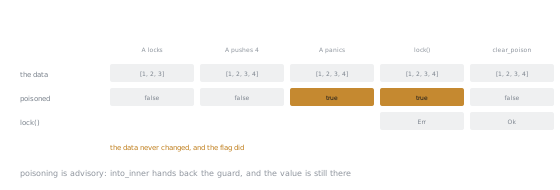
The data row is constant from the second column on. Everything that goes wrong afterwards happens in the row above it, which is what "advisory" means here.
Breaking the .lock().unwrap() habit
That unwrap asserts something specific: not that this call is fine, but that no thread anywhere in the program's run has ever panicked holding this mutex, a claim about the whole program's history, not something the call site can verify. Lesson 17's question one is instructive: the failure came from another part of the same program, closer to "your own code" than a stranger's bad input, yet this site cannot state the invariant question four asks for, since it does not know what the other thread was doing. A short-lived tool or test, where any panic should end the run, lesson 9's second exception generalised, makes a bare unwrap defensible. A long-running server does not get that for free: matching the Result and propagating lesson 15's own error type, recovering with into_inner when the invariant plainly survives a panic, or calling clear_poison after checking, are more honest. Lesson 35 avoids this judgement, giving each piece of data to one worker at a time.
Practice
-
▢ Predict what this prints, then compile and run it.
use std::sync::{Arc, Mutex};
use std::thread;

fn main() {
    let total = Arc::new(Mutex::new(0i32));
    thread::scope(|s| {
        for _ in 0..2 {
            let total = Arc::clone(&total);
            s.spawn(move || {
                for _ in 0..500 {
                    *total.lock().unwrap() += 1;
                }
            });
        }
    });
    println!("{}", *total.lock().unwrap());
}
Check
It prints 1000. Each iteration locks, adds one, and drops the guard in the same statement, so the two threads' increments cannot overlap.
- ▢ In this lesson's guard-scope example, predict whether
B: acquired the lockcan print beforeA: work donein the held-too-long version, then run both several times to check.
Hint
Ask what thread B is actually waiting on in each version: the guard's lifetime, or the sleep's.
Check
No, not in the held-too-long version: A keeps its guard through the sleep, so B's lock cannot return first. In the narrowed version A drops its guard before the sleep starts, so B's line consistently comes first.
-
▢ Predict whether this panics immediately, returns an
Err, or hangs, then run it under a timeout you set yourself.use std::sync::Mutex; fn main() { let m = Mutex::new(0); let _first = m.lock().unwrap(); println!("locked once"); let _second = m.lock().unwrap(); println!("locked twice"); }
Check
It hangs: Mutex is not reentrant, and the standard library documents the second call as unspecified. On this toolchain it deadlocks, printing locked once and then nothing.
- ▢ After a panic poisons a
Mutex<Vec<i32>>,let recovered = mutex.lock().unwrap_err().into_inner();runs without panicking. Predictrecovered's type, then predict what happens if the next line callsmutex.lock()again whilerecoveredis still in scope.
Hint
Mutex::lock returns Result<MutexGuard<'_, T>, PoisonError<MutexGuard<'_, T>>>. What does into_inner hand back from that Err?
Check
recovered is a MutexGuard, not a bare Vec<i32>, since into_inner gives back exactly what a successful lock would have. It still holds the mutex, so a second lock while it is alive hangs, the same as two ordinary guards from one thread.
-
▢ This one is a judgement call, not a compile check. For each
.lock().unwrap()site, say whether it is defensible as written or should propagate the poisoning instead.- a) A one-shot script that counts things behind a shared
Mutex, prints the result and exits. - b) A server's shared request counter, where one bad request should not stop other workers.
- c) A test that locks a shared fixture set up on another thread.
- a) A one-shot script that counts things behind a shared
Check
a) Defensible: a short tool where any panic is an acceptable reason to stop, lesson 9's second exception, generalised. b) Not defensible: one bad request should not poison a counter every worker needs, so match and recover with into_inner. c) Defensible: a test already treats any panic as a failure, lesson 9's third exception.
Real-world reps
- [ ] Give your project's file-summarising threads a single
Arc<Mutex<Summary>>that every worker locks per update, instead of the partial summary each already builds; run it, confirm the totals still match, then put lesson 30's design back, each worker returning its own partial summary with no lock, and write one comment saying which version you would ship and why. - [ ] For every
.lock().unwrap()the shared-accumulator version needed, decide with this lesson's procedure whether it was defensible or needed amatchor a propagated error instead, and keep that note beside the comment above. - [ ] Tomorrow: pick one guard in code you touched today and check it is dropped before the next line that might lock the same value again.
Going further
- std::sync::RwLock: the reader-writer lock's full API
- std::sync::PoisonError: the error type
lockreturns once poisoned, withinto_innerand its guard-shaped payload - Shared-State Concurrency: the Book's chapter introducing
Mutex<T> - Announcing Rust 1.77.0: the release that stabilised
clear_poison - Sharing and threads: the stage 5 reference sheet
- Resources
Not landing? Reread the primary source at the top, since this lesson compresses it and compression is where understanding leaks. Check the glossary for any term that felt slippery.
If the lesson itself is unclear rather than the material, that is a defect: open an issue.