Lesson 34. Send and Sync
Mission link: A closure that fails to compile inside thread::spawn almost always blames a type several fields deep inside the one you actually captured, not the struct you wrote, and reading that correctly is what separates a design fix from a clone that only makes the message go away.
Primary source: Special types and traits
Prerequisites: Lesson 21, Lesson 31
Warm-up
- ▢ Lesson 21 defined a trait bound as a promise an
implblock writes out by hand. Given that, what would it mean for a type to satisfy a trait despite nobody, anywhere, ever writingimpl TraitName for YourType?
Check
It would mean the compiler decides the answer itself, from a rule applied to the type's own definition rather than from a written impl. Send and Sync work exactly this way; this lesson calls that an auto trait.
- ▢ Lesson 31 distinguished
RcfromArcby what each spends to keep its count: a plain integer forRc, an atomic one forArc. Which of the two would you expect a compiler to consider safe to clone from two threads at once, and which not?
Check
It is Arc, since an atomic counter cannot be corrupted by two threads updating it at once. Rc's plain integer can be, the undefined behaviour that makes it unsafe from more than one thread and why it carries neither of this lesson's two traits.
Know this
Two traits, one relation
Send and Sync answer different questions. Send marks "types that can be transferred across thread boundaries": moving a Send value into another thread is safe. Sync marks "types for which it is safe to share references between threads": a shared borrow, &T, of a Sync type can be handed to another thread while the owner keeps using it. The relation is Sync's own definition: "a type T is Sync if and only if &T is Send", a bound the compiler checks rather than an assertion to trust:
fn assert_send<T: Send>() {}

fn requires_sync<T: Sync>() {
    assert_send::<&T>();
}
This compiles for any T: Sync: &T satisfies assert_send's bound solely because requires_sync already established T: Sync.
Auto traits: derived, not written
Neither trait has an impl block an ordinary author writes. The Reference states the rule instead: "structs, enums, unions, and tuples implement the trait if all of their fields do", and "closures implement the trait if the types of all of their captures do". An error about Send can therefore name a type absent from the line you wrote, since the compiler walks a type's fields structurally, and the moment one lacks the trait, everything containing it loses it too, silently.
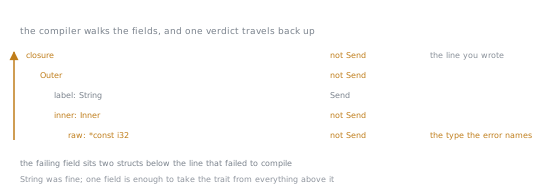
Read the arrow, not the indentation: the verdict is decided at the bottom and carried upward, while the code is written at the top. That mismatch is the whole reason the message names a type you never typed, and it is why the fix is found by reading downward through the fields rather than by adding a bound at the line that failed. To see this, bury the losing field two structs deep, then move the whole thing into a thread:
struct Inner {
    raw: *const i32,
}

struct Outer {
    label: String,
    inner: Inner,
}

fn main() {
    let value = 5;
    let outer = Outer {
        label: String::from("x"),
        inner: Inner { raw: &value as *const i32 },
    };
    std::thread::spawn(move || {
        println!("{} {}", outer.label, outer.inner.raw as usize);
    })
    .join()
    .unwrap();
}
error[E0277]: `*const i32` cannot be sent between threads safely
   --> src/main.rs:16:24
    |
 16 |       std::thread::spawn(move || {
    |       ------------------ ^------
    |       |                  |
    |  _____|__________________within this `{closure@src/main.rs:16:24: 16:31}`
    | |     |
    | |     required by a bound introduced by this call
 17 | |         println!("{} {}", outer.label, outer.inner.raw as usize);
 18 | |     })
    | |_____^ `*const i32` cannot be sent between threads safely
    |
    = help: within `{closure@src/main.rs:16:24: 16:31}`, the trait `Send` is not implemented for `*const i32`
note: required because it's used within this closure
   --> src/main.rs:16:24
    |
 16 |     std::thread::spawn(move || {
    |                        ^^^^^^^
note: required by a bound in `spawn`
    |
125 | pub fn spawn<F, T>(f: F) -> JoinHandle<T>
    |        ----- required by a bound in this function
...
128 |     F: Send + 'static,
    |        ^^^^ required by this bound in `spawn`
The standard library's path line is cut here, since it names an absolute location on the compiling machine. What remains is the teaching: the message names only *const i32, never Outer, never Inner. Every note talks about "this closure", because the loss happened silently at each layer: Inner lost Send when its field did, Outer lost it when Inner did, and the closure lost it by capturing outer whole. This is why such diagnostics read as coming from nowhere: the somewhere is real, just never named unless you know to look past your own type for the field that failed.
The catalogue: four types, four reasons
Four standard-library types make a missing trait concrete; the two traits are independent rather than a ladder, so each is worth checking on its own.
Rc<T> has neither trait: assert_send and assert_sync both fail on it. Its reference count is a plain, unsynchronised integer, so two threads cloning or dropping the same Rc could rewrite it at once, the race Arc pays an atomic operation to avoid.
RefCell<T> is Send but not Sync: assert_send compiles, assert_sync fails. Handing the whole cell to one other thread is fine, since only one owner touches it at a time, but sharing &RefCell would let two threads each believe they hold the only mutable borrow, since its borrow counter has no cross-thread synchronisation either.
MutexGuard<'_, T> is Sync but not Send: assert_sync compiles, assert_send fails. Sharing a reference to a guard is fine, since the lock behind it works the same from anywhere, but moving the guard off the thread that acquired it would let a lock be released by a thread that never took it, unsound on platforms whose mutexes require the unlocking thread to match the locking one.
A raw pointer, *const T or *mut T, has neither trait, failing both assertions as the centrepiece already showed. It carries none of the compiler's aliasing or lifetime information, so nothing stops two threads racing on what it points to, or one outliving the memory it names.
Reading an E0277 for Send, and one for Sync
The canonical case is Rc moved into thread::spawn:
use std::rc::Rc;
use std::thread;

fn main() {
    let shared = Rc::new(vec![1, 2, 3]);
    let handle = thread::spawn(move || {
        println!("{:?}", shared);
    });
    handle.join().unwrap();
}
error[E0277]: `Rc<Vec<i32>>` cannot be sent between threads safely
   --> src/main.rs:6:32
    |
  6 |       let handle = thread::spawn(move || {
    |                    ------------- ^------
    |                    |             |
    |  __________________|_____________within this `{closure@src/main.rs:6:32: 6:39}`
    | |                  |
    | |                  required by a bound introduced by this call
  7 | |         println!("{:?}", shared);
  8 | |     });
    | |_____^ `Rc<Vec<i32>>` cannot be sent between threads safely
    |
    = help: within `{closure@src/main.rs:6:32: 6:39}`, the trait `Send` is not implemented for `Rc<Vec<i32>>`
note: required because it's used within this closure
   --> src/main.rs:6:32
    |
  6 |     let handle = thread::spawn(move || {
    |                                ^^^^^^^
note: required by a bound in `spawn`
    |
125 | pub fn spawn<F, T>(f: F) -> JoinHandle<T>
    |        ----- required by a bound in this function
...
128 |     F: Send + 'static,
    |        ^^^^ required by this bound in `spawn`
The standard library's path is cut again. Read top to bottom: the error line names the type that lacks the trait, not shared and not main. The underlined span covers the whole closure, because the bound applies to its captured environment, and moving shared in put an Rc inside it. required because it's used within this closure is the explicit link: the missing trait travelled from the value into the closure's own status, the structural walk the previous section built by hand. The final note shows where the requirement was written, F: Send + 'static on spawn itself.
Now the Sync version, Arc<RefCell<T>> sent to a thread:
use std::cell::RefCell;
use std::sync::Arc;
use std::thread;

fn main() {
    let shared = Arc::new(RefCell::new(vec![1, 2, 3]));
    let other = Arc::clone(&shared);
    let handle = thread::spawn(move || {
        other.borrow_mut().push(4);
    });
    handle.join().unwrap();
    println!("{:?}", shared.borrow());
}
error[E0277]: `RefCell<Vec<i32>>` cannot be shared between threads safely
   --> src/main.rs:8:32
    |
  8 |       let handle = thread::spawn(move || {
    |  __________________-------------_^
    | |                  |
    | |                  required by a bound introduced by this call
  9 | |         other.borrow_mut().push(4);
 10 | |     });
    | |_____^ `RefCell<Vec<i32>>` cannot be shared between threads safely
    |
    = help: the trait `Sync` is not implemented for `RefCell<Vec<i32>>`
    = note: if you want to do aliasing and mutation between multiple threads, use `std::sync::RwLock` instead
    = note: required for `Arc<RefCell<Vec<i32>>>` to implement `Send`
note: required because it's used within this closure
   --> src/main.rs:8:32
    |
  8 |     let handle = thread::spawn(move || {
    |                                ^^^^^^^
note: required by a bound in `spawn`
    |
125 | pub fn spawn<F, T>(f: F) -> JoinHandle<T>
    |        ----- required by a bound in this function
...
128 |     F: Send + 'static,
    |        ^^^^ required by this bound in `spawn`
The bound spawn checks is the same F: Send + 'static as before, but this text says "cannot be shared" and its help names Sync. Arc's own note explains why: required for Arc<RefCell<Vec<i32>>> to implement Send, because Arc<T> is only Send when T is both Send and Sync, sharing an Arc means sharing a &T underneath its atomic count, and Sync is what that needs. RefCell is Send on its own but not Sync, and that missing Sync surfaces here as a Send failure one layer up, on the Arc. The compiler's suggested RwLock is lesson 33's territory; this lesson only needed the contrast in which trait each message names.
Where the bounds come from, and the fix that is not a bound
Both diagnostics end at a bound on a signature. thread::spawn, stable since release 1.0.0, is:
pub fn spawn<F, T>(f: F) -> JoinHandle<T>
where
    F: FnOnce() -> T + Send + 'static,
    T: Send + 'static,
Scope::spawn, stabilised in release 1.63.0 alongside thread::scope itself from lesson 30, is:
pub fn spawn<F, T>(&'scope self, f: F) -> ScopedJoinHandle<'scope, T>
where
    F: FnOnce() -> T + Send + 'scope,
    T: Send + 'scope,
Both require Send, since handing a closure's captured state to a new thread is exactly what Send gates. Only thread::spawn requires 'static: the parent function might return, and everything it owned might go, before the new thread finishes, so nothing borrowed can be trusted to still exist. Scope::spawn asks for 'scope instead, the block's own lifetime, because thread::scope blocks until every spawned thread has joined, so a borrow that only needs to outlive the scope is provably good for as long as the thread runs, lesson 30's guarantee stated here as a bound.
When a type is not Send, the missing trait is reporting a design question, not asking for a workaround. Reach for the threaded counterpart when a value genuinely needs sharing: Rc becomes Arc from lesson 31, RefCell becomes a Mutex or RwLock from lesson 33. Keep the value on one thread when sharing was never required, and only touch it from there. Or send the data itself, an owned copy now or later a channel message from lesson 35, rather than a handle to memory the sender still cares about.
Practice
-
▢ Predict whether this compiles, then check it with
assert_send::<Session>().struct Session { id: u32, cache: std::rc::Rc<Vec<String>>, }
Check
It does not: Rc<Vec<String>> cannot be sent between threads safely, with a note that it is required because it appears within the type Session. Session is named here, unlike in the centrepiece, because you named it directly in the turbofish; a closure's captured environment has no name of its own to give.
-
▢ Predict whether this compiles.
let cell = std::cell::RefCell::new(0);
let handle = std::thread::spawn(move || {
    *cell.borrow_mut() += 1;
});
handle.join().unwrap();
Hint
Ask which of the two traits a one-way ownership transfer actually needs.
Check
It compiles. Moving cell gives the new thread sole ownership, and thread::spawn's bound only asks for Send, which RefCell has. Nothing here shares &RefCell between two threads, so Sync, which RefCell lacks, never enters into it.
-
▢ Predict the error and which trait it names, for this program under
thread::scope.let shared = std::rc::Rc::new(vec![1, 2, 3]); std::thread::scope(|s| { s.spawn(move || { println!("{:?}", shared); }); });
Hint
thread::scope removes the 'static requirement lesson 30 taught. Ask whether it removes the other one too.
Check
It is E0277 naming Send: Rc<Vec<i32>> cannot be sent between threads safely, quoting Scope::spawn's own bound. Dropping 'static only drops half of the requirement; a scoped thread still needs a Send environment, since sharing is still happening, only for a shorter time.
-
▢ Predict whether this compiles, and if not, which trait its
helpnames.let m = std::sync::Mutex::new(0i32); let guard = m.lock().unwrap(); let handle = std::thread::spawn(move || { println!("{}", *guard); }); handle.join().unwrap();
Check
It does not compile: E0277 naming Send, because a MutexGuard is Sync but not Send, the catalogue entry above. Moving the Mutex itself into the closure, rather than a guard already taken from it, would compile instead, since the lock would then be acquired on the thread that needs it.
- ▢ Add a second field, another
String, toOuterfrom this lesson's centrepiece example. Predict whether the diagnostic changes.
Hint
The auto trait rule looks at every field, but a struct only fails once.
Check
It does not change: the diagnostic still names only *const i32, because a struct implements the trait only if all of its fields do, and a field that already has the trait changes nothing about the one that does not.
Real-world reps
- [ ] In your summariser's threaded worker, add a field to whatever value each thread carries back that is not
Send, such as anRcused to avoid cloning a shared label, and read the exact error; fix it by design rather than a bound, and write down which of this lesson's three fixes you used and what the alternative would have cost. - [ ] Pick one type already in your project that is single-threaded on purpose, such as a parser's internal cache, and write one comment saying which of
SendorSyncit lacks and why that is fine as long as it never crosses a thread boundary. - [ ] Tomorrow: find one value your workers return by handle rather than by data, such as a shared tag, and note it as a candidate for a channel instead, which lesson 35 covers.
Going further
- Send: the standard library's definition, with its own
Rccounterexample - Sync: the standard library's definition, including the exact relation to
Send - E0277: the diagnostic for a type missing a trait a bound requires
- Extensible Concurrency with Send and Sync: the Book's introduction to both traits
- Sharing and threads: the stage 5 reference sheet
- Resources
Not landing? Reread the primary source at the top, since this lesson compresses it and compression is where understanding leaks. Check the glossary for any term that felt slippery.
If the lesson itself is unclear rather than the material, that is a defect: open an issue.