Lesson 43. Cancellation Safety
Mission link: Lesson 42 showed that dropping a future is silent: no error, no panic, nothing resembling a bug report. A select! loop that discards a loser every lap turns that silence into a routine way to lose data, and knowing whether a given call can afford it means looking it up, which is this lesson's skill.
Primary source: tokio::select!
Prerequisites: Lesson 42, Lesson 35
Warm-up
- ▢ Lesson 42 showed a future dropped mid-flight destroys its own locals with no notification. If a
select!loser was partway through building a value in one of its own locals when it lost the race, what happens to that value?
Check
It is dropped with everything else the future owned, like any local going out of scope; nothing preserves it and nothing reports it, which is why cancellation is a design question, not a runtime one.
- ▢ Lesson 35 covered what each end of a channel does when the other disappears. A single call to a receiver's
recvreturns a whole message or learns none is coming, never half of one. If aselect!branch is exactly onerecv()call, does losing that race leave anything partial behind?
Check
No. recv() resolves in one indivisible step, a full message or nothing, so a single call has no partial state to lose; this lesson's loss comes from state built up around several calls, not from any one call's own result.
Know this
The property, not a list of safe methods
Lesson 42 established the mechanism: any future can be dropped before it finishes, stopping it there with nothing resembling an error. What that lesson left open is which futures can afford it. tokio::select!'s documentation names the property and gives it a precise test: "Cancellation safety can be defined in the following way: If you have a future that has not yet completed, then it must be a no-op to drop that future and recreate it." This is a statement about the future's state, not the code racing it: cancel safe means whatever it has done so far can be thrown away and restarted unnoticed; cancel unsafe means it has taken an action, or built up a value, that restarting cannot recover. The warm-up already applied the test: a bare recv() passes since it has no intermediate state, and the rest of this lesson fails it because that state lives somewhere the test does not reach.
The failure, reproduced
A batching consumer reads two values at a time before recording them, racing a per-batch deadline in a loop:
async fn unsafe_consumer(mut rx: mpsc::Receiver<u8>) -> Vec<u8> {
    let mut seen = Vec::new();
    loop {
        let mut batch = Vec::new();                 // rebuilt every lap
        tokio::select! {
            n = collect_two(&mut rx, &mut batch) => {
                if n == 0 { break; }
                seen.extend(batch);
            }
            _ = sleep(Duration::from_millis(30)) => {
                // batch is dropped here, with anything already collected
            }
        }
    }
    seen
}
Fed the values one to five, sent every twenty milliseconds against a thirty millisecond deadline, this lost data every run: across thirty runs, twenty seven kept exactly [1, 2, 5] and the other three kept [1, 2, 4, 5], but none printed the full [1, 2, 3, 4, 5], and none printed an error, a panic or a log line. The two groups disagree on which value goes missing, which is the lesson: batch looks local to one lap, but a lost race throws it all away and the next lap starts empty, regardless of what collect_two had pushed. The bug is not in collect_two or recv; it is in where batch lives.
The fix is where the state lives, not a different method
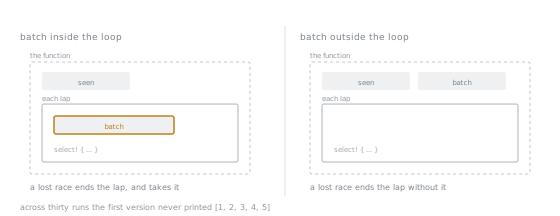
The lap box is the same size in both drawings, and seen is outside it in both. The only thing that moves is batch, and a lost race ends the lap either way; what changes is whether the lap has anything of yours inside it when it does.
Moving batch above the loop is the entire change: the variable survives a lost race, so a version of collect_two that fills to a target length, rather than always adding two more, picks up next lap where it left off.
async fn safe_consumer(mut rx: mpsc::Receiver<u8>) -> Vec<u8> {
    let mut seen = Vec::new();
    let mut batch = Vec::new();                     // now outside the loop
    loop {
        tokio::select! {
            n = fill_to_two(&mut rx, &mut batch) => {
                if n == 0 { break; }
                seen.append(&mut batch);
            }
            _ = sleep(Duration::from_millis(30)) => {
                // the timer won, but batch keeps whatever was already pushed
            }
        }
    }
    seen
}

async fn fill_to_two(rx: &mut mpsc::Receiver<u8>, batch: &mut Vec<u8>) -> usize {
    while batch.len() < 2 {
        match rx.recv().await {
            Some(v) => batch.push(v),
            None => return batch.len(),
        }
    }
    2
}
Across fifteen runs, against the same producer and deadline that lost data every time above, this version printed sent 1..=5, consumer kept [1, 2, 3, 4, 5] every time: the whole sequence, nothing missing.
Where the answer lives: looked up per method
Tokio documents cancel safety once per method, under that method's own "Cancel safety" heading, checked before a call goes into a select! branch. AsyncReadExt's page alone carries twenty five such headings, one per method. AsyncReadExt::read states: "This method is cancel safe. If you use it as a branch in tokio::select! and another branch completes first, then it is guaranteed that no data was read." mpsc::Receiver::recv, the method the two examples above rely on, says almost the same thing in its own words: "This method is cancel safe. If recv is used as a branch in tokio::select! and another branch completes first, it is guaranteed that no messages were received on this channel." Not every method gets a reassuring version: tokio's asynchronous Mutex::lock states "This method uses a queue to fairly distribute locks in the order they were requested. Cancelling a call to lock makes you lose your place in the queue." That cost is real without being data loss: nothing corrupts, only requeues. None of these three sentences generalise, so look up the specific method every time, before it goes into a select! branch.
The &mut pattern: the same future, not a new one
Sometimes the state worth protecting is the future's own progress, not a value built around it: hold the future across laps instead of rebuilding it. Racing a slow task against a fast timer, recreating it every lap:
let mut ticks = 0;
loop {
    tokio::select! {
        v = slow_task() => { println!("finished: {v} after {ticks} ticks"); break; }
        _ = sleep(Duration::from_millis(10)) => { ticks += 1; }
    }
}
never finishes if the timer is faster than the task: under a three second watchdog, this stalled in three of three attempts, printing an increasing tick count and never reaching finished, since the task restarts from nothing every lap. Awaiting &mut the same future fixes it:
let fut = slow_task();
tokio::pin!(fut);
let mut ticks = 0;
loop {
    tokio::select! {
        v = &mut fut => { println!("finished: {v} after {ticks} ticks"); break; }
        _ = sleep(Duration::from_millis(10)) => { ticks += 1; }
    }
}
Across ten runs this printed finished: 9 after 4 ticks or finished: 9 after 5 ticks every time: the task, now making progress instead of restarting, was eventually ready. tokio::pin! is doing real work this lesson will not explain: an ordinary local can move, and &mut fut needs a guarantee it will not, which is lesson 44's subject; for now, treat tokio::pin!(fut) as the line that makes &mut fut legal.
What is not a cancellation-safety problem
This property has a scope; reaching outside it is its own mistake. A call with no partial state, the warm-up's bare recv() or AsyncReadExt::read's guarantee above, has nothing for a lost race to catch, so recreating it every lap costs nothing. The same is true of anything whose retry is free: a timer branch like the sleep calls above carries no data, so a fresh one next lap is as good as the original. The property only bites when a future, or the code racing it, has taken an action or built up a value a fresh attempt cannot recover, narrower than "anything involving select!."
Practice
- ▢ Predict what
unsafe_consumerprints when fed one to five, sent every twenty milliseconds, racing a thirty millisecond deadline, then run it several times.
Check
It loses at least one value every run, most often [1, 2, 5] and occasionally [1, 2, 4, 5], since batch is rebuilt at the top of the loop and a lap the timer wins throws away whatever collect_two had already pushed.
-
▢ Predict whether
unsafe_consumerstill loses data if the deadline slows from thirty milliseconds to two hundred, same producer, then run it to check._ = sleep(Duration::from_millis(200)) => { /* unchanged otherwise */ }
Hint
Which branch of a select! wins depends on which becomes ready first, not on which one is "wrong."
Check
It keeps everything: a batch of two now always completes before the deadline fires, so the timer branch never wins. The bug is still there; it just never triggers, which is why a clean run proves nothing about a race.
- ▢ Predict what
safe_consumer, withbatchmoved above the loop, prints under the original thirty millisecond deadline, then run it several times.
Check
It prints sent 1..=5, consumer kept [1, 2, 3, 4, 5] every time: losing a lap to the timer costs nothing now, since batch lives above the loop and fill_to_two resumes rather than starting over.
-
▢ Predict whether this compiles, then try it.
let mut fut = slow_task();
tokio::select! {
    v = &mut fut => { println!("{v}"); }
    _ = sleep(Duration::from_millis(5)) => { println!("tick"); }
}
Hint
&mut fut needs a guarantee that fut will never move again. Does an ordinary local give that on its own?
Check
It does not compile, trimmed to the line and note that carry the teaching:
error[E0277]: `{async fn body of slow_task()}` cannot be unpinned
   = note: consider using the `pin!` macro
Lesson 44 explains Unpin and why an async fn's future lacks it; for now, adding tokio::pin!(fut); before the select! is what the note asks for.
-
▢ A judgement call, not a compile check: for each
select!branch, say whether recreating it every lap is fine or needs the state moved above the loop.- a) A branch that is a bare
mpsc::Receiver::recv()call, nothing else. - b) A hand-rolled branch that appends bytes to a
Vec<u8>declared inside the loop, waiting for a full line, racing a per-line timeout. - c) A branch that calls tokio's
Mutex::lock()and increments a counter immediately after acquiring it, racing a shutdown signal.
- a) A branch that is a bare
Check
a) Fine as is: recv is documented cancel safe and carries no state beyond its own return value. b) Needs moving: the Vec<u8> is this lesson's bug in a different shape, and belongs above the loop. c) Not a data-loss risk: lock's guarantee is only about queue position, but losing this race repeatedly sends the same waiter to the back of the queue each time, worth noticing under contention.
Real-world reps
- [ ] In your project's async summariser, list every tokio method your per-source read loop puts in a
select!branch, look up each one's "Cancel safety" section, and write its verdict beside the call; then move any buffer or partial line the loop builds up inside the loop body, rather than above it, the way this lesson's fix does. - [ ] Rerun lesson 42's timeout experiment against the restructured loop and confirm the lines a slow source's deadline used to lose are no longer lost; if any still are, some state is living in the wrong place.
- [ ] Tomorrow: pick one
select!loop already in your code and decide, using this lesson's test, whether recreating its losing branch's future every lap was a decision or an oversight.
Going further
- Select: the tutorial chapter working the
&mut-and-pin!pattern used above, in its Loops section - tokio::io::AsyncReadExt: the trait behind the twenty five per-method "Cancel safety" sections cited above
- tokio::sync::mpsc::Receiver:
recv's cancel safety guarantee, quoted above - tokio::sync::Mutex: the asynchronous mutex whose
lockis the caveat above - Async: the stage 6 reference sheet
- Resources
Not landing? Reread the primary source at the top, since this lesson compresses it and compression is where understanding leaks. Check the glossary for any term that felt slippery.
If the lesson itself is unclear rather than the material, that is a defect: open an issue.