Data and control
Lookup sheet for stage 2. The question it exists to answer: what shape should this value have, and how do I get at it without an unwrap?
Struct or enum
| Question | Reach for |
|---|---|
| The value is one shape, made of parts that are always present together | Struct |
| The value is exactly one of several distinct shapes, never a mix | Enum |
The one-line test: if a struct's fields would need a comment saying which combinations are meaningful, the illegal combinations are constructible and an enum removes them; if every field is always present, an enum buys nothing but an extra ::Variant at every construction site and every match.
Ownership of a field or a payload
A struct's field and an enum variant's payload are owned identically: dropping the container drops what it holds, and moving a payload out of a match arm is the same move rule as moving a field out by value.
| Choice | What it costs | What it removes |
|---|---|---|
Owned field (String, Vec<T>, ...) | An allocation the borrowed form would not need | The question "how long does this struct live", from every use site |
Borrowed field (&'a str, ...) | A lifetime parameter on the struct itself, struct S<'a> { .. } | Nothing, until a measured cost justifies the annotation |
Stage 2 owns its fields: a lifetime-carrying struct needs a lifetime annotation, which is stage 4's tool, not this one. A borrowed field with no lifetime parameter fails with E0106, missing lifetime specifier.
The Option API
| Method | Question it answers | Returns |
|---|---|---|
map | If it's there, what do I want instead? | Some(f(x)) or None unchanged |
and_then | Given the value, what's the next lookup, and can that fail too? | Whatever the closure returns, no Option<Option<T>> |
unwrap_or(v) | If absent, what plain default? | T, argument built regardless |
unwrap_or_else(f) | If absent, what computed default? | T, closure runs only when needed |
unwrap_or_default() | If absent, what's the type's own default? | T::default() |
ok_or(e) | Turn absence into a reason | Ok(x) or Err(e) |
filter(p) | Keep it only if a predicate holds | Some(x) or None |
as_ref | Look without moving | Option<&T> |
take | Empty the slot and hand back what was there | Option<T>, leaves None behind |
replace(v) | Swap in a new value, hand back the old | Option<T>, leaves Some(v) behind |
is_some | Yes or no, without touching the value | bool |
as_ref fixes a real error: an Option<String> field read twice with if let Some(p) = rec.path fails E0382 on the second read, since the first already moved the String out; .as_ref() borrows an Option<&String> instead. take and replace are the fix when only a &mut to a struct is in hand and a value must be handed to the caller: the compiler suggests .clone() there, which is the wrong fix, since take satisfies the rule for free.
The Result API
| Method | Question it answers | Returns |
|---|---|---|
map | If it succeeded, what do I want instead? | Ok(f(x)) or Err unchanged |
map_err | If it failed, what do I want instead, on the error side? | Ok unchanged or Err(f(e)) |
and_then | Given success, what's the next step, and can it also fail? | Whatever the closure returns |
unwrap_or(v) | If it failed, what plain default? | T |
unwrap_or_else(f) | If it failed, what computed default, maybe from the error? | T |
ok | Keep only the success side | Option<T> |
err | Keep only the failure side | Option<E> |
is_ok | Yes or no, without consuming anything | bool |
? is the match that returns Err(e) early and unwraps Ok(x), compressed to one character. It needs the function's error type reachable from the expression's error type through From; without that conversion the call fails with E0277, "? couldn't convert the error", and inside this stage the stopgap is .map_err at the call site, since an error type's own From implementations are stage 3's subject. Result carries #[must_use], so dropping one unread produces a warning rather than a compile error, and the program keeps running past the unnoticed failure. ? also short-circuits on Option, with no Err payload to carry; main may return Result<(), E> whenever E: Debug, printing Error: {the Err value's Debug form} on standard error and exiting with status 1.
Panic against error, one line: a Result is for a failure the caller could plan for and recover from; a panic is for a broken invariant in your own code that should never happen if the program is correct.
The pattern rules
| Pattern kind | Answers |
|---|---|
| Literal | Is it exactly this value? |
Range, a..=b | Is it within this inclusive range? |
Alternation, a \| b | Is it one of several values sharing an arm? |
Struct destructuring, { x, y, .. } | Which fields do I need, ignoring the rest? |
| Tuple or tuple struct, by position | What are the positional parts? |
| Nested pattern | What does a value made of several parts look like all at once? |
@ binding | Does it match this shape, and what was the value? |
Guard, pat if cond | Does the shape match, and does an arbitrary condition also hold? |
Binding modes, and the 2024 edition change. Matching a non-reference pattern against a reference borrows the contents instead of moving them: match &line { Line::Note(text) => .. } binds text as &String, threading a ref binding through automatically, so line stays whole afterwards. Matching line by value instead moves the payload out on the same rule lesson 2 established for plain assignment. Since the 2024 edition, an explicit & pattern may no longer mix with an implicit borrow: (_, &b) matched against a reference to a tuple compiles and prints on edition 2021, and fails on edition 2024 with error: cannot explicitly dereference within an implicitly-borrowing pattern, labelled reference pattern not allowed when implicitly borrowing. The fix is either an explicit & at every level, &(_, &b), or no inner & at all, (_, b) => *b.
| Refutability | Allowed in |
|---|---|
| Irrefutable (matches every value of the type) | let, a function parameter, a for loop's binding |
| Refutable (some value could fail to match) | if let, while let, let ... else, a match arm |
A refutable pattern in an irrefutable position fails with E0005, refutable pattern in local binding.
Diagnostics of the stage
| Code / message | Cause | Honest fix |
|---|---|---|
E0106, missing lifetime specifier | A struct field is a bare reference, &str with no lifetime | Own the field (String), or add the lifetime parameter once stage 4 gives you the tool |
E0061, wrong number of arguments to a tuple variant | Trying to hand one variant the data two separate fields used to hold | There is no fix inside the call: the illegal combination has nowhere to fit, which is the point |
E0382, use / partial move of a moved value | Matching or passing an enum or struct by value moved a non-Copy field or payload out | Match or pass a reference instead, or return the value back if the move was real |
E0594, cannot assign to a field behind a & reference | A method takes &self but writes to a field | Change the receiver to &mut self |
E0277, trait not implemented | {:?} with no Debug derive; ? with no From<E> for the target error; indexing a String or str by an integer | Derive Debug; write or stub the From conversion (stage 3) or .map_err at the call site; use .chars().nth(i) or a byte-range slice instead of s[i] |
E0004, non-exhaustive patterns | A match over an enum is missing a variant | Add the missing arm; reach for _ only when the rest is genuinely uninteresting, never unreachable!() on an enum you own |
E0005, refutable pattern in local binding | A refutable pattern, such as Some(x), used in a let | Use if let, while let, or let ... else |
E0507, cannot move out of a value behind a &mut reference | Returning a field by value through only a &mut to its container | Option::take, not .clone(), when the field is an Option |
error, let chains are only allowed in Rust 2024 or later | if let ... && let ... { } compiled under edition 2021 | Move to edition 2024, or nest the if lets |
error, cannot explicitly dereference within an implicitly-borrowing pattern | An explicit & pattern nested inside an implicit borrow, under edition 2024 | &(_, &b) throughout, or drop the inner & and deref at use, (_, b) => *b |
Iterators
| Kind | Method | Question it answers |
|---|---|---|
| Adapter | map | What do I want instead of each element? |
| Adapter | filter | Which elements do I keep? |
| Adapter | filter_map | Keep only what a closure turns into Some |
| Adapter | enumerate | Pair each element with its index |
| Adapter | zip | Pair two sequences in step, stopping at the shorter |
| Adapter | take / skip | Keep or drop from the front |
| Adapter | chain | Join a second iterator onto the first's end |
| Adapter | flat_map | Map and flatten in one step |
| Adapter | rev | Give the back first |
| Adapter | peekable | What's next, without taking it |
| Consumer | collect | Gather into a named type |
| Consumer | sum / count | Reduce to one number |
| Consumer | fold | Run a computation from a seed, no early exit |
| Consumer | any / all | Yes or no, stopping once settled |
| Consumer | find / position | First match as a value, or as an index |
| Consumer | min_by_key / max_by_key | The extreme by a derived key |
| Consumer | for_each | Run a closure on every element, keep nothing |
Laziness, one line: building a chain does no work; only a consumer calling next runs anything inside it, which a dropped, unconsumed chain proves by leaving a side-effecting closure's log empty. Collecting an iterator of Result<T, E> into Result<Vec<T>, E> stops at the first Err; collecting into Vec<Result<T, E>> keeps every attempt.
| Trait | Permits |
|---|---|
Fn | Only reads what it captured; callable any number of times |
FnMut | Mutates a capture; needs a mut binding, callable any number of times |
FnOnce | Moves a captured value out; callable exactly once |
FnOnce is the floor every closure meets. move decides what is captured (by value, not by reference), not which trait results. Since edition 2021, a closure captures only the fields it names, so a closure touching p.left leaves p.right readable while it is alive.
Collections
| Access pattern | Reach for |
|---|---|
| Ordered list, indexed or walked from the start | Vec<T> |
| Look up by key, order does not matter | HashMap<K, V> |
| Look up by key, need them in order or by range | BTreeMap<K, V> |
| Is this value present, order does not matter | HashSet<T> |
| Is this value present, need them in order | BTreeSet<T> |
| Add or remove from either end | VecDeque<T> |
| Always hand me the largest (or smallest) next | BinaryHeap<T> |
Vec and HashMap cover most programs; the entry API, *map.entry(k).or_insert(0) += 1, writes to a slot whether or not it was occupied and never resets one already there. A HashMap has no iteration order you may rely on, and that is a correctness matter, not a style preference: any output a person or a test depends on has to be sorted first, where a BTreeMap built from the same pairs needs no such step. Indexing a Vec out of range panics; .get(i) returns Option<&T> instead, the same absence-as-a-value choice Option makes everywhere else in this stage. dedup only ever compares adjacent elements; sort first if every duplicate, not just adjacent runs, needs to go.
Sizes, on this target
| Type | Size (bytes) |
|---|---|
Option<&u8>, &u8 | 8, 8 |
Option<Box<u8>>, Box<u8> | 8, 8 |
Option<&str>, &str | 16, 16 |
Option<u8> | 2 |
Option<u32> | 8 |
A three-variant enum with payloads up to two f64s | 24 |
A three-field struct of String, u16, u64 | 40 |
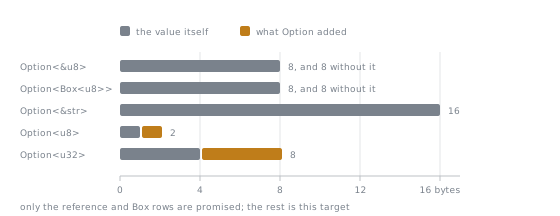
The accent is the entire cost of Option, so the first three rows have none: nothing was added, which is what a niche is. The last two are where a discriminant had nowhere free to hide and had to be paid for in bytes. Splitting the first three is the sheet's own paired figures; splitting the last two is its Option size against the width the integer already had.
Only the reference and Box niche cases are a documented promise of the standard library; every other number here is this target's measurement, not a language guarantee. An enum's size is its largest variant plus a discriminant, rounded up to alignment; the discriminant often hides for free in existing padding, which is why a struct and the enum built from the same fields can measure the same.
Where the project should be
The stage 2 slice of the arc's rep project, logsum, is a line parsed into an enum with payloads, a Result returned on a malformed line, and a whole input summarised with a map: counts per kind, bytes per path, and a rejected-line count. See the project for the full brief and the state expected at the end of every stage.