Errors and API shape
Lookup sheet for stage 3. The question it exists to answer: what does this error type let a caller do, and what have I promised by making it public?
?
| On | Does | Requires | Cannot go in | Fix |
|---|---|---|---|---|
Ok(v) | Unwraps to v, execution continues | Nothing | A closure passed to map returning a plain i32 rather than Result/Option | Make the closure return Result/Option and collect the chain, .map(\|s\| s.parse::<i32>().map(\|n\| n * 2)) |
Err(e) | Returns early as Err(From::from(e)) | The function's error type implements From<E> for the error's type, or one of map_err, a From impl, or Box<dyn Error> is used first | A function returning (), including a #[test] with no return type | Give the function -> Result<(), Box<dyn std::error::Error>> and end with Ok(()) |
Some(v) | Unwraps to v, no conversion | The function returns Option | Option's ? inside a function returning Result | .ok_or(e)? or .ok_or_else(\|\| e)?, converting first |
Without a matching From, the diagnostic is E0277, "? couldn't convert the error", naming the missing From<SourceError> implementation directly.
Choosing the error shape
| Shape | A caller can | Costs |
|---|---|---|
| Enum, one variant per failure | match on the variant itself | Adding a named field to a variant breaks a caller who destructured it exhaustively, E0027 |
Struct with a kind() enum plus private fields | match on kind(), same as above | Adding a private field never breaks a caller; only a new kind variant does |
Box<dyn Error> | Print with {}, nothing else without guessing | The signature stops naming what can go wrong; branching needs downcast_ref and a guessed concrete type, None for a wrong guess is indistinguishable from None for absence |
#[non_exhaustive] on an enum has no effect inside its own defining crate, where a match may still list every variant with no catch-all; from any other crate the same match needs a wildcard arm or fails E0004. It buys room to add a variant later without that counting as a breaking change, at the cost of every external caller needing a catch-all up front.
The two implementations an error type needs
| Implementation | Holds | Rule |
|---|---|---|
Display | One match arm per variant, in words, naming what this layer knows | Must not repeat what the wrapped error's own Display will say when a caller walks the chain |
std::error::Error::source | Some(&wrapped) for a variant carrying a foreign error, None otherwise | The only method worth overriding; the default already returns None |
Breaking the rule is visible immediately: a BadNumber whose Display reads "field bytes is not a number: {source}" and a report function that also walks source() together print invalid digit found in string twice, once from each layer. The fix is to let Display say only what this layer adds and trust the walk to print the rest.
Convert against wrap
| Choice | Keeps | A caller can still |
|---|---|---|
Wrap (source returns Some(&foreign)) | The original value | Match on it, downcast it, walk to it through the chain |
Convert (From formats a message and discards the value) | Only the formatted text | Read the message; nothing to downcast, source() returns None |
Both compile and report the same fact through Display; the difference shows only in what source() can still return. Wrap when a caller or a log needs the specific cause to match or count by kind; convert when the cause is an implementation detail that must not become part of the public type. Whichever type gets wrapped becomes visible in the public error the moment it is wrapped: a caller who finds std::num::ParseIntError inside can now depend on that exact type never changing. A From implementation on a public error type is not a private convenience; once it exists, the type it accepts is part of that error's API.
From can only be implemented where the source or target type is defined in the implementing crate (E0117 otherwise, the orphan rule), which bites even inside one workspace: an error type living in a library crate cannot gain a From written from a thin binary crate that depends on it, since the binary owns neither type. The workaround inside this stage is a local wrapper type in the crate that needs the conversion.
What thiserror and anyhow each replace
| Crate | Replaces | Stays hand-written |
|---|---|---|
thiserror | Display (one #[error("...")] per variant), Error::source (#[source] on a field), and From for a wrapping variant with no other fields (#[from]) | The enum's variants and fields themselves |
anyhow | Box<dyn Error> at a binary's edge, plus a hand-formatted .map_err string bolted on for context at every call site | Nothing; it is an opaque error type end to end |
The rule: a library returns a typed error a caller can match on, so thiserror belongs there; a binary can afford an opaque one, since nothing above main branches on it, only a human reading standard error, so anyhow belongs there and not in a library's public signature. #[from] only generates a conversion when the variant's other fields, besides the source and an optional backtrace, are empty; a variant that also carries a field name is refused with a compile error naming that requirement. On crates.io, read at the time of writing rather than as a stable figure: thiserror 2.0.20 has about 343 million recent downloads and 1.4 billion all time; anyhow 1.0.104 about 203 million recent and 922 million all time. Evidence a reader will meet both shapes often, not an endorsement of either.
The visibility levels
| Level | Answers | From outside |
|---|---|---|
| Private (default) | Is there any reason for this to exist outside the module that wrote it? | E0603 |
pub(super) | Can the parent, and anything it can already reach, use this? | E0603 from a sibling or anywhere further than the parent |
pub(crate) | Can any module in this crate reach it, while a dependant crate cannot? | E0603 from a dependant crate |
pub | Can anything reach this, even a different crate? | Reachable |
Every one of these diagnoses E0603 when it fails: to the compiler, private-by-default and a narrower visibility that does not reach the caller are the same fact. use never grants access; it only shortens a path already reachable, so use-ing a private item fails with the identical E0603 a bare call would.
A struct's visibility and its fields' visibility are separate decisions: a pub struct with a private field blocks the struct literal from outside (E0451), which is the mechanism behind the constructor pattern, pub fn new(...) -> Self, that lets a type enforce an invariant no caller can bypass by naming every field. pub use re-exports an item at a shorter path than where it lives, so a library can hide its internal layout while keeping a caller's path stable; the old long path then fails with E0603 once the module it passed through loses its own pub.
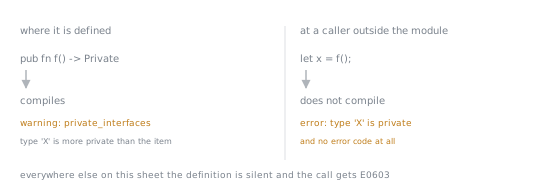
This is the one row on the sheet where the two sides disagree. Everywhere above, the definition is silent and the caller gets E0603; here the author is warned and the caller is stopped by something with no code to look up. Both halves are easy to miss on their own, which is why the shape is worth seeing before the paragraph that follows.
A pub fn returning a private type compiles with a warning, private_interfaces, on by default, rather than a hard error: type 'X' is more private than the item, noting the function is reachable at a wider visibility than the type it returns. This replaced a hard error, private_in_public, as of Rust 1.74.0. A caller outside the defining module who tries to call such a function anyway still fails, with type 'X' is private and no code.
What the public API is
A caller can reach:
- Every pub item reachable from the crate root, directly or through a pub use re-export.
- Every field of every pub struct that is itself marked pub.
- Every variant of a pub enum, and every named field on a variant that lacks #[non_exhaustive].
- Every trait implementation on a public type.
- The error type named in every public signature, including its own public surface by the same rules.
Anything without a visibility keyword, or narrower than pub, is not part of it, however far it is called from inside the crate.
The documentation conventions
| Heading | Says |
|---|---|
# Examples | A runnable demonstration; the only section cargo test executes |
# Errors | Which Err variant shows up under which condition, named rather than left as "this can fail" |
# Panics | Every way the function can panic, plainly enough that a caller can decide whether to call it |
# Safety | The invariants a caller must uphold for an unsafe fn call to be sound |
None of the four is compiler-enforced the way a missing match arm is; #![warn(missing_docs)] only checks that a doc comment exists, not that it says anything, so a one-word comment satisfies it as fully as a complete write-up. What makes an example a test: a fenced ```rust block inside a /// comment, compiled and run by cargo test under a running 1 test heading separate from the crate's unit tests, and failing the build the same way a wrong assertion anywhere else would. A line starting with # inside the block compiles but never renders; ending an example that uses ? with # Ok::<(), YourErrorType>(()) gives the hidden fn main rustdoc generates the return type ? needs, since without it the example fails E0277 for the same reason any plain function using ? with no compatible return type would.
Panic or error
Four questions, in order:
- Did the failing value come from outside this function, or is it a state this code already ruled out itself? Outside, continue; already ruled out, skip to 4.
- Is there a plausible way forward other than stopping, a fallback, a retry, rejecting one input and continuing? Yes,
Result; genuinely not, continue. - Can the caller see inside this function, or are you both its author and only caller? A caller who cannot see inside gets
Result; your own top-level code with no other caller, continue. - Can you write, in one sentence, the invariant of your own code that broke? Yes, panic. If the sentence really describes input that merely surprised you, return
Resultinstead.
Four ways a library panics without a panic! in sight: indexing a slice past its length, unwrap on None, integer division by zero, and arithmetic overflow, the last of which panics in a normal build but silently wraps in --release, since overflow-checks defaults to true for dev and false for release. A constant expression such as 250_u8 + 10_u8 is caught at compile time instead, #[deny(arithmetic_overflow)], since the compiler evaluates it itself.
Diagnostics of the stage
| Code / message | Cause | Honest fix |
|---|---|---|
E0277, ? couldn't convert the error | The function's error type has no From for the expression's error type | Write the From impl, map_err at the call site, or widen the signature to Box<dyn Error> |
E0277, the ? operator can only be used on Results, not Options | ? on an Option inside a function returning Result | .ok_or(e)? or .ok_or_else(\|\| e)? first |
E0277, ? used in a function returning () or with no return type | A plain function, or a #[test], with no Result/Option return type | Give it -> Result<(), Box<dyn std::error::Error>> and end with Ok(()) |
E0277, same, inside a doctest | A # Examples block calls ? with no hidden line giving the generated fn main a compatible return type | Add # Ok::<(), YourErrorType>(()) as the block's last line |
E0117, only traits defined in the current crate can be implemented for types defined outside of it | A From (or any trait) between two foreign types, including a library type and a dependent binary's local type | A local wrapper type owned by the crate that needs the conversion |
E0027, pattern does not mention field | An enum variant gained a named field a caller's exhaustive destructuring did not expect | Add the field to the pattern, or move to a struct-with-a-kind shape if callers should not need to |
E0004, non-exhaustive patterns | A match on a #[non_exhaustive] enum, from outside its defining crate, with no wildcard arm | Add _ => ... |
E0603, item is private | Any of the four visibility levels not reaching the caller | Widen the visibility, or reach it through a pub constructor or re-export instead |
E0451, field of struct is private | A struct literal outside the defining module names a private field | Use the type's constructor instead of a literal |
warning: private_interfaces, type is more private than the item | A pub fn returns a type that is not itself pub | Make the type pub, since a caller cannot hold a value of a type they cannot name; this replaced a hard error, private_in_public, before Rust 1.74.0 |
warning: missing documentation, from #![warn(missing_docs)] | A pub item with no /// comment at all | Add one; the lint checks presence, not usefulness |
warning: unresolved link, from broken_intra_doc_links | An intra-doc link, [`Name`], to an item that does not exist | Fix the name; the build still finishes, since this warns rather than fails |
Doctest FAILED, wrong left/right | An assertion inside a # Examples block no longer holds | Fix the example or the code; the failure names the exact line in the doc comment |
Panic, index out of bounds | Indexing a slice or Vec past its length | .get(i) and handle None, or prove the index in range first |
Panic, called Option::unwrap() on a None value | unwrap/expect on an absent value that was not already proven present | Propagate with ? after ok_or, or prove presence first |
Panic, attempt to divide by zero / attempt to add with overflow | Division or arithmetic on a runtime value with no check | checked_div, checked_add, and convert None to an error |
Panic, internal error: entered unreachable code | unreachable!() reached, meaning the code's own reasoning about possible branches was wrong | Add the missing match arm; never reach for unreachable!() on an enum you do not own |
Where the project should be
The stage 3 slice of the arc's rep project, logsum, splits into a library plus a thin binary, with an error type a caller can match on, ? propagation throughout, module boundaries chosen deliberately, and documentation examples that compile. See the project for the full brief and the state expected at the end of every stage.