title: Judgment
description: The stage 8 reference sheet: what a public API commits to, what breaks a caller, the release procedure, and where to look when nothing is written down
type: reference
Judgment
Lookup sheet for stage 8. The question it exists to answer: does this change need a major version, and where do you look when the documentation does not say?
Variance: what makes a lifetime parameter covariant, invariant or contravariant
A type's variance over a lifetime parameter answers one question: given 'long: 'short, does Type<'long> convert to Type<'short>, the reverse, or neither. It is computed from the fields, not declared: if every field agrees, the struct gets that answer; if any two disagree, or one field is itself invariant, the whole struct is invariant, since invariance in one place can never be taken back elsewhere.
| Shape | Variance | Why |
|---|---|---|
&'a T, or a struct holding only plain &'a T fields | Covariant | reading through a shorter-lived borrow is harmless, so a longer-lived borrow satisfies everything a shorter one would |
A function parameter of type &'a T, or PhantomData<fn(T)> | Contravariant | a function that accepts any short-lived borrow already accepts every longer-lived one, so the substitution runs the other way |
&'a mut T, in T | Invariant | a caller could otherwise write a shorter-lived value into a slot the compiler believes lives longer, then read it back once that value is gone |
Cell<&'a T>, RefCell<&'a T>, Mutex, RwLock, or any interior-mutability wrapper, anywhere in the type | Invariant | the same hazard as &mut, since interior mutability grants a write path through what looks like a shared reference |
PhantomData<*mut T> | Invariant | a raw pointer carries none of the compiler's aliasing guarantees, regardless of what T would otherwise allow |
PhantomData<T> | Whatever T itself is | declares an owned T for variance purposes, as though the field were really there |
PhantomData<&'a T> | Covariant | declares a borrow, exactly as a real &'a T field would |
| A struct mixing covariant and invariant fields | Invariant overall | one field asking for the strictest answer decides the whole type |
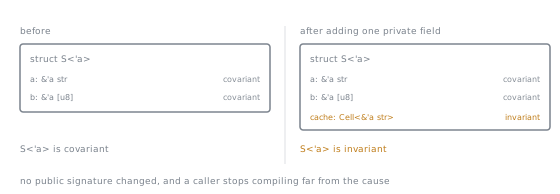
The last row of the table, on one concrete type. Everything a caller can name is identical on both sides: the same two public fields, the same signatures, the same documentation. The field that changed the answer is the one they cannot see, which is why the failure arrives in their code rather than in yours.
The compiler names this for you once a type is your own: = note: the struct `Name<'a>` is invariant over the parameter `'a`, with a help line pointing at the Nomicon's subtyping chapter. A type's variance is part of its public contract exactly as its signatures are: adding a Cell to a private field for an internal cache flips a type from covariant to invariant with no change to any public signature, and a caller's code simply stops compiling with that same note, far from the change that caused it.
Where for<'a> is required rather than optional
| Situation | Sugar covers it? |
|---|---|
A bound with one borrowed parameter and no borrowed return, Fn(&str) -> usize | Yes, every elided-lifetime closure bound already carries an implicit for<'a> |
A bound whose return also borrows from the argument, Fn(&'a str, &'a str) -> &'a str | No: there is no elided form for "the same lifetime, for every lifetime"; write for<'a> by hand |
| A function that must hand the closure a borrow it created itself, after the caller's own lifetime was already fixed | No: a single named lifetime is fixed before the body runs and cannot reach back to cover a value born later; only a bound satisfied afresh at every call, for<'a>, works |
| A trait you define whose method takes its own lifetime-parameterised borrow, used the same way | No, for the same reason; write it on the bound or as a supertrait |
Quantifying over a type parameter instead of a lifetime, for<T> | Not available on stable (E0658); move the type parameter onto the method instead, as an ordinary generic |
The diagnostic to recognise either way is implementation of `Fn` is not general enough, or, comparing two named function types directly, one type is more general than the other: both mean a bound asked for every lifetime and got a closure or function pinned to one specific lifetime instead.
The breaking-change table
The change, whether cargo-semver-checks 0.50.0 catches it, and what to do instead.
| Change | Tool catches it | What to do instead |
|---|---|---|
New field on a plain pub struct buildable with a literal | Yes, constructible_struct_adds_field | #[non_exhaustive] plus a constructor, from the first release |
New variant on a plain pub enum | Yes, enum_variant_added | #[non_exhaustive] on the enum, from the first release |
New field on a struct-like variant, when only the enum carries #[non_exhaustive] | Yes, enum_struct_variant_field_added | mark the struct-like variant #[non_exhaustive] too; the enum-level attribute protects only the set of variants, not the fields inside one that is itself struct-like |
| A non-sealed public trait gains a method with no default body | Yes, trait_method_added | give it a default body, or seal the trait first so no external impl exists to break |
A field quietly drops an auto trait such as Send or Sync | Yes, auto_trait_impl_removed | keep every field's own type Send/Sync, or treat the loss as deliberate and take the major version |
A blanket impl added where a dependant already implemented the trait by hand | No; the conflict is E0119 in the dependant, outside a single crate's own surface | check for a plausible downstream impl before adding a blanket one; the tool has nothing to say here |
Narrowing an accepted type, impl Into<String> to String | No | keep the wider bound once shipped; narrowing is the breaking direction even on a clean report |
A function's behaviour changes with no signature change, such as unwrap_or(0) becoming unwrap() | No | tests catch behaviour a signature cannot express; document panics so the promise is written down somewhere |
Adding #[non_exhaustive] to a type that shipped without it | Yes, cargo's own semver reference names this a breaking addition | ship it with the type's first release; adding it later revokes literals and matches a caller already relied on |
A private field changes a public lifetime parameter's variance, for example adding a Cell for a cache | No dedicated lint; surfaces as an ordinary compile failure in the dependant | decide covariance or invariance at first release, and treat later interior mutability as a variance-changing, hence breaking, decision |
Four of the shapes above need only the tool against one crate; the blanket-impl and narrowed-parameter rows need a second, dependent crate compiled against the change, since a coherence conflict or a tightened bound is invisible from inside the crate that made it.
The future-proofing tools, and what each costs a caller
| Tool | What it buys | What it costs today |
|---|---|---|
#[non_exhaustive] on a struct or enum (and on a struct-like variant, separately) | A future field or variant costs no major version | the literal constructor is gone entirely (E0639) from outside the crate, functional update included, and an exhaustive match needs a wildcard arm it may never use |
| A private field behind a constructor | The field can be validated, renamed or defaulted later with no caller-visible change | the literal and any functional-update shorthand are gone; every caller goes through the constructor |
| A sealed trait (a private supertrait no other crate can name) | A method can be added in a minor release, since no external impl exists to break | only types the crate itself provides may ever implement it |
| A newtype around a foreign or unsettled type | The wrapped type can change later, or the crate can start owning a foreign trait's impl, with nothing a caller wrote depending on it | every method the inner type had is gone unless forwarded on purpose |
#[doc(hidden)] | Hides an item from generated documentation | nothing else: the item is exactly as callable and exactly as public as before; a workaround for a macro's own generated items, not a substitute for deciding something should be private |
None of these are free in general; each is worth its cost only where a real dependant would be hurt without it; a type with nothing left to protect, such as two public f64 fields and no invariant, is more useful left plain.
Features: the additive rule and unification
A feature must only add. Cargo's own reference states it plainly: enabling a feature should never disable functionality, and it should usually be safe to enable any combination of features at once.
| Fact | Consequence |
|---|---|
| Features are unique to the package that defines them | enabling one on your own crate does not enable a same-named feature anywhere else |
| Cargo builds one copy of a shared dependency per build, unioning every feature any package in that build asked for | a package that never touched a feature can still receive its effects, if another package sharing the same dependency asked for it |
optional = true on a dependency defines an implicit feature of the same name | writing dep:name inside another feature's list turns that implicit name off, available since Rust 1.60 |
#[cfg(feature = "...")] on a pub item removes it from the build entirely when the feature is off | calling it without the feature is a compile error, E0425, "configured out", never a runtime surprise |
rust-version in [package] is enforced, not merely advisory | the wrong toolchain fails outright with a named requirement; placed after [dependencies] by mistake, cargo instead searches crates.io for a package called rust-version and reports it missing |
What a feature cannot fix: a signature or an error type that should differ between callers. Every feature in one build is on or off for everyone sharing that dependency, and unification means "everyone" is not a set any one caller controls; the honest alternatives are a major version, a new type, or a function under a new name.
The release procedure, ending in a dry run
- The test suite passes.
cargo semver-checks check-releaseruns clean against the version actually on the registry (--baseline-versionin continuous integration;--baseline-rev HEADagainst a git commit day to day).cargo docbuilds with no broken intra-doc-link warnings.cargo package --listis read by eyes at least once, since a narrowedincludecan look plausible and still be missing a filecargo packageitself would catch by compiling the packaged copy.- The manifest carries
descriptionandlicenseorlicense-file, both required in practice by crates.io, plusrepository,documentationandreadmewhere they exist. - In a workspace, a library is published before any sibling that path-depends on it; a dependant's own dry run fails first with "failed to prepare local package for uploading" if the registry has never seen the library it needs restated as a registry dependency.
- The version number follows the change actually being shipped: below
1.0.0a change the tool calls major lands on the minor position instead; at or above1.0.0it is a true major bump; reaching1.0.0itself is a judgement that the API is settled, never a count of#[non_exhaustive]attributes added. cargo publish --dry-runpackages, verifies by compiling the packaged copy, and ends with "warning: aborting upload due to dry run".- Only after all of the above, publish for real, which is one command this arc's reps never run.
A published version is never modified once uploaded; a mistake is yanked instead (cargo yank --version), which blocks any new dependency on that version while every lock file already naming it keeps working. A yank deletes no code.
API Guidelines items worth citing by identifier
Citing an identifier names a sentence someone else already argued through in public, rather than a feeling. None of these are enforced by any tool.
| Identifier | What it says | Why it earns a citation |
|---|---|---|
C-CONV | as_, to_ and into_ prefixes carry a cost and an ownership shape | fixes an argument about naming with a table instead of taste |
C-GETTER | the get_ prefix is not used for a getter, barring a single obvious thing to fetch | the exception is narrow and named, not "whatever is already common in the file" |
C-ITER | a collection's iter, iter_mut and into_iter follow one fixed shape | lets a caller reach for an ownership mode by a name already known from Vec |
C-CASE | acronyms count as one word inside UpperCamelCase (Uuid, not UUID) | a convention, not a soundness question; costs only a reader's eye |
C-COMMON-TRAITS | a crate defining a new type should eagerly implement Copy, Clone, Eq, PartialEq, Ord, PartialOrd, Hash, Debug, Display, Default | the orphan rule means a missing one can never be patched in from outside |
C-CONV-TRAITS | never implement Into or TryInto directly; implement From or TryFrom instead | the blanket impl already gives you the other direction for free |
C-GENERIC | fewer assumptions on an input make a function more widely usable | cuts both ways: every extra generic parameter is more surface for the breaking-change table above |
C-STRUCT-PRIVATE | making a field public pins a representation and gives up all validation | the argument for a constructor over a public field, stated as a cost rather than a taste |
C-GOOD-ERR | an error type should be Send and Sync | catches a type that compiles fine until somebody returns it from a spawned thread |
C-FAILURE | function docs state error, panic and safety considerations | the checklist's own name for writing down what lesson 0057 shows the tool cannot see |
#[must_use] is not on this checklist at all; it is sourced from the Reference's own attribute documentation instead, and belongs on anything whose only job is producing a value the caller is expected to act on.
The order of authority when sources disagree
Stated once, in rank order, highest first.
| Rank | Source | Loses to the one above because |
|---|---|---|
| 1 | A run on your own toolchain | every document below describes some toolchain; only your own compiler says what yours does with what you just wrote |
| 2 | The item's own source and its release notes | a rendered stability badge is generated from the same attributes you can open directly, so it can only be a rendering of them, never a second fact beside them |
| 3 | The Reference | maintained continuously and corrected when wrong, unlike a blog post that announces a release once and simplifies on purpose |
| 4 | A tracking issue | keeps recording what an implementation became through every amendment after a design was agreed, so it is a stale RFC's own conversation still being updated |
| 5 | An RFC | a design record of alternatives and objections at the moment of a decision, not a description of current behaviour |
The review order
Seven levels, hardest to undo first; the argument is reversibility, not severity.
| Order | Level | What to check |
|---|---|---|
| 1 | The public API's commitments | does this need to be pub at all; for a struct or enum, what happens the day it needs one more field or variant, including a field added inside a struct-like variant |
| 2 | What the types make impossible | could a caller already construct or exhaustively match today's shape |
| 3 | Error and panic behaviour | does it panic on caller-supplied input when a Result was available, and does the documentation say so |
| 4 | Sharing and concurrency | which sharing strategy picked this Mutex, atomic or channel, and does the code still answer the question that chose it |
| 5 | unsafe | the five questions a boundary must answer; failing any of the first four skips the fifth |
| 6 | A performance claim | is there a ratio, a stated workload and the safe version kept for comparison, or only an assertion |
| 7 | Naming and style | would a formatter or a five-second rename have settled this without a comment |
What separates a comment worth making from one that only looks like feedback is what it costs to ignore, not its politeness: a missing #[non_exhaustive] on a struct-like variant costs a major version if ignored; an unmeasured "this clone will be slow" costs nothing to ignore and states an opinion the arc's own measurement discipline already rules out.
What this arc deliberately never taught, and where to go next
Not taught anywhere in this arc: embedded targets and no_std, foreign function interfaces, macros beyond deriving, or any particular framework. Where a specific gap needs filling, the Cargo Book's future-proofing and semver pages, the API Guidelines themselves, and the Rust RFC book are the sources this stage read from directly rather than summarised in full; go to them once a question is narrower than this sheet, and to the Resources page for everything general the arc pointed at along the way.