Lesson 18. Recursive Queries
Mission link: An org chart, a bill of materials, a category tree: each is a table with a column pointing at its own kind, and no fixed number of joins answers "everything under this node" when the depth is not known in advance. A recursive query walks a structure like this without knowing how deep it goes.
Primary source: PostgreSQL, 7.8.2 Recursive Queries
Prerequisites: Lesson 12, Lesson 13
Warm-up
- ▢ Lesson 13 established that
UNIONdiscards a row that duplicates one already produced, whileUNION ALLkeeps every row exactly as many times as it was produced. Which of the two could, on its own, bring an otherwise endless repetition to a stop, and why?
Check
UNION. If the values a repeating step produces eventually come back around to one already seen, UNION throws that repeat away, and once a step produces nothing new there is nothing left to feed the next step, so it ends. UNION ALL keeps every row regardless, so the same repeating step never runs out of rows to add on its own; something else has to stop it.
Know this
The shape: an anchor, a UNION, and a term that names itself
A recursive WITH has three parts in a fixed order: a non-recursive term that fixes the starting rows, UNION or UNION ALL, and a recursive term, the only one allowed to mention the CTE's own name. Lesson 12 already named the whole construct WITH RECURSIVE; this lesson calls the first part the anchor term, since that is what it does.
WITH RECURSIVE countdown(n) AS (
    SELECT 5
    UNION ALL
    SELECT n - 1 FROM countdown WHERE n > 1
)
SELECT n FROM countdown;
n
-
5
4
3
2
1
The manual describes the evaluation as a working table. The anchor term runs once; its rows go into the result and seed that table. Then, as long as the working table holds anything, the recursive term runs again, not against everything produced so far, only against the rows the previous round produced. Whatever it returns replaces the working table for the next round and joins the result. The moment a round produces no rows, the table is empty and the whole thing stops. countdown ran the recursive term five times: n = 5 produced 4, 4 produced 3, and so on until the round working from n = 1 found n > 1 false and produced nothing, which is why the query stopped rather than being told to.
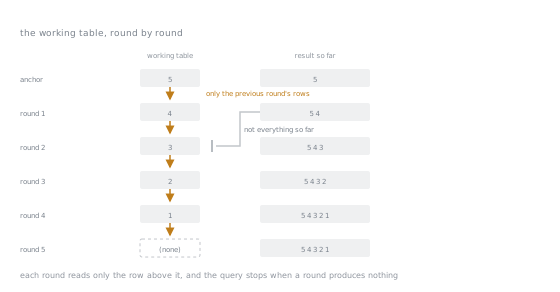
The chain runs down the left column only. The right column grows every round and is never read back: that is what "not against everything produced so far" means, and it is also why the last round, working from 1, produces nothing and ends the query.
Termination is your job, not the engine's
Nothing in PostgreSQL checks that a recursive term will eventually stop. Write one with no condition that ever fails and it produces rows forever, and running that without a limit is not something to try to see what happens.
WITH RECURSIVE counter(n) AS (
    SELECT 1
    UNION ALL
    SELECT n + 1 FROM counter
)
SELECT n FROM counter LIMIT 5;
n
-
1
2
3
4
5
It returns, and it is worth knowing precisely why. PostgreSQL evaluates a WITH RECURSIVE query lazily, producing one round only as the outer query asks for more, so LIMIT 5 stops asking once five rows exist and the recursion never reaches a sixth round. That is a way to inspect a query you are not yet sure of, not a substitute for a real stopping condition: sort the same query, or join its result to another table, and the outer query typically has to pull everything first, so the LIMIT stops helping.
Two things actually make a recursive term stop on its own. The first is a condition on a column that changes every round, most often a depth counter carried alongside the real data: WHERE depth < 5 guarantees at most five rounds however the data is shaped. The second is deduplication itself: UNION discards a row that repeats one already produced, and if the values a step can produce are drawn from a finite set, the recursion eventually has nothing new left to offer.
WITH RECURSIVE dedup(n) AS (
    SELECT 1
    UNION
    SELECT (n + 1) % 3 FROM dedup
)
SELECT n FROM dedup;
n
-
1
2
0
Three rows, one each of 0, 1 and 2, in an order the query does not fix. 1 produces 2, 2 produces 0, 0 produces 1 again, and that 1 is a repeat UNION throws away, so the next round produces nothing. The same query with UNION ALL never stops, since keeping every repeat is the whole difference UNION ALL makes, and here that difference is all that stands between a query and an infinite one.
Walking a hierarchy
This is the reason the feature exists, and the three tables in this workspace's dataset have no hierarchy in any of them, so a small table earns its place here:
CREATE TABLE parts (
    id     bigint PRIMARY KEY,
    name   text NOT NULL,
    parent bigint REFERENCES parts (id)
);

INSERT INTO parts (id, name, parent) VALUES
    (1, 'bike',  NULL),
    (2, 'wheel', 1),
    (3, 'frame', 1),
    (4, 'spoke', 2),
    (5, 'tube',  2),
    (6, 'valve', 5);
Walking down from the root, joining the recursive term's parts to the previous round's rows on parent, and tracking a depth as we go:
WITH RECURSIVE descend(id, name, depth) AS (
    SELECT id, name, 1
    FROM parts
    WHERE parent IS NULL
    UNION ALL
    SELECT p.id, p.name, d.depth + 1
    FROM parts p
    JOIN descend d ON p.parent = d.id
)
SELECT id, name, depth FROM descend ORDER BY depth, id;
id | name  | depth
---+-------+------
1  | bike  | 1
2  | wheel | 2
3  | frame | 2
4  | spoke | 3
5  | tube  | 3
6  | valve | 4
Walking up from a leaf reverses which side of parent the join uses:
WITH RECURSIVE ascend(id, name, parent) AS (
    SELECT id, name, parent FROM parts WHERE id = 6
    UNION ALL
    SELECT p.id, p.name, p.parent
    FROM parts p
    JOIN ascend a ON p.id = a.parent
)
SELECT id, name FROM ascend;
id | name
---+------
6  | valve
5  | tube
2  | wheel
1  | bike
A path column earns its keep the same way, built by concatenating the current row's name onto the previous round's path as the recursion descends:
WITH RECURSIVE descend(id, name, path) AS (
    SELECT id, name, name FROM parts WHERE parent IS NULL
    UNION ALL
    SELECT p.id, p.name, d.path || ' > ' || p.name
    FROM parts p
    JOIN descend d ON p.parent = d.id
)
SELECT id, path FROM descend ORDER BY id;
id | path
---+----------------------------
1  | bike
2  | bike > wheel
3  | bike > frame
4  | bike > wheel > spoke
5  | bike > wheel > tube
6  | bike > wheel > tube > valve
A path is worth carrying for two reasons: it makes the route from the root to a row visible without a second query, and it is the raw material a cycle check needs, since a cycle is exactly a row appearing on its own path.
Cycles, and what PostgreSQL gives you
Add two rows that point at each other and the plain query above would walk back and forth forever, since a parent-child join has no way to notice it has been here before. Bounding it with a LIMIT makes the loop visible instead of merely theoretical:
INSERT INTO parts (id, name, parent) VALUES (7, 'left-bracket', 8), (8, 'right-bracket', 7);
WITH RECURSIVE descend(id, name, path) AS (
    SELECT id, name, name FROM parts WHERE id = 7
    UNION ALL
    SELECT p.id, p.name, d.path || ' > ' || p.name
    FROM parts p
    JOIN descend d ON p.parent = d.id
)
SELECT id, path FROM descend LIMIT 4;
id | path
---+---------------------------------------------
7  | left-bracket
8  | left-bracket > right-bracket
7  | left-bracket > right-bracket > left-bracket
8  | left-bracket > right-bracket > left-bracket > right-bracket
The CYCLE clause replaces the guesswork with a real stop:
WITH RECURSIVE descend(id, name, path) AS (
    SELECT id, name, name FROM parts WHERE id = 7
    UNION ALL
    SELECT p.id, p.name, d.path || ' > ' || p.name
    FROM parts p
    JOIN descend d ON p.parent = d.id
)
CYCLE id SET is_cycle USING visited
SELECT id, name, path, is_cycle FROM descend;
id | name          | path                                        | is_cycle
---+---------------+---------------------------------------------+---------
7  | left-bracket  | left-bracket                                | f
8  | right-bracket | left-bracket > right-bracket                | f
7  | left-bracket  | left-bracket > right-bracket > left-bracket | t
CYCLE id names the column that identifies a row, SET is_cycle names the boolean the clause adds, and USING visited names the array it keeps behind the scenes to remember every id seen; visited is not part of the output unless also listed in the SELECT. The moment a row's id repeats one already in visited, that row is still returned, marked is_cycle = true, and the recursion stops there. PostgreSQL has had CYCLE, and the matching SEARCH clause for ordering, since release 14, whose release notes list "the SQL-standard SEARCH and CYCLE options for common table expressions". Before that release, the same protection was hand-written as an array column carried alongside the data and a WHERE NOT id = ANY(visited) test in the recursive term, excluding the repeat rather than returning it flagged.
What belongs in the anchor, and what belongs in the recursive term
A condition in the anchor term decides which rows the walk starts from; a condition in the recursive term decides which rows the walk is allowed to add at every round after that. Confusing the two changes the answer, not just the style. Starting from wheel alone and walking down without restriction:
WITH RECURSIVE descend(id, name) AS (
    SELECT id, name FROM parts WHERE id = 2
    UNION ALL
    SELECT p.id, p.name FROM parts p JOIN descend d ON p.parent = d.id
)
SELECT id, name FROM descend ORDER BY id;
returns 4 rows: wheel, spoke, tube, valve. Starting from the real root instead, but testing p.id = 2 inside the recursive term:
WITH RECURSIVE descend(id, name) AS (
    SELECT id, name FROM parts WHERE parent IS NULL
    UNION ALL
    SELECT p.id, p.name FROM parts p JOIN descend d ON p.parent = d.id WHERE p.id = 2
)
SELECT id, name FROM descend ORDER BY id;
returns only 2 rows, bike and wheel: the anchor walks from the top, but the recursive term admits a child only when that child's own id is 2, so bike's other child frame is refused outright, and once wheel is admitted its own children fail the same test. The same condition, tested in two different places, answers two different questions.
It travels: SQLite has this too
SQLite supports WITH RECURSIVE with the same anchor, UNION or UNION ALL, recursive term shape, and its own documentation's "Recursive Common Table Expressions" section works through a hierarchy example much like this lesson's. The parts table and the descent query above run there unchanged:
1|bike|1
2|wheel|2
3|frame|2
4|spoke|3
5|tube|3
6|valve|4
SQLite has no CYCLE clause, so a graph that might loop needs the hand-written array check there regardless of version.
Practice
-
▢ Predict the rows returned by the query below.
WITH RECURSIVE up(n) AS (
    SELECT 1
    UNION ALL
    SELECT n + 1 FROM up WHERE n < 4
)
SELECT n FROM up;
Check
1, 2, 3, 4. Each round adds one to the previous round's single row until a round works from n = 4, finds n < 4 false, and produces nothing.
- ▢ Predict what
WITH RECURSIVE t(n) AS (SELECT 1 UNION ALL SELECT n + 1 FROM t) SELECT n FROM t LIMIT 3returns, given that the recursive term carries no condition that could ever stop it.
Hint
The recursive term never stops itself here; something else is doing the stopping, and it is not a safeguard to rely on outside a quick check like this one.
Check
1, 2, 3. The recursion runs lazily, one round per row the outer query still needs, so LIMIT 3 stops asking after the third and a fourth round never runs. Sort the result or join it elsewhere and this stops helping, since both usually pull every row first.
-
▢ Using the
partstable from Know this, predict the rows returned by descending from the root withWHERE d.depth < 2added to the recursive term's join condition, everything else unchanged from the depth-tracking query.WITH RECURSIVE descend(id, name, depth) AS ( SELECT id, name, 1 FROM parts WHERE parent IS NULL UNION ALL SELECT p.id, p.name, d.depth + 1 FROM parts p JOIN descend d ON p.parent = d.id WHERE d.depth < 2 ) SELECT id, name, depth FROM descend ORDER BY depth, id;
Check
Three rows: bike at depth 1, wheel and frame at depth 2. The recursive term only fires again while the previous round's depth is under 2, so the round that would have produced spoke and tube at depth 3 never runs.
- ▢ Predict the row count if the anchor term of the same query is changed to
WHERE id = 3instead ofWHERE parent IS NULL, with no other change.
Hint
Check which rows in parts have parent = 3 before predicting how many rounds follow the first.
Check
One row, frame at depth 1. frame has no children, so the first recursive round finds nothing to join against and the walk never gets past the anchor.
- ▢
partsalso holds two rows pointing at each other,left-bracket(parentright-bracket) andright-bracket(parentleft-bracket). Predict the output of walking down fromleft-bracketwith apathcolumn andCYCLE id SET is_cycle USING visited.
Check
Three rows: left-bracket false, right-bracket false, then left-bracket again with is_cycle true and path left-bracket > right-bracket > left-bracket. The third round would repeat left-bracket, CYCLE recognises it, returns that row flagged, and stops rather than producing a fourth.
- ▢ The hand-written equivalent to
CYCLEcarries an array and testsWHERE NOT id = ANY(visited)in the recursive term. Predict what aLIMIT 5query over the same two cycling rows returns if thatWHEREtest is left out entirely.
Check
left-bracket, right-bracket, left-bracket, right-bracket, left-bracket, alternating forever with no test to refuse the repeat, and the query only stops because LIMIT 5 stops asking for more rounds, not because the recursion found nothing left to produce.
Real-world reps
- [ ] Find a table at work with a self-referencing column, a category tree, an org chart, a comment thread, and write a recursive query that walks it in the direction the business question actually needs, up or down.
- [ ] Take a hierarchy query someone hand-rolled with a fixed number of joins for "up to three levels deep" and replace it with a recursive
WITHthat has no depth limit built into its shape. - [ ] Tomorrow: pick one hierarchical report you maintain and add a path column to it, then use that path to spot whether the underlying data actually contains a cycle nobody had noticed.
Going further
- 7.8.2. Recursive Queries: the working-table evaluation model, the
SEARCHclause for ordering, and the fullCYCLEsyntax - PostgreSQL 14 Release Notes: the release that added the SQL-standard
SEARCHandCYCLEclauses - The WITH Clause: SQLite's own reference, with worked hierarchy and graph examples under "Recursive Common Table Expressions"
- Beyond the basics: the stage 3 reference sheet
- Resources
Not landing? Reread the primary source at the top, since this lesson compresses it and compression is where understanding leaks. Check the glossary for any term that felt slippery.
If the lesson itself is unclear rather than the material, that is a defect: open an issue.