Lesson 22. Choosing a Key
Mission link: Every table answers this question once: a key built from data the business edits ties every foreign key to that edit, while a generated key costs meaning and, depending how it is made, bytes or ordering guarantees you may not need.
Primary source: PostgreSQL, 5.5 Constraints
Prerequisites: Lesson 6, Lesson 21
Warm-up
- ▢ Lesson 6 showed that a
customerstable usually gets a generatedbigintprimary key plus aUNIQUEconstraint onemail, giving it two candidate keys with only one chosen as primary. What does the surrogate buy that email alone would not?
Check
Stability. The surrogate id never has to change when a customer edits their address, so nothing referencing it changes either; email still identifies the row, as a candidate key, it is simply not the one every foreign key points at.
Know this
The trade, not the rule
A natural key is data the domain already has: an ISO country code, an email address, a national identifier. It carries meaning of its own and enforces uniqueness of the real-world thing it names, so a countries table keyed on code gets a free guarantee that the same country never appears twice. A surrogate key is invented for the sole purpose of naming a row, and the glossary's point stands: it carries no meaning of its own, which is exactly why it does not have to change when the meaning does. The fixture makes both cases concrete. countries.code is genuinely stable: GB has meant the United Kingdom since the standard was drafted, and no ordinary business change touches it. customers.id is the opposite: a surrogate sitting beside email, a candidate key in the glossary's exact sense, and the one column here a person can and does change. Neither choice is universally right; the question is whether the identifying column is also one someone outside the database has reason to edit. When yes, a surrogate earns its keep; when genuinely no, as with a country code, a natural key costs nothing extra and gives a free constraint besides.
What a natural key costs when the domain moves
A schema of your own holds the rest of this lesson's tables.
CREATE SCHEMA design;

CREATE TABLE design.suppliers_nat (
    code text PRIMARY KEY,
    name text NOT NULL
);
CREATE TABLE design.parts_nat (
    id            bigint PRIMARY KEY,
    supplier_code text NOT NULL REFERENCES design.suppliers_nat (code)
);
INSERT INTO design.suppliers_nat (code, name) VALUES ('ACME', 'Acme Fasteners');
INSERT INTO design.parts_nat (id, supplier_code) VALUES (1, 'ACME'), (2, 'ACME');
Renaming the supplier's code looks like a single statement and is not one:
UPDATE design.suppliers_nat SET code = 'ACME-CORP' WHERE code = 'ACME';
ERROR: update or delete on table "suppliers_nat" violates foreign key constraint "parts_nat_supplier_code_fkey" on table "parts_nat", DETAIL: Key (code)=(ACME) is still referenced from table "parts_nat"., SQLSTATE 23503. Renaming for real takes three statements in this order, since a child row can no more point at a code not yet created than be left pointing at one just deleted:
INSERT INTO design.suppliers_nat (code, name) VALUES ('ACME-CORP', 'Acme Fasteners');
UPDATE design.parts_nat SET supplier_code = 'ACME-CORP' WHERE supplier_code = 'ACME';
DELETE FROM design.suppliers_nat WHERE code = 'ACME';
Every one of those statements is a place the rename can be interrupted, and every referencing table has to be found first; a lone insert against the vanished code still fails with the same 23503. Now build the same relationship with a surrogate: code becomes an ordinary column, and the reference points at a generated id instead.
CREATE TABLE design.suppliers_sur (
    id   bigint GENERATED ALWAYS AS IDENTITY PRIMARY KEY,
    code text NOT NULL,
    name text NOT NULL
);
CREATE TABLE design.parts_sur (
    id          bigint PRIMARY KEY,
    supplier_id bigint NOT NULL REFERENCES design.suppliers_sur (id)
);
INSERT INTO design.suppliers_sur (code, name) VALUES ('ACME', 'Acme Fasteners');
INSERT INTO design.parts_sur (id, supplier_id) VALUES (1, 1), (2, 1);
UPDATE design.suppliers_sur SET code = 'ACME-CORP' WHERE code = 'ACME';
That UPDATE reports one row changed and nothing else moves: parts_sur never mentioned the code, so there is nothing downstream to find. That is the whole cost of a natural key: identity and meaning are the same column, so a change to the meaning is a change to every table that referenced it.
A composite natural key
Some real identities are two columns together rather than one.
CREATE TABLE design.enrolments (
    student_id integer NOT NULL,
    course_id  integer NOT NULL,
    grade      text,
    PRIMARY KEY (student_id, course_id)
);
INSERT INTO design.enrolments (student_id, course_id, grade) VALUES (1, 100, 'B');
INSERT INTO design.enrolments (student_id, course_id, grade) VALUES (1, 100, 'A');
The second insert is correctly rejected: ERROR: duplicate key value violates unique constraint "enrolments_pkey", DETAIL: Key (student_id, course_id)=(1, 100) already exists., SQLSTATE 23505; a student is not enrolled twice in the same course. The width does not stay contained to this table, though: any child naming one enrolment has to carry both columns:
CREATE TABLE design.assignments (
    id         integer PRIMARY KEY,
    student_id integer NOT NULL,
    course_id  integer NOT NULL,
    FOREIGN KEY (student_id, course_id) REFERENCES design.enrolments (student_id, course_id)
);
That works, and rejects a pair absent from the parent with the same 23503. Referencing only student_id fails outright at CREATE TABLE time instead: ERROR: there is no unique constraint matching given keys for referenced table "enrolments", SQLSTATE 42830, since one column of a two-column key identifies nothing alone. A composite natural key can be exactly the right model, but every downstream table inherits its width, two columns where a surrogate key would have needed one.
Identity columns, the surrogate generator this engine prefers
A surrogate key still has to come from somewhere, and on this engine an identity column is the mechanism to write in new code, not serial.
CREATE TABLE design.by_default_ids (
    id   bigint GENERATED BY DEFAULT AS IDENTITY PRIMARY KEY,
    note text
);
INSERT INTO design.by_default_ids (note) VALUES ('a'), ('b');
INSERT INTO design.by_default_ids (id, note) VALUES (100, 'explicit');
INSERT INTO design.by_default_ids (note) VALUES ('c');
GENERATED BY DEFAULT AS IDENTITY lets that explicit 100 straight through, so the four ids come back 1, 2, 3, 100: the sequence was never told about the value that bypassed it and keeps counting from where it stood. Advancing the sequence to 99 and inserting once more reproduces the collision this leaves waiting: ERROR: duplicate key value violates unique constraint "by_default_ids_pkey", DETAIL: Key (id)=(100) already exists., SQLSTATE 23505, the moment the sequence catches up. GENERATED ALWAYS AS IDENTITY closes that door instead:
CREATE TABLE design.always_ids (
    id   bigint GENERATED ALWAYS AS IDENTITY PRIMARY KEY,
    note text
);
INSERT INTO design.always_ids (note) VALUES ('a');
INSERT INTO design.always_ids (id, note) VALUES (50, 'explicit');
The explicit insert is refused: ERROR: cannot insert a non-DEFAULT value into column "id", DETAIL: Column "id" is an identity column defined as GENERATED ALWAYS., HINT: Use OVERRIDING SYSTEM VALUE to override., SQLSTATE 428C9. The hinted escape works when a migration restoring old rows, not an ordinary insert, is what is asking:
INSERT INTO design.always_ids (id, note) OVERRIDING SYSTEM VALUE VALUES (50, 'explicit');
serial looks like the same idea and is not: it is sugar for an ordinary column with a nextval() default, and information_schema.columns reports its data_type as integer, four bytes, and is_identity as NO, against YES and eight bytes for the identity column above. Write GENERATED ALWAYS AS IDENTITY in new code: it is the mechanism the engine tracks as an identity, serial an older shorthand predating it, and lesson 1's advice to make an identifier bigint is the same advice arriving with a generator attached.
UUID keys, and what the version buys
A UUID is a surrogate key generated as a value rather than counted by a sequence, and this release offers two ways to make one with no extension required. gen_random_uuid() produces sixteen bytes of pure randomness: three successive calls share no prefix, for example 15c4b061-c90d-4b62-..., 6435fb38-8743-40f6-... and 6ee77620-0b80-4900-.... uuidv7() is new in PostgreSQL 18, named in that release's own notes as the "uuidv7() function for generating timestamp-ordered UUIDs", and three successive calls show exactly that, a shared leading prefix and strictly increasing values: 01a062fb-cf7d-7de6-..., 01a062fb-cf7d-7df3-... and 01a062fb-cf7d-7df8-.... On an older supported major, 14 to 17, there is no such function and gen_random_uuid() is the only built-in generator. The honest comparison stops short of a performance claim. A UUID of either kind can be generated anywhere, including by a client before the row exists, which a sequence-backed identity column cannot do, and it costs more either way: pg_column_size() reports sixteen bytes against eight for a bigint. A time-ordered UUID keeps rows inserted together near each other in the key's own order, where a random one scatters them; whether that scattering costs anything is a question about index structure for stage 6, and nothing measured here answers it.
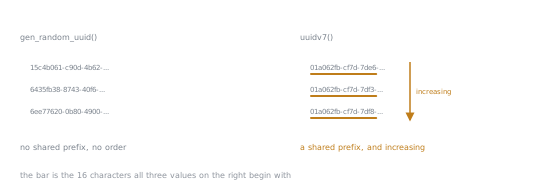
The bars line up because the values do, and that is the whole of what is shown here: a shared prefix and an order on one side, neither on the other. What that costs an index is still stage 6's question.
The rule that survives all of it
Whichever of the above ends up as a table's primary key, every other candidate key still needs its own constraint, because a primary key only enforces uniqueness of the column it names.
CREATE TABLE design.customers_nounique (
    id    bigint GENERATED ALWAYS AS IDENTITY PRIMARY KEY,
    email text NOT NULL
);
INSERT INTO design.customers_nounique (email) VALUES ('ada@example.com');
INSERT INTO design.customers_nounique (email) VALUES ('ada@example.com');
Both inserts succeed, two rows with different ids and the identical email, with nothing in the schema noticing. That is lesson 21's duplicate-row anomaly again, arriving through a different door: not a denormalised report table with no keys at all, but a properly surrogate-keyed one that never declared email as the candidate key it actually is. The fix is the pairing lesson 6 already recommended, a surrogate primary key plus a UNIQUE constraint on every column meant to identify a row on its own; choosing a good primary key is only half the design, and forgetting a table can have more than one key worth enforcing is the other half of getting it wrong.
DROP SCHEMA design CASCADE;
Practice
- ▢ Using
suppliers_natandparts_natabove, predict the exact error and SQLSTATE of updating a supplier's code while a part still references the old value.
Hint
The failure is the same shape as deleting a referenced parent row: both leave a child row pointing at a value that no longer exists.
Check
ERROR: update or delete on table "suppliers_nat" violates foreign key constraint "parts_nat_supplier_code_fkey" on table "parts_nat", DETAIL: Key (code)=(ACME) is still referenced from table "parts_nat"., SQLSTATE 23503. To the constraint, updating the referenced value is indistinguishable from deleting it.
- ▢ Predict the exact error and SQLSTATE of inserting a
parts_natrow whosesupplier_codeis'GLOBEX', a codesuppliers_natdoes not hold.
Check
ERROR: insert or update on table "parts_nat" violates foreign key constraint "parts_nat_supplier_code_fkey", DETAIL: Key (supplier_code)=(GLOBEX) is not present in table "suppliers_nat"., SQLSTATE 23503. Same SQLSTATE as before: a foreign key value must exist on the other side, whether it vanished afterward or was never there.
- ▢ Using the composite-keyed
enrolments (student_id, course_id)table, predict the exact error and SQLSTATE of declaring a foreign key againststudent_idalone from a new table.
Hint
The failure happens at CREATE TABLE, before any row is inserted, because the problem is with what the reference names rather than with any data.
Check
ERROR: there is no unique constraint matching given keys for referenced table "enrolments", SQLSTATE 42830. student_id alone is not a key of enrolments, only the pair is, so there is nothing unique for a single-column reference to point at.
- ▢ A
GENERATED BY DEFAULT AS IDENTITYcolumn has produced ids 1, 2 and 3, then accepted an explicit insert of 100. Predict what happens once further default inserts bring the sequence up to 100, and name the SQLSTATE.
Check
The default insert that would produce 100 fails instead: ERROR: duplicate key value violates unique constraint "by_default_ids_pkey", DETAIL: Key (id)=(100) already exists., SQLSTATE 23505. BY DEFAULT let 100 through without telling the sequence, which keeps counting as though 100 were still free.
- ▢ Predict whether three successive calls to
gen_random_uuid()share any structural pattern the way three calls touuidv7()do.
Check
No. Three gen_random_uuid() values come back with no shared prefix and no ordering between them, since every bit is random. uuidv7() shares a leading prefix and increases across calls because part of the value is a timestamp; gen_random_uuid() carries no timestamp to share.
- ▢ A table has a
bigint identityprimary key and anemailcolumn with no constraint on it at all. Predict whether two rows can hold the same email, and name the earlier lesson whose anomaly this reproduces.
Hint
The primary key only says the id column is unique; ask what, if anything, it says about any other column.
Check
Yes: two rows with different ids and the identical email insert without complaint, since the primary key enforces uniqueness of id alone. This is lesson 21's duplicate-row anomaly, reached this time through a properly surrogate-keyed table that never gave its natural candidate key a UNIQUE constraint of its own.
Real-world reps
- [ ] Pick a table you work with and identify every column, or column combination, unique in practice; check how many actually carry a
UNIQUEconstraint rather than being unique by convention. - [ ] Find a primary key in a schema you maintain that is a natural key, such as a code or an email, and trace how many other tables would need a change if that value were ever edited.
- [ ] Tomorrow: check which surrogate key generator a table you own uses,
serial, an identity column, or a UUID function, and whether that choice was made on purpose or inherited from an older example.
Going further
- 5.3. Identity Columns: the
GENERATED ... AS IDENTITYsyntax and howALWAYSandBY DEFAULTdiffer - 9.14. UUID Functions:
gen_random_uuid(),uuidv4()anduuidv7(), with their signatures side by side - E.6. Release 18: where
uuidv7()and virtual generated columns were introduced - Appendix A. PostgreSQL Error Codes: where SQLSTATEs 23503, 23505, 428C9 and 42830 are catalogued
- Schema design: the stage 4 reference sheet
- Resources
Not landing? Reread the primary source at the top, since this lesson compresses it and compression is where understanding leaks. Check the glossary for any term that felt slippery.
If the lesson itself is unclear rather than the material, that is a defect: open an issue.