Lesson 40. Pagination and Counting
Mission link: A paginated list fast on page one and slow on page five hundred is not a server problem but a query shape problem, and the fix a senior engineer reaches for never gets slower no matter how deep a reader scrolls.
Primary source: PostgreSQL, LIMIT and OFFSET
Prerequisites: Lesson 5, Lesson 38
Warm-up
- ▢ Lesson 5 showed that
ORDER BY customer_id LIMIT 10with no tiebreaker can place a tied row differently between two runs, so a page can show a row twice or skip it entirely. Why does addingOFFSETto that same query make the problem worse rather than just carrying it along unchanged?
Check
OFFSET decides which rows to skip using that same unstable order, so a reshuffle among tied rows can move one across the page boundary, not just within a page. A row ranked 20 on one run and 21 on the next appears on both pages or on neither, and nothing looks wrong to the database: the order was never unique, so every rank past the tie is up for grabs.
Know this
OFFSET reads what it skips
A "recent orders" page reads the newest rows first, backed by the primary key:
SELECT id, amount FROM orders ORDER BY id DESC LIMIT 20;
Limit (actual rows=20.00 loops=1)
  Buffers: shared hit=4
  ->  Index Scan Backward using orders_pkey on orders (actual rows=20.00 loops=1)
        Index Searches: 1
        Buffers: shared hit=4
Twenty rows out, 4 buffers touched; Index Searches is release 18's own addition to this node. Page twenty-five thousand of the same list, the ordinary way, adds OFFSET 500000:
SELECT id, amount FROM orders ORDER BY id DESC LIMIT 20 OFFSET 500000;
Limit (actual rows=20.00 loops=1)
  Buffers: shared hit=4993
  ->  Index Scan Backward using orders_pkey on orders (actual rows=500020.00 loops=1)
        Index Searches: 1
        Buffers: shared hit=4993
The one number that answers the question is buffers: 4 against 4993, well over a thousand times as many, for the same twenty columns. The scan node's own row count explains why, reporting 500020.00: the server has no way to hand back row 500001 without first producing and discarding rows 1 through 500000. OFFSET is not a jump, it is a full walk from the start of the order, and only after the walk does the server start keeping rows. The rule: the cost of page N grows with N, so the last page of a long list is the slowest thing in the feature, and it only gets slower as the list grows.
Keyset pagination
The fix remembers a row instead of a position. A client that has already seen the last page's final row, id 550905, asks for the next slice with a condition:
SELECT id, amount FROM orders WHERE id < 550905 ORDER BY id DESC LIMIT 20;
Limit (actual rows=20.00 loops=1)
  Buffers: shared hit=7
  ->  Index Scan Backward using orders_pkey on orders (actual rows=20.00 loops=1)
        Index Cond: (id < 550905)
        Index Searches: 1
        Buffers: shared hit=7
Seven buffers, for the same depth that OFFSET paid 4993 for, because the index condition starts the scan exactly where the last page ended rather than walking past everything before it. That is the whole trade: a client stops sending "page 25001" and starts sending "the last row I saw was id 550905", and every page then costs the same seven buffers regardless of depth. What crosses the wire changes shape too: not a page number, but a key, opaque to the client beyond "send this back next time".
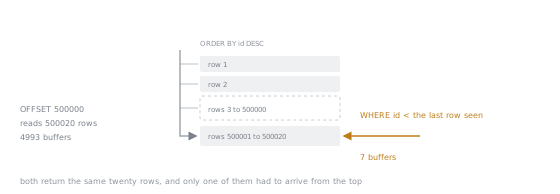
The elided stretch is one cell because half a million rows cannot be drawn to scale without the page becoming invisible, which is itself the point: both queries return the same twenty rows, and only one of them had to arrive from the top.
That key has to be unique, or the order it walks is not stable, the warm-up's problem now applied to WHERE as well as ORDER BY. Sorting by customer_id alone, a column many orders share, shows why a bare comparison breaks. With an index on (customer_id, id) built for this, and a page's last row recorded as (9, 1008), the naive rewrite drops the tiebreaker:
SELECT customer_id, id FROM orders WHERE customer_id > 9 ORDER BY customer_id, id LIMIT 20;
That returns rows starting at (10, 1019), silently skipping the rest of customer 9's orders, ids 1009 through 1018, since none satisfy customer_id > 9. Nothing errors; those rows are simply gone from every page ever requested. The correct rewrite compares both columns together as a row, Row Constructor Comparison:
SELECT customer_id, id FROM orders WHERE (customer_id, id) > (9, 1008) ORDER BY customer_id, id LIMIT 20;
Limit (actual rows=20.00 loops=1)
  Buffers: shared hit=4
  ->  Index Only Scan using i40_customer_id on orders (actual rows=20.00 loops=1)
        Index Cond: (ROW(customer_id, id) > ROW(9, 1008))
        Heap Fetches: 20
        Index Searches: 1
        Buffers: shared hit=4
This continues correctly, the rest of customer 9's orders then customer 10 from 1019 onward, no gap and no repeat. The rule that generalises: any keyset condition on a non-unique column needs the same tiebreaker in WHERE as in ORDER BY, compared as a tuple, or it reintroduces the gap it was meant to close.
What keyset pagination gives up
Three things, honestly: no jumping to page fifty-seven, since there is no page number left, only "after this key"; no total page count without a separate query; and an arbitrary sort the user picks freely needs a matching tiebreaker and usually a matching index per sort offered, lesson 38's territory. None of that makes OFFSET wrong: a settings page capped at a few hundred rows never reaches the depth where its cost matters, and a keyset rewrite there buys nothing a reader notices.
Counting, and the three answers
"How many rows match" has three honest answers, and the choice is about what the number is for. An exact count reads every row:
SELECT count(*) FROM orders;
Finalize Aggregate (actual rows=1.00 loops=1)
  Buffers: shared hit=7230 read=378
  ->  Gather (actual rows=3.00 loops=1)
        Workers Planned: 2
        ->  Partial Aggregate (actual rows=1.00 loops=3)
              ->  Parallel Seq Scan on orders (actual rows=349972.00 loops=3)
7608 buffers, the whole table, split across parallel workers (Gather is lesson 39's subject). A filtered count(*), WHERE amount > 100, costs the same 7608, since every heap page still has to be read before deciding what to keep. The second answer is an estimate that costs nothing to ask:
SELECT reltuples::bigint FROM pg_class WHERE relname = 'orders';
Immediately after ANALYZE orders this returned 1049916, matching count(*) exactly. reltuples is maintained by ANALYZE and autovacuum, lesson 37's subject, and it drifts between those runs rather than tracking every write. The third answer is a bounded count, cheap because it stops early:
SELECT count(*) FROM (SELECT 1 FROM orders WHERE amount > 100 LIMIT 1000) s;
Aggregate (actual rows=1.00 loops=1)
  Buffers: shared hit=9
  ->  Limit (actual rows=1000.00 loops=1)
        ->  Seq Scan on orders (actual rows=1000.00 loops=1)
              Filter: (amount > '100'::numeric)
Nine buffers, against 7608 for the exact filtered count, since the scan stops the moment it has a thousand matches. It answers "more than a thousand" cheaply and nothing finer; asked about a predicate matching fewer rows than the bound, it still reports the true number, since there was nothing left to cut off. The rule across all three: decide what the number is for before deciding how to get it, since a page count nobody reads is not worth a pass over the table.
An index that removes the sort
The first plan above already showed this unnamed: ordering by id, the primary key's own order, produced no Sort node, because Index Scan Backward hands rows back already in that order. The same query ordered by a column with no matching index, amount, plans entirely differently:
SELECT id, amount FROM orders ORDER BY amount DESC LIMIT 20;
Limit (actual rows=20.00 loops=1)
  Buffers: shared hit=7682
  ->  Gather Merge (actual rows=20.00 loops=1)
        ->  Sort (actual rows=16.00 loops=3)
              Sort Key: amount DESC
              Sort Method: top-N heapsort  Memory: 26kB
              ->  Parallel Seq Scan on orders (actual rows=349972.00 loops=3)
7682 buffers, most of the table, since every row has to be read before the twenty largest are known; Gather Merge, combining sorted streams from parallel workers, is lesson 39's subject, named here only in passing. Sort Method: top-N heapsort and its 26kB show this sort knew only twenty rows would survive, keeping a small heap rather than sorting everything. Choosing, or refusing, an index whose leading columns match an ORDER BY is lesson 38's decision; this lesson only shows what that decision buys back.
A LIMIT changes the plan, not just the result
The planner treats a bounded result as a different problem from a full one, and a query fast at one LIMIT can change shape at another. Filtering for unshipped orders, ordered newest first, with a small LIMIT:
SELECT id, amount FROM orders WHERE shipped_at IS NULL ORDER BY id DESC LIMIT 20;
Limit (actual rows=20.00 loops=1)
  Buffers: shared hit=5
  ->  Index Scan Backward using orders_pkey on orders (actual rows=20.00 loops=1)
        Filter: (shipped_at IS NULL)
        Rows Removed by Filter: 122
        Buffers: shared hit=5
Five buffers: the planner bets that walking the index backward turns up twenty matches quickly, and it does. Raising LIMIT to 150000, close to everything that filter matches, changes the plan's shape entirely:
Limit (actual rows=149991.00 loops=1)
  Buffers: shared hit=7611, temp read=460 written=462
  ->  Sort (actual rows=149991.00 loops=1)
        Sort Key: id DESC
        Sort Method: external merge  Disk: 3680kB
        ->  Seq Scan on orders (actual rows=149991.00 loops=1)
              Filter: (shipped_at IS NULL)
              Rows Removed by Filter: 899925
7611 buffers, plus a disk-backed sort, Sort Method: external merge Disk: 3680kB, because at this depth the earlier bet no longer pays: filtering the index in order would touch nearly the whole table anyway, so a plain sequential scan followed by one sort of just the matches wins outright. Nothing about the query changed except the number after LIMIT; the plan answering it is a different shape, not a slower version of the same one.
Practice
- ▢ Predict whether the buffer count at
OFFSET 900000is higher or lower than atOFFSET 500000, and why.
Check
Higher: OFFSET 900000 LIMIT 20 reads rows=900020.00 and touches 8984 buffers, against 500020 rows and 4993 buffers at OFFSET 500000. Buffers track the rows produced and discarded before any are kept, so the count grows with the offset, not with the twenty rows returned.
- ▢ A page's last row, sorted by
customer_idthenid, is(12, 2044). Predict whatWHERE customer_id >= 12 ORDER BY customer_id, id LIMIT 20returns, against the correct keyset condition.
Hint
Ask which rows satisfy customer_id >= 12 that the previous page already returned.
Check
It repeats rows: every order of customer 12 with id at or before 2044 still satisfies customer_id >= 12. The correct condition, (customer_id, id) > (12, 2044), excludes exactly the already-seen rows.
- ▢
SELECT count(*) FROM (SELECT 1 FROM orders WHERE customer_id = 999999999 LIMIT 1000) sruns against acustomer_idmatching nothing. Predict the number returned.
Check
0, the true count, not 1000 or an error. LIMIT only caps the count from above; when fewer matches exist than the bound, the scan simply runs out of rows first and reports exactly how many it found.
- ▢ The same
ORDER BY amount DESCquery runs once withLIMIT 20and once with noLIMITat all. Predict how theSort Methodline differs between the two.
Hint
One version can discard every row outside the top twenty as it goes; the other has to keep all of them.
Check
With LIMIT 20 it is Sort Method: top-N heapsort Memory: 26kB, a small heap keeping only the current best twenty. With no LIMIT, sorting all 1049916 rows, it is Sort Method: external merge Disk: 25656kB, spilling to disk since every row has to be held, not just the winners.
- ▢
SELECT id, amount FROM orders LIMIT 20runs with noORDER BYat all. Predict the scan node and whether the twenty rows returned are the same on a repeated run.
Check
A plain Seq Scan, cheap at 2 buffers, reading whichever rows sit first in storage. Nothing promises those are the same twenty next time: without an ORDER BY there is no order to begin with, the same gap the warm-up named, minus even a tiebreaker to argue about.
- ▢ A table is
ANALYZEd at 50000 rows, then 20000 more rows are inserted with no furtherANALYZE. Predict whatcount(*)andreltupleseach report.
Check
count(*) reports 70000, the true count, since it reads the rows that exist right now. reltuples still reports 50000, the figure from the last ANALYZE, because nothing has refreshed it since; the estimate is only as current as its last statistics run, the drift the counting section named.
Real-world reps
- [ ] Find a paginated list in code you maintain and check whether it sends a page number or a remembered key.
- [ ] Run
EXPLAIN (ANALYZE)on a query of your own past a largeOFFSET, and read its scan node's row count against the rows it actually returns. - [ ] Tomorrow: pick one list in your own systems that uses
OFFSET, and decide honestly whether its depth is bounded enough to leave alone or large enough to earn a keyset rewrite.
Going further
- 7.6. LIMIT and OFFSET: the clause this lesson replaces past a shallow page
- 9.25.5. Row Constructor Comparison: the
(a, b) > (x, y)syntax behind a composite keyset condition - 52.11. pg_class: where
reltupleslives - CREATE INDEX: syntax for the composite index behind the keyset example
- Performance: the stage 6 reference sheet
- Resources
Not landing? Reread the primary source at the top, since this lesson compresses it and compression is where understanding leaks. Check the glossary for any term that felt slippery.
If the lesson itself is unclear rather than the material, that is a defect: open an issue.