NULL and Three-Valued Logic
Lookup sheet for stage 1. The question it exists to answer: why did this row not come back?
The one rule
NULL is a marker for the absence of a value, not a value. Any comparison with it yields unknown.
WHERE, ON and HAVING keep a row only when the condition is true. Unknown is discarded exactly like false.
Truth tables
AND | true | false | unknown |
|---|---|---|---|
| true | true | false | unknown |
| false | false | false | false |
| unknown | unknown | false | unknown |
OR | true | false | unknown |
|---|---|---|---|
| true | true | true | true |
| false | true | false | unknown |
| unknown | true | unknown | unknown |
NOT | |
|---|---|
NOT true | false |
NOT false | true |
NOT unknown | unknown |
false AND unknown is false and true OR unknown is true, so a NULL can be harmless in one position and fatal in another.
What each expression yields
| Expression | Result |
|---|---|
NULL = NULL | unknown |
NULL <> NULL | unknown |
NULL = 1 | unknown |
NULL IS NULL | true |
NULL IS NOT DISTINCT FROM NULL | true |
NULL + 1 | NULL |
'a' \|\| NULL | NULL |
count(*) over 0 rows | 0 |
sum(x) over 0 rows | NULL |
coalesce(NULL, NULL, 3) | 3 |
Where NULL behaves as if equal
The asymmetry worth memorising: for comparison two NULLs are unknown, and for grouping and deduplication they are the same thing.
| Operation | Two NULLs are |
|---|---|
=, <>, <, > | unknown |
IS NOT DISTINCT FROM | equal |
GROUP BY | one group |
DISTINCT | duplicates |
UNION, INTERSECT, EXCEPT | duplicates |
ORDER BY | tied |
UNIQUE constraint | distinct, so several are allowed |
CHECK constraint | passes, because only false fails |
Aggregates
| Query | Behaviour |
|---|---|
count(*) | counts rows |
count(col) | counts non-null values |
sum, avg, min, max | skip NULLs entirely |
avg(col) | divides by the count of non-null values, not by the row count |
| any aggregate over no rows | NULL, except count, which is 0 |
count(*) next to count(col) is the cheapest way to measure how complete a column is.
Wrap any total that feeds arithmetic or a report: coalesce(sum(amount), 0).
Traps, with the fix
| Trap | Why | Fix |
|---|---|---|
WHERE col = NULL | always unknown, returns nothing | WHERE col IS NULL |
WHERE col <> 'x' expecting the NULL rows | unknown, so they are dropped | WHERE col <> 'x' OR col IS NULL |
NOT IN (SELECT nullable) | one NULL empties the result | NOT EXISTS (...) |
UNIQUE on a nullable column | many NULLs allowed | add NOT NULL, or UNIQUE NULLS NOT DISTINCT |
sum() used in arithmetic | NULL over no rows | coalesce(sum(...), 0) |
ORDER BY d DESC for "most recent" | NULLs sort first in PostgreSQL | ORDER BY d DESC NULLS LAST |
avg() treating NULL as zero | it does not | avg(coalesce(col, 0)) when zero is meant |
a CHECK that is unknown | unknown passes | state the null case explicitly |
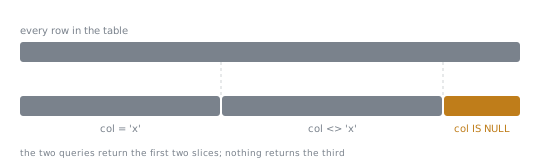
The second row of that table, seen from one level up. Two opposite conditions look like they cut the table in two, and they do not: the third slice is in neither result, so the two counts never add up to the row count. This is review question 4 below, and the reason it is worth asking is that nothing about either query looks wrong on its own.
Expanding NOT IN
id NOT IN (1, NULL)
-- expands to
id <> 1 AND id <> NULL
-- which is
(true or false) AND unknown
-- which is never true
IN is safer only by accident: id IN (1, NULL) is true when id is 1 and unknown otherwise, so it fails to match rather than emptying the result.
Substituting a value
| Function | Does |
|---|---|
coalesce(a, b, c) | first non-null argument |
nullif(a, b) | NULL when a = b, else a |
greatest, least | ignore NULLs in PostgreSQL, which is engine-specific |
Note that coalesce(col, 'x') = 'x' prevents an index on col from being used, so it is a reporting tool rather than a filtering one.
Deciding in review
- Which columns in this query are nullable? Check the schema, not the sample data.
- Does any of them appear in a comparison? Then the unknown case is being discarded.
- Is there a
NOT INwith a subquery? Then check the selected column isNOT NULL. - Does the query claim to partition rows, for example a matching and a non-matching branch? Then the NULL rows are in neither.
- Does an aggregate feed arithmetic? Then the empty-input case is
NULL.