Querying
Lookup sheet for stage 2. The question it exists to answer: which join, subquery or set operation answers this question, and where does a condition belong?
All counts below are against the small fixture: eight customers, twelve orders, eight countries, described in The Dataset.
Every join type
| Join | Keeps | Invents | Verified count |
|---|---|---|---|
CROSS JOIN | every pairing of both tables, no condition | nothing | customers CROSS JOIN orders: 96 |
JOIN / INNER JOIN | only pairs where the condition is true | nothing | customers JOIN orders ON c.id = o.customer_id: 12 |
LEFT JOIN | every left row, matched or not | NULL for every right-hand column when nothing matched | customers LEFT JOIN orders: 13 |
RIGHT JOIN | every right row, matched or not; LEFT JOIN with sides swapped | NULL for every left-hand column when nothing matched | customers RIGHT JOIN countries ON n.code = c.country: 10 |
FULL JOIN | every row from both sides | NULL on whichever side failed to match | customers FULL JOIN countries ON n.code = c.country: 13 |
NATURAL JOIN | guesses the shared column names instead of naming them; a trap, not a shortcut | nothing, but silently changes what the condition means | customers NATURAL JOIN orders (guesses id = id): 0. orders NATURAL JOIN countries (no shared column, degrades to a cross product): 96 |
A RIGHT JOIN is never a distinct operation: swapping which table is named first and writing LEFT JOIN instead gives the identical rows, and reads in the direction everyone already scans FROM in.
ON versus WHERE
For an inner join the two are interchangeable: customers, orders WHERE customers.id = orders.customer_id and customers JOIN orders ON c.id = o.customer_id both return 12. The equivalence breaks once a join can invent a row.
| Where the condition sits | Effect |
|---|---|
ON, on the outer table's own columns | decides what counts as a match, before the row is invented; a customer matching nothing still appears once, with NULLs |
WHERE, after a LEFT/RIGHT/FULL JOIN | filters the already-built result; a real comparison against an invented NULL evaluates to unknown and drops the row, quietly turning the outer join back into an inner one |
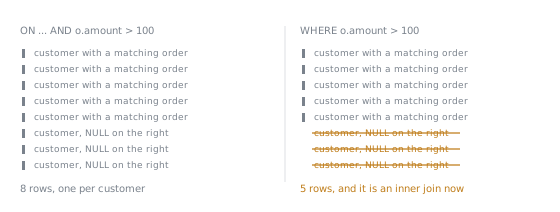
Verified on customers LEFT JOIN orders ON o.customer_id = c.id: adding WHERE o.amount > 100 gives 5 rows; moving the identical condition into ON ... AND o.amount > 100 gives 8, one per customer. The one safe test to run in WHERE after an outer join is IS NULL on the invented side, since IS NULL never returns unknown: that idiom is the anti-join, WHERE o.id IS NULL after customers LEFT JOIN orders, isolating customer 6 alone.
What each aggregate does with NULL
Every aggregate except count(*) ignores NULL: it is treated as absent from the calculation, not as zero.
| Aggregate | A NULL in the column | Over zero rows |
|---|---|---|
count(*) | irrelevant, it counts rows | 0 |
count(column) | skipped | 0 |
count(DISTINCT column) | skipped | 0 |
sum(column) | skipped | NULL |
avg(column) | skipped, and the divisor is the count of values seen, not the row count | NULL |
Verified on orders (12 rows, shipped_at missing on four): count(*) 12, count(shipped_at) 8, sum(amount) 2406.49, avg(amount) 200.5408333333333333. Verified with WHERE amount > 100000 (zero rows survive): count(*) 0, sum(amount) and avg(amount) both NULL. coalesce(sum(amount), 0) turns that blank into a 0 a caller can print without it reading as a failed query.
GROUP BY treats NULL differently from WHERE and a join condition: WHERE country = 'GB' and a join's ON both refuse to match a NULL, but GROUP BY puts every NULL into one group rather than dropping the rows, since grouping only needs somewhere to put a row it cannot compare. Verified: customers JOIN orders GROUP BY c.country gives five groups, not four, the fifth holding both NULL-country customers with 2 orders and 700.00.
Where a condition belongs
Tied to Evaluation order: ON and FROM run first, WHERE second, GROUP BY third, HAVING fourth, then SELECT.
| Clause | Runs | Sees | Put here |
|---|---|---|---|
ON | while the join builds its rows | both sides of that one join | a condition on how two rows relate, including the outer table's own columns when a NULL row must not be invented for the wrong reason |
WHERE | one row at a time, before grouping | a row's own columns; no aggregate, no SELECT alias | a condition on a single row |
HAVING | one group at a time, after grouping | grouped columns and aggregate results | a condition on a whole group, usually an aggregate |
FILTER (WHERE ...) | attached to one aggregate call | restricts only what that call sees | a per-aggregate row condition, when different aggregates in the same query need different rows |
HAVING needs no GROUP BY: with none, the whole table is one group, and HAVING can still reject it. Verified: SELECT count(*) FROM orders HAVING count(*) > 5 returns 12; the same query with > 500 returns no rows at all, not a row holding 0, the one way an aggregate query with no rows can come back empty.
The diagnostics of the stage
Every error a lesson quoted, re-run and confirmed.
| Error | SQLSTATE | Cause |
|---|---|---|
column reference "id" is ambiguous | 42702 | both sides of a join have a column of that name; qualify it with the table's alias |
column "x" must appear in the GROUP BY clause or be used in an aggregate function | 42803 | the column is neither grouped nor aggregated, and does not follow functionally from a grouped primary key; fires the same way whether the column sits in SELECT or in HAVING |
aggregate functions are not allowed in WHERE | 42803 | WHERE runs before GROUP BY exists, so no aggregate has a set of rows to work over yet |
aggregate function calls cannot be nested | 42803 | an aggregate consumes a set of rows and produces one scalar; there is nothing left resembling a set for an outer aggregate to consume |
more than one row returned by a subquery used as an expression | 21000 | a scalar subquery must return exactly one row; this one returned several. A runtime failure, not caught by review or by testing against data that happens to have one row |
each UNION query must have the same number of columns | 42601 | set operators match columns by position; the same wording appears with INTERSECT or EXCEPT in place of UNION |
UNION types bigint and text cannot be matched | 42804 | the column counts match but a position has no common type between the two branches |
syntax error at or near "UNION" | 42601 | an ORDER BY was written inside one branch; only a parenthesised branch or a trailing ORDER BY after the last branch is legal |
All four 42803 errors share one SQLSTATE: a clause was given something it cannot have yet at the point it runs.
Which subquery form answers which question
| Form | Question | Note |
|---|---|---|
| Scalar subquery | "give me the one value to compare against" | must return exactly one row, or 21000 at runtime, verified above |
IN / EXISTS (a semi-join) | "does at least one match exist" | returns the outer row at most once; a join asking the same question needs an explicit GROUP BY or DISTINCT to avoid returning it once per match. Verified: customers with an order over 50, by IN or EXISTS, 6 rows; the equivalent join with no GROUP BY, 7 rows, count(DISTINCT c.id) 6 |
| Correlated subquery | "one answer per outer row" | re-scans the inner table once per outer row; reach for a join with GROUP BY when the whole table needs the number, not just one row |
Derived table (subquery in FROM) | "treat this computed result as a table" | needs an alias in PostgreSQL 15 and earlier; PostgreSQL 16 onward accepts none, verified: SELECT count(*) FROM (SELECT * FROM orders WHERE amount > 100) returns 5 with no alias at all. Write the alias regardless, since older code always has one |
The NOT IN and NULL rule. NOT IN expands to a chain of <> joined by AND; one NULL anywhere in the subquery's result makes that chain unknown for every row, not just the row connected to the NULL, so WHERE keeps nothing. Verified: id NOT IN (SELECT customer_id FROM orders) returns customer 6, correctly, since customer_id is NOT NULL. Add one NULL to the same set, ... UNION SELECT NULL, and the identical query returns zero rows. NOT EXISTS asks a different question, whether a matching row exists, and never expands into a comparison against every value, so it returns customer 6 either way. Default to NOT EXISTS; use NOT IN only against a column verified NOT NULL, never one merely assumed to be.
The four set operations
Over orders, one branch for amount > 100, one for shipped_at IS NULL:
| Operator | Duplicates | Verified count |
|---|---|---|
UNION | removed | 8 |
UNION ALL | kept | 9 |
INTERSECT | removed | 1 |
EXCEPT | removed | 4 |
An ALL variant exists for every operator except plain UNION, which already has UNION ALL as its counterpart, and keeps a row exactly as many times as it was produced: amount FROM orders WHERE customer_id = 4 EXCEPT amount FROM orders WHERE customer_id = 999 returns 2 rows, since the plain form deduplicates a genuine repeated 10.00; the EXCEPT ALL form of the identical query returns 3.
Columns match by position, not by name: the output header comes entirely from the first branch. ORDER BY cannot sit inside an unparenthesised branch, only after the last branch, where it orders the combined result, or inside a parenthesised branch that carries its own. Without a trailing ORDER BY, a set operation's result has no defined order at all: the plain UNION above, run with nothing after it, came back as 103, 104, 105, 106, 110, 101, 108, 112, matching neither branch's own order.
EXCEPT is a third way to write an anti-join, alongside LEFT JOIN ... IS NULL and NOT EXISTS: customers EXCEPT SELECT customer_id FROM orders returns customer 6 alone, the identical answer. It differs from the other two because it compares whole rows and deduplicates by nature, so it cannot return a column the second query lacks, where a filter never has that restriction.
PostgreSQL and SQLite
Most of this stage runs identically on both engines: every join type, including FULL JOIN and RIGHT JOIN, gives the same counts; FILTER works the same way; the NOT IN-and-NULL trap behaves identically; grouping by a SELECT alias is accepted by both.
| Feature | PostgreSQL | SQLite |
|---|---|---|
GROUPING SETS | works | syntax error naming SETS |
ROLLUP | works | not implemented; read as a call to a nonexistent function |
DROP TABLE IF EXISTS a, b; | works | syntax error, one table per statement |
GROUPING SETS and ROLLUP are the one piece of this stage that is PostgreSQL only.