Lesson 4. this Is Decided by the Call
Mission link: Passing a method as a callback is the most ordinary thing in a codebase, and it is the exact operation that loses this. The type system does catch some of it, and only if you know what it is checking.
Primary source: You Don't Know JS Yet: Objects & Classes, chapter 4
Prerequisites: Lesson 3
Warm-up
- ▢ Where does a class method live, and where does a class field live?
Check
The method is on the prototype and shared by all instances. The field is an own property, created per instance by the constructor.
- ▢ What does
instanceofactually check?
Check
Whether the constructor's prototype object appears in the value's prototype chain.
Know this
this is not a variable and it is not lexically scoped. For an ordinary function it is an implicit parameter, and the call site decides its value. The same function called four ways gets four different this.
The four rules, in precedence order:
new:new F()setsthisto the newly created object.- Explicit:
f.call(obj),f.apply(obj),f.bind(obj)set it toobj. - Method call:
obj.f()sets it toobj, because of the dot, not because of wherefwas defined. - Default: anything else gets
undefinedin strict mode, which includes every module and every class body. In sloppy mode it gets the global object instead, which is how these bugs used to be silent.
Arrow functions are outside this system entirely: they have no this of their own and close over the one in scope where they were written.
The bug this produces
class Service {
  constructor(private name: string) {}
  describe() { return this.name; }
}

const svc = new Service("api");
svc.describe();                     // "api"

const fn = svc.describe;
fn();                               // TypeError: cannot read 'name' of undefined

[1].map(svc.describe);              // same failure
setTimeout(svc.describe, 0);        // same failure
Nothing was mutated and no reference was lost. svc.describe evaluates to the function, and the function has no attachment to svc. The dot is what supplied this, and once you extract the function there is no dot.
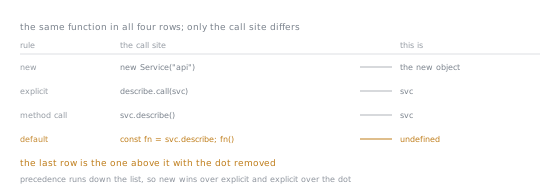
Read the middle column as the only thing that changes. The function is byte for byte identical in all four rows, which is why no amount of reading describe will tell you what this is inside it; the answer is not written there. The last row is the third one with the dot taken away, and that single edit is the whole distance between "api" and a TypeError.
TypeScript catches part of this, and only part. With strictBindCallApply and noImplicitThis on, a function that uses this and is called without a receiver can be reported, but a method passed as a callback usually type-checks fine, because its signature says nothing about needing a receiver.
Three fixes, and when each is right
setTimeout(() => svc.describe(), 0);            // 1: call it at the call site
setTimeout(svc.describe.bind(svc), 0);          // 2: bind explicitly
class Service { describe = () => this.name; }   // 3: an arrow class field
- Wrapping in an arrow is the default. It is local, obvious, costs nothing structurally, and keeps the method on the prototype.
bindis right when you need the bound function as a value, for example to store it and remove a listener later. Note thatbindreturns a new function, soremoveEventListener(el, this.handler.bind(this))removes nothing.- The arrow field is right when a class exists to be used as a bag of callbacks. It costs one function object per instance and it is not on the prototype, so it cannot be overridden by a subclass in the usual way.
this in an arrow function
const obj = {
  name: "x",
  ordinary() { return this.name; },       // "x"
  arrow: () => this.name,                 // NOT obj: `this` is the enclosing scope's
};
An arrow in an object literal captures whatever this was outside the literal, which at module top level is undefined. So arrows are correct for callbacks inside a method and wrong for methods themselves. That is the one rule worth memorising: methods should be ordinary functions, callbacks should be arrows.
Practice
-
▢ Predict each of the four.
class Counter {
  n = 0;
  inc() { this.n++; return this.n; }
}
const c = new Counter();
console.log(c.inc());
const f = c.inc;
console.log(f());
console.log(f.call(c));
console.log([0].map(c.inc));
Hint
For each call, find what is immediately to the left of the parentheses.
Check
1, then a TypeError from f().
c.inc() had the dot, so this was c. f() is a plain call in strict mode, so this is undefined and reading this.n throws. The remaining two lines never run; f.call(c) would have returned 2, and the map call would have thrown for the same reason as f().
-
▢ Which of these logs
"api"?const svc = new Service("api");- a)
setTimeout(svc.describe, 0) - b)
setTimeout(() => svc.describe(), 0) - c)
setTimeout(svc.describe.bind(svc), 0) - d)
setTimeout(function () { svc.describe(); }, 0)
- a)
Check
b), c) and d) all work. Only a) fails.
In b and d the call happens with svc to the left of the dot, inside the callback. In c, bind attached the receiver permanently. In a, the function is handed over with nothing attached, and the timer calls it with no receiver.
Note that d works despite being an ordinary function: what matters is not how the callback was written but how describe is called inside it.
-
▢ Why does this listener never get removed?
class Widget {
  handle() { }
  attach(el: HTMLElement) { el.addEventListener("click", this.handle.bind(this)); }
  detach(el: HTMLElement) { el.removeEventListener("click", this.handle.bind(this)); }
}
Check
bind returns a new function object every time it is called, so the function passed to removeEventListener is not the one that was added, and removal is by identity.
The fix is to bind once and keep the result:
class Widget {
  private readonly bound = this.handle.bind(this);
  attach(el: HTMLElement) { el.addEventListener("click", this.bound); }
  detach(el: HTMLElement) { el.removeEventListener("click", this.bound); }
  handle() { }
}
An arrow class field, handle = () => {}, has the same effect: one stable function per instance.
-
▢ One of these two is wrong. Which, and why?
const timer = {
  seconds: 0,
  startA() { setInterval(() => this.seconds++, 1000); },
  startB() { setInterval(function () { this.seconds++; }, 1000); },
};
Check
startB is wrong. The ordinary function passed to setInterval is called with no receiver, so this is not timer, and this.seconds++ either throws or silently writes to something else depending on the environment and mode.
startA is correct: the arrow has no this of its own, so it uses the one from startA, which is timer because startA was called with the dot.
This is the memorable version of the rule: the method is an ordinary function, and the callback inside it is an arrow.
- ▢ A colleague proposes making every class method an arrow field, so
thiscan never be lost. Give the strongest argument for and against.
Check
For: the failure mode disappears completely. Methods survive being passed as callbacks, destructured, or handed to a framework, and nobody has to think about the call site again. In a codebase that mostly wires callbacks, that is a real reduction in a whole class of bug.
Against: it moves every method off the prototype, so each instance carries its own copy of every function, which matters when instances are numerous. Subclass overriding stops working the usual way, since a field on the child shadows rather than overrides and the ordering of field initialisation starts to matter. super.method() is no longer available. And the methods vanish from the prototype, so anything reflecting over the class, including some test and serialisation tooling, no longer sees them.
The defensible middle: ordinary methods by default, arrow fields for the specific handful that are genuinely passed as callbacks, and a comment saying which.
Real-world reps
- [ ] Run practice 1 line by line and watch exactly which call throws. Then add
"use strict"reasoning to it: in a module you are already in strict mode, sothisisundefinedrather than the global object. - [ ] Reproduce the
bindlistener bug: attach, detach, then click and see the handler still fire. - [ ] Tomorrow: search code you know for a method passed directly as a callback, meaning
something(this.method)orsomething(obj.method)with no wrapper. Each one either already has an arrow field or is a latent bug.
Going further
- You Don't Know JS Yet: Objects & Classes, chapter 4: the four rules, argued in full
- TSConfig:
noImplicitThisandstrictBindCallApply: what the compiler can and cannot catch here - Resources
Not landing? Reread the primary source at the top, since this lesson compresses it and compression is where understanding leaks. Check the glossary for any term that felt slippery.
If the lesson itself is unclear rather than the material, that is a defect: open an issue.