Lesson 17. unknown Instead of any
Mission link: Owning a codebase means being able to point at any value that arrived from outside your own code and say exactly what has been checked about it so far, and unknown is the type that keeps that answer honest instead of erased.
Primary source: More on Functions, Other Types to Know About, TypeScript Handbook
Prerequisites: Lesson 12, Lesson 8
Warm-up
- ▢ Lesson 8 typed
xasanyand ranx.toUpperCase()whilexheld42. Predict whether the compiler objects, and say in one sentence whatanydid to make that so.
Check
No objection. any switches off checking for whatever value carries it, so a method call that makes no sense for a number compiles anyway, and fails only when the program actually runs. This lesson gives you the type that behaves the opposite way.
Know this
The asymmetry
unknown and any both accept every value on the way in. let u: unknown; u = 1; u = "x"; u = {}; compiles for all three assignments, exactly as it would with any. The difference is what happens on the way out. Assign unknown into a typed variable and the compiler stops you:
let u: unknown = "x";
const s: string = u;
// error TS2322: Type 'unknown' is not assignable to type 'string'.
any never does that. Assign any anywhere and it fits, silently, in both directions. unknown is compatible with every type in one direction only: values flow in freely, nothing flows out until you have shown the compiler what it actually is. That asymmetry is the whole idea. unknown is the honest type for a value you have not yet established anything about; any is not a type for not-yet-established, it is an instruction to stop asking.
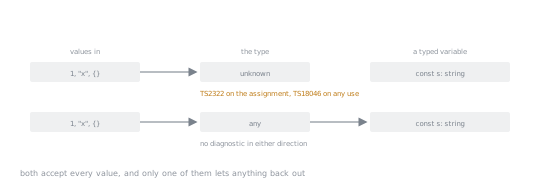
The left half of the two rows is identical. The right half is where they part, and on the unknown row there is simply no arrow to draw.
Nothing flows out, not even a method call
The restriction is not limited to assignment. Reading a property or calling an unknown value is refused before the assignment question even arises:
let u: unknown = "x";
u.length;
// error TS18046: 'u' is of type 'unknown'.
u();
// error TS18046: 'u' is of type 'unknown'.
Same diagnostic for a property read and for a call: the compiler treats unknown as carrying no operations at all until something narrows it, a stronger position than merely disallowing assignment, and one any never takes.
Narrowing is how you leave unknown
Lesson 12 covered the narrowing operators. They are exactly what removes the restriction here, typeof included:
let u: unknown = "x";
if (typeof u === "string") {
  const s: string = u;
}
Inside the branch, u is string, the same way a typeof check narrowed a union in lesson 12. unknown is not a special case for narrowing; it behaves like any other type the checker can narrow with control flow, instanceof, in, or an equality check against a literal. The only thing unusual about unknown is how little it lets you do before you narrow it, which is the entire point of choosing it.
any propagates, and does so silently
any differs from this in a way that is easy to underestimate. Every expression derived from an any value is itself any, and this is true no matter how far you chain it:
let a: any = { whatever: { deeply: { nested: "x" } } };
const n: number = a.whatever.deeply.nested;
// compiles
a();
// compiles
Reading a five-level-deep property that does not exist on any reasonable declared shape compiles, assigning it into a number compiles, and calling the whole thing as a function compiles. One any, placed anywhere in a chain, removes checking from every expression built on top of it, not just from the line where it was written, and there is no diagnostic for this, because there is no check that ran and failed; the check never happened. A codebase with an unexplained any near its edge is a codebase where a whole region has quietly stopped being checked, and nothing in the compiler's output will point at the region for you. That silence is the danger unknown avoids: every attempt to use an unknown value before narrowing it produces a diagnostic you can see, TS18046, right at the line where checking would otherwise have stopped.
Catch variables
This is where most readers meet unknown first, whether they went looking for it or not. Under strict checking, the variable a catch block binds is typed unknown, controlled by the flag useUnknownInCatchVariables, on by default in the strict family, so using it as if it were a known shape fails the same way any other unnarrowed unknown does:
try {
  riskyOperation();
} catch (e) {
  const s: string = e;
  // error TS2322: Type 'unknown' is not assignable to type 'string'.
}
Narrow it and it behaves exactly like the earlier examples:
try {
  riskyOperation();
} catch (e) {
  if (e instanceof Error) {
    console.log(e.message);
    // compiles
  }
}
You can still write catch (e: any), and the compiler allows it, which switches off checking for e the same way any does everywhere else. What you cannot write is a claim that the caught value is something more specific than any or unknown:
try {
  riskyOperation();
} catch (e: string) {
  console.log(e);
}
// error TS1196: Catch clause variable type annotation must be 'any' or 'unknown' if specified.
That refusal is worth a moment's thought. The language will not let you annotate a catch variable as string, or as any other specific type, because nothing can guarantee it: stage 1 covered the fact that makes this unavoidable, that JavaScript's throw accepts any value at all, not only Error instances, so a catch block has no basis for assuming a shape. unknown is the only honest answer, and any is the only other one the syntax permits.
The practical rule
Reach for unknown at every point where a value arrives from outside your own code and you have not yet checked it: a parsed response, a caught exception, a value read out of storage, an argument on a boundary you do not control. Narrow it before you use it, with the same operators lesson 12 gave you. Lesson 18 covers what happens when someone reaches for an assertion instead of narrowing. Stage 5 is where narrowing an unknown value from a real boundary becomes the whole subject.
Where any is still defensible
None of this makes any a mistake in every appearance. It is a reasonable, deliberate escape hatch in two situations: a boundary you are about to validate anyway, and a third-party type declaration you cannot fix yourself. Both are worth a comment saying which one it is and why. The defect this lesson argues against is not the keyword; it is an unexplained any, indistinguishable from one nobody noticed.
Practice
-
▢ Predict the diagnostic, with its
TSnumber.function parse(raw: string): unknown { return JSON.parse(raw); } const value = parse("42"); console.log(value.toFixed(2));
Check
error TS18046: 'value' is of type 'unknown'. parse returns unknown, so calling .toFixed on the result is refused before assignability even comes into it, the same way u.length was refused above.
-
▢ Predict the diagnostic, with its
TSnumber.function parse(raw: string): unknown { return JSON.parse(raw); } const value = parse("42"); const n: number = value;
Check
error TS2322: Type 'unknown' is not assignable to type 'number'. unknown accepted the value coming out of parse with no complaint, but leaving unknown for a specific type on assignment is exactly what it refuses until you narrow.
-
▢ Does this compile?
function parse(raw: string): unknown {
  return JSON.parse(raw);
}
const value = parse('"hello"');
if (typeof value === "string") {
  console.log(value.toUpperCase());
}
Hint
Ask what lesson 12's typeof narrowing did to a union, then ask whether unknown is any different once you are inside the branch it narrows.
Check
Yes. Inside the if, value is narrowed to string, exactly as typeof narrowed a union in lesson 12, so .toUpperCase() is a check the compiler can verify rather than a guess.
-
▢ Compare this with practice item 1. Predict whether either line reports anything.
function parseAny(raw: string): any {
  return JSON.parse(raw);
}
const value = parseAny("42");
console.log(value.toFixed(2));
value();
Check
Neither line reports anything. value is any, so .toFixed(2) compiles regardless of whether the parsed value is actually a number, and calling value() as a function compiles too. Change only the return type from unknown to any and the diagnostic from item 1 disappears, not because the code became safer but because checking stopped.
-
▢ Predict the diagnostic, with its
TSnumber, and say which flag is responsible fore's type before the annotation was added.function risky(): void {} try { risky(); } catch (e: string) { console.log(e); }
Check
error TS1196: Catch clause variable type annotation must be 'any' or 'unknown' if specified. Without the annotation, useUnknownInCatchVariables (on by default under strict) makes e unknown, and the language accepts only any or unknown as an explicit override, never a more specific claim, because nothing about a throw guarantees what was thrown.
Real-world reps
- [ ] Find a
catchblock in your own code and check what it does with the caught value before any narrowing. If it reads a property straight off it, that code is one non-Errorthrow away from a runtime failure the type checker would have caught asunknown. - [ ] Find every
anyin a project you can see, including ones inside third-party type declarations you cannot edit, and for each one write, or confirm there already is, a comment saying whether it is a boundary you are about to validate or a declaration you cannot fix. - [ ] Tomorrow: take one function that currently returns or accepts
anyand change the annotation tounknown. Fix every use the compiler now objects to, and notice how many of those objections point at a check your code was silently skipping.
Going further
- TypeScript Handbook: Everyday Types,
any, for howanyis introduced before this lesson contrasts it - TypeScript Design Goals, for why an escape hatch exists at all rather than being removed
- Resources
Not landing? Reread the primary source at the top, since this lesson compresses it and compression is where understanding leaks. Check the glossary for any term that felt slippery.
If the lesson itself is unclear rather than the material, that is a defect: open an issue.