Lesson 21. Module Resolution
Mission link: Owning a codebase means predicting whether an import will compile and then run, before either the compiler or the runtime tells you, which rests on keeping two separate questions straight rather than treating module configuration as one setting.
Primary source: Handbook, Modules, Theory
Prerequisites: Lesson 19, Lesson 7
Warm-up
- ▢ Lesson 7 said extensions in an import specifier are the runtime's business, not the compiler's, and that this is why
moduleandmoduleResolutionexist as two separate settings. In one sentence each, what doesmodulecontrol and what doesmoduleResolutioncontrol?
Check
module decides what import and export syntax the compiler emits, import/export against require/module.exports. moduleResolution decides something earlier: given the text "./dep" in an import, which file on disk it points to, and whether the specifier may even omit an extension.
Know this
This lesson stays inside two models: what the compiler decides about a program it will never run, and what Node.js, on its active long-term-support line, does with the files that compiler produces.
The two questions
A tsconfig.json has two settings that sound like one, and conflating them is the single most common way this material goes wrong. module decides the shape of the emitted code, import/export against require/module.exports. moduleResolution decides something earlier: given the text "./dep" in an import, which file that points to, and whether an extension is even optional. nodenext sets both together to follow Node's own rules, which is why choosing it sets moduleResolution along with it unless overridden. The configuration tsc --init writes for a brand new project already sets module to nodenext, so the compiler's own default assumption is already this runtime's model.
The fact that decides everything
Here is the fact this lesson rests on. One project, one tsconfig.json with module: nodenext and strict on, src/main.ts importing src/dep.ts. Nothing in the compiler options changes between the rows below, only package.json does, and identical import text gets opposite verdicts.
package.json | Import in main.ts | Result |
|---|---|---|
{"type": "module"} | from "./dep" | TS2835: Relative import paths need explicit file extensions in ECMAScript imports when '--moduleResolution' is 'node16' or 'nodenext'. |
{"type": "module"} | from "./dep.js" | compiles, even though the file on disk is dep.ts |
{"type": "module"} | from "./dep.ts" | TS5097: An import path can only end with a '.ts' extension when 'allowImportingTsExtensions' is enabled. |
{} | from "./dep" | compiles |
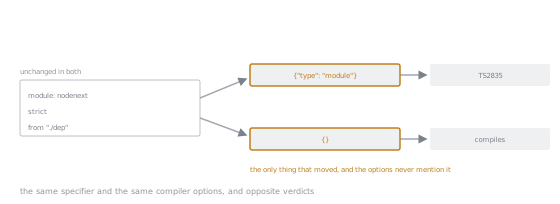
The specifier is drawn once because it never changes. Everything the compiler was configured with is on the left, and the thing that decided the answer is not in it.
The only thing that moved is one field the compiler options never mention. package.json's type field tells Node whether a plain file in that package is an ES module or a CommonJS module, and once module is nodenext the compiler reads exactly the same field, for exactly the same reason: it must decide which module system a file belongs to before saying anything about how its imports resolve. {"type": "module"} puts the package under ES module rules, which require a relative specifier to carry the extension the file will actually have at run time. Leave the field out and the package falls back to CommonJS rules, where an extension has always been optional. The compiler is not consulting its options in isolation, it is doing what Node would do with the same two files.
The extension you write is the extension that will exist
The middle two rows look backwards until the compiler's actual job is placed correctly. from "./dep.js" compiles even though nothing named dep.js exists, only dep.ts. from "./dep.ts" fails, even though that exact file is right there. The compiler is type-checking the program that will exist after emit, and after emit dep.ts becomes dep.js, so the import that will run has to say .js. Writing .ts claims a file that will never exist once the project is built, and TS5097 refuses exactly that claim. This is lesson 2's erasure fact wearing different clothes: a readonly marker disappears at run time and the compiler checks the marked version rather than the erased one, and here the source extension disappears at run time and the compiler checks the specifier against the emitted file. allowImportingTsExtensions relaxes this, but only alongside noEmit, emitDeclarationOnly, or rewriteRelativeImportExtensions, refused otherwise with TS5096, because the option only suits a project that never emits the files whose extensions it relaxes.
How a file's module system is decided
Every file belongs to exactly one module system, decided in a fixed order rather than guessed from context. First, the extension: .mts is always an ES module and .cts is always CommonJS, whatever the package says. Second, for a plain .ts or .js file, the nearest package.json above it answers through its type field. Third, with nothing above the file, the default is CommonJS. Verified both ways: an .mts file in a package with no type field still needs the extension, and a .cts file in a package marked {"type": "module"} compiles the extensionless form, because the extension overrules the package either way. So two files in one repository, even a few directories apart, can sit in different module systems, and identical text such as from "./dep" can be legal in one and refused in the other.
verbatimModuleSyntax: what you see is what ships
Ordinarily the compiler may drop an import from the emitted file when nothing in the file uses the imported name as a value: import a name that turns out to be a type only, and the compiler infers you meant import type and erases it without telling you. verbatimModuleSyntax stops that inference and insists you say what you mean. import { v, T } from "./dep.js", where T is a type-only export, fails with TS1484: 'T' is a type and must be imported using a type-only import when 'verbatimModuleSyntax' is enabled., and import { v, type T } from "./dep.js" compiles. The flag buys emitted imports that are exactly the ones written, never a set the compiler edited, which is why lesson 7's warnings about live bindings and side-effecting imports matter here: an import kept only for its side effect must never be silently elided, and a binding you rely on staying live has to still be there in the emitted file.
When the compiler and the runtime disagree
Everything above is the compiler's model. Node resolves and runs a program it never type-checked, following each import through its own algorithm and either finding a file or throwing. The compiler checks a program it will never run, predicting what emit will produce. nodenext arranges agreement between the two on purpose, it does not guarantee it. When an import fails, ask first which side failed. A TS2835 or TS5097 comes from tsc, fixed in the source or the configuration. A MODULE_NOT_FOUND from node, against files tsc accepted without complaint, is a mismatch between what was emitted and what the runtime was told to load. Bundlers add a third resolver again, each approximating this model differently, which is why this lesson does not survey them.
One documentation trap
One habit worth keeping when a claim depends on the version: the unversioned address for Node's module documentation always serves whichever release happens to be current, so when a claim depends on the version, link a path that names the release line explicitly rather than the address that will quietly change under a link that already exists.
Practice
- ▢ A project has
module: nodenextandpackage.jsonis{"type": "module"}. Predict the result for each import inmain.ts, wheredep.tsexists anddep.jsdoes not:from "./dep",from "./dep.js",from "./dep.ts".
Check
from "./dep" fails with TS2835: an extensionless relative specifier is not allowed under ES module resolution. from "./dep.js" compiles: that is the extension the file will have once emitted, even though no dep.js exists yet. from "./dep.ts" fails with TS5097: .ts is never the extension of a file that will exist at run time unless allowImportingTsExtensions is on.
- ▢ Same project and files, except
package.jsonbecomes{}. Predict the result forfrom "./dep"now, and say why the verdict flipped without any compiler option changing.
Check
It compiles. With no type field the package falls back to CommonJS rules, where an extension has always been optional, so the same text that failed under {"type": "module"} is legal here. Nothing in the compiler options moved, only which module system Node, and therefore the compiler, considers the file to be in.
- ▢ A file named
worker.mtssits in a package whosepackage.jsonis{}. It imports a sibling withfrom "./util", whereutil.tsexists. Predict whether the extension is required, and say what decided the answer.
Hint
Ordering matters: the file's own extension is checked before anyone looks at package.json.
Check
The extension is required, and the extensionless form fails with TS2835. .mts is always an ES module regardless of what package.json says, so its type field is never even consulted for this file.
- ▢
verbatimModuleSyntaxis on.helpers.tsexports a functionrunand an interfaceOptions, used only as a type annotation.main.tswritesimport { run, Options } from "./helpers.js";. Predict the diagnostic, then write the line that compiles.
Check
TS1484: 'Options' is a type and must be imported using a type-only import when 'verbatimModuleSyntax' is enabled. The fix is import { run, type Options } from "./helpers.js";, which states that Options contributes nothing to the emitted import.
- ▢ A project sets
allowImportingTsExtensions: truebut does not setnoEmit,emitDeclarationOnly, orrewriteRelativeImportExtensions. Predict what happens when you runtsc, before it even reaches any source file.
Hint
The failure here is about the configuration itself, not about anything an import specifier says.
Check
tsc refuses the configuration with TS5096: Option 'allowImportingTsExtensions' can only be used when one of 'noEmit', 'emitDeclarationOnly', or 'rewriteRelativeImportExtensions' is set. The compiler enforces that precondition before looking at any import.
Real-world reps
- [ ] Build the four-row table yourself: one
tsconfig.jsonwithmodule: nodenext, two versions ofpackage.json, and watch the same specifier pass and fail as you switch between them. - [ ] Turn
verbatimModuleSyntaxon in a small project importing both a type and a value from one file, and fix every import the compiler flags until it is silent. - [ ] Tomorrow: check a project's
package.jsonfor itstypefield, then pick one relative import there and decide, before running anything, whether it may omit its extension.
Going further
- Handbook, Modules, Reference: every
moduleandmoduleResolutionvalue - Node, Packages: the
typefield and how Node decides a file's module system - Resources
Not landing? Reread the primary source at the top, since this lesson compresses it and compression is where understanding leaks. Check the glossary for any term that felt slippery.
If the lesson itself is unclear rather than the material, that is a defect: open an issue.