Lesson 23. Exhaustiveness With never
Mission link: Owning a codebase means that when someone adds a member to a union six months from now, every switch that ignored it should fail to compile instead of quietly doing the wrong thing at runtime.
Primary source: Narrowing, TypeScript Handbook
Prerequisites: Lesson 22, Lesson 12
Warm-up
- ▢ Lesson 22 gave you a
Shapeunion with akindfield, narrowed inside aswitchso that each case saw only the members that arm actually has. Predict what happens if, insidecase "circle":, you writes.sideinstead ofs.radius.
Check
error TS2339: Property 'side' does not exist on type '{ kind: "circle"; radius: number; }'. Narrowing on kind gave that branch exactly the members a circle has, and side is not one of them, the same restriction lesson 22 built, seen here from the branch that lost a member.
Know this
never: the type with no values
never is the type that no value has. Every other type describes some set of values, however large; never describes the empty set, so nothing is assignable to it except a value already narrowed all the way down to nothing. Writing const x: never = someValue is therefore a claim, checked by the compiler, that someValue's type has narrowed to nothing left. This lesson uses exactly that property; never also shows up as the return type of a function that never returns and inside type-level machinery, both for a later stage.
The technique: handle every case, then check the claim
Take the Shape union from lesson 22.
type Shape =
  | { kind: "circle"; radius: number }
  | { kind: "square"; side: number };

function area(s: Shape): number {
  switch (s.kind) {
    case "circle":
      return Math.PI * s.radius * s.radius;
    case "square":
      return s.side * s.side;
    default:
      const _e: never = s;
      return _e;
  }
}
This compiles. Inside default, the compiler has already ruled out "circle" and "square" via the two case labels above, so whatever s still has at that point is nothing: never. Assigning s to _e: never is the compiler checking that belief out loud, and the same idea works on a plain literal union with no object shape at all. Now add a triangle member to Shape and leave the switch above unchanged.
error TS2322: Type '{ kind: "triangle"; base: number; height: number; }' is not assignable to type 'never'.
default used to see never; now it sees the leftover triangle shape, the one member the two case labels do not exclude. Run the same experiment on a bare literal union such as "a" | "b" with a third member "c" added, and the message shrinks to error TS2322: Type '"c"' is not assignable to type 'never'., no object shape, just the literal. Same mechanism either way; a discriminated union just has more to print.
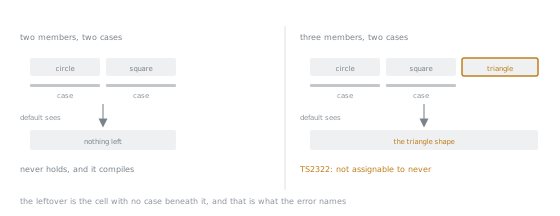
Nothing about the switch changed between the panels; a member was added above it. The leftover is simply the cell with no case beneath it, and that is exactly what the error names.
Why this is the good failure
That diagnostic does not say "something is wrong with this switch." It names the value left over, "c" or the triangle shape, at the exact switch that failed to handle it. Without the guard, a new member is a silent change: every switch that used to be exhaustive keeps compiling and does the wrong thing for the case nobody told it about, discovered from a bug report rather than a build. With the guard, a new member becomes a list of compile errors, one at every site not yet updated, each naming the member responsible. This is the mechanism behind stage 4's completion criterion, illegal states unrepresentable and the compiler proving it: lesson 22 shaped the type so a bad combination cannot be constructed, and this guard makes the compiler enforce that every consumer kept up. Without the guard, a discriminated union is a convenience; with it, a guarantee.
What you get without it
It is worth seeing the weaker version so the two are easy to tell apart. Drop the default clause and rely on the declared return type to catch a missed case.
type Shape =
  | { kind: "circle"; radius: number }
  | { kind: "square"; side: number }
  | { kind: "triangle"; base: number; height: number };

function area(s: Shape): number {
  switch (s.kind) {
    case "circle":
      return Math.PI * s.radius * s.radius;
    case "square":
      return s.side * s.side;
  }
}
error TS2366: Function lacks ending return statement and return type does not include 'undefined'.
That is a real error, and it catches the missing case here, but read what it says: a return statement is missing, not which case is missing. With several unhandled members you would have to work that out yourself, and there is a case where this signal does not fire at all: a function that returns void.
function log(s: Shape): void {
  switch (s.kind) {
    case "circle":
      console.log("circle", s.radius);
      return;
    case "square":
      console.log("square", s.side);
      return;
  }
}
Run that through the compiler and nothing happens: no error, despite triangle never being mentioned. A void function need not return anything on any path, so falling off the end after an unhandled case breaks no rule the return type imposes. This is where a reader who trusts the return-type signal is not covered and does not know it, exactly what the never guard closes, since it checks the union directly rather than the return type.
Where to put the guard
The default clause is where it goes in a switch, as above. A final else of an if/else if chain plays the same role: else { const _e: never = s; } checks whatever is left once every named branch is excluded. Most codebases factor this into a standalone helper rather than repeating const _e: never = s; at every site.
function assertNever(x: never): never {
  throw new Error(`unhandled case: ${JSON.stringify(x)}`);
}

function area(s: Shape): number {
  switch (s.kind) {
    case "circle":
      return Math.PI * s.radius * s.radius;
    case "square":
      return s.side * s.side;
    case "triangle":
      return 0.5 * s.base * s.height;
    default:
      return assertNever(s);
  }
}
assertNever takes a parameter typed never, so calling it with anything else is the same check, phrased as a call; leave a member unhandled and the diagnostic moves to the call site: error TS2345: Argument of type '"c"' is not assignable to parameter of type 'never'. The body throws rather than returns, and that matters: if every case is handled and the types are honest, assertNever is unreachable, dead by construction, and throwing costs nothing. If it does run, a value crossed in from somewhere the compiler could not see, typically a boundary with the outside world, and throwing turns that surprise into an immediate failure at the point it was found rather than a wrong answer computed from a value nobody checked; validating a value at that boundary is a problem the next stage owns.
The limits, honestly
Everything here is a compile-time check. It proves the code you wrote handles every member the union currently has, and proves it again, automatically, next time the union changes. It proves nothing about a value entering the program from outside, a network response, a parsed file, a database row, since the compiler only ever sees the declared type, not the value; that gap belongs to stage 5. It is also a habit rather than a setting: nothing forces a never guard, so it only protects the switches where someone actually wrote one.
Practice
- ▢
type Weather = "sunny" | "rainy". A function returns a string for each case, and thedefaultclause assignsconst _e: never = w;before returning_e. Does it compile?
Check
Yes. Both members are excluded by the two case labels, so w is never in default and the assignment checks out.
- ▢
"cloudy"is added toWeather, and the function from item 1 is left unchanged. Predict the diagnostic, with itsTSnumber.
Check
error TS2322: Type '"cloudy"' is not assignable to type 'never'. default no longer sees never, since "cloudy" is not excluded by either case, and that is the one value left over.
- ▢ Take the same unhandled-
"cloudy"function from item 2, but change its return type tovoidand have each handled case end with a barereturn;instead of a value, with nodefaultclause at all. Does it still fail to compile?
Hint
Ask what a void return type actually requires on a path that falls off the end of the function, not what a number or string return type would require.
Check
No, it compiles cleanly. A void function is never required to return a value on any path, so falling off the end after the unhandled "cloudy" case breaks no rule the compiler checks, and there is no default clause to catch it another way. This is the silent gap: a return-type check says nothing here, because the missing case was never the return type's job.
- ▢ Using the
assertNeverhelper from Know this,Weatherincludes"cloudy"and the switch'sdefaultcallsreturn assertNever(w);without handling"cloudy". Predict the diagnostic, with itsTSnumber, and say why it differs from item 2's.
Check
error TS2345: Argument of type '"cloudy"' is not assignable to parameter of type 'never'. It is TS2345 rather than item 2's TS2322 because the leftover value is now a function argument, checked against assertNever's parameter type, rather than assigned to a const. The underlying reason is identical: something wider than never met a position that only accepts it.
- ▢ Go back to the
Shapeunion withcircle,squareandtriangle, and aswitchwhosedefaultassignsconst _e: never = s;, but thesquarecase is missing entirely. Predict what the diagnostic names: just the word"square", or something larger, and why.
Check
Something larger: error TS2322: Type '{ kind: "square"; side: number; }' is not assignable to type 'never'. Shape's members are object types, not bare literals, so what is left over in default is the whole object shape, not just its discriminant, same mechanism as the clean literal case with a bigger printout.
Real-world reps
- [ ] Find a
switchin your own code, or write one, over a union with three or more members, and add adefaultclause that assigns the selector toconst _e: never. - [ ] Add a member to that union on purpose and count how many places light up with
TS2322orTS2345before fixing any of them; that count is what the guard just saved you from finding out in production. - [ ] Tomorrow: find one function in a real project that returns
voidand switches over a union with nodefault, and check by hand whether every member is handled, since the compiler will not tell you either way.
Going further
- TypeScript Handbook: Everyday Types, for the union and literal types this lesson's switches close over
- Effective TypeScript, for exhaustiveness checks framed as a habit worth building rather than a one-off trick
- Resources
Not landing? Reread the primary source at the top, since this lesson compresses it and compression is where understanding leaks. Check the glossary for any term that felt slippery.
If the lesson itself is unclear rather than the material, that is a defect: open an issue.